
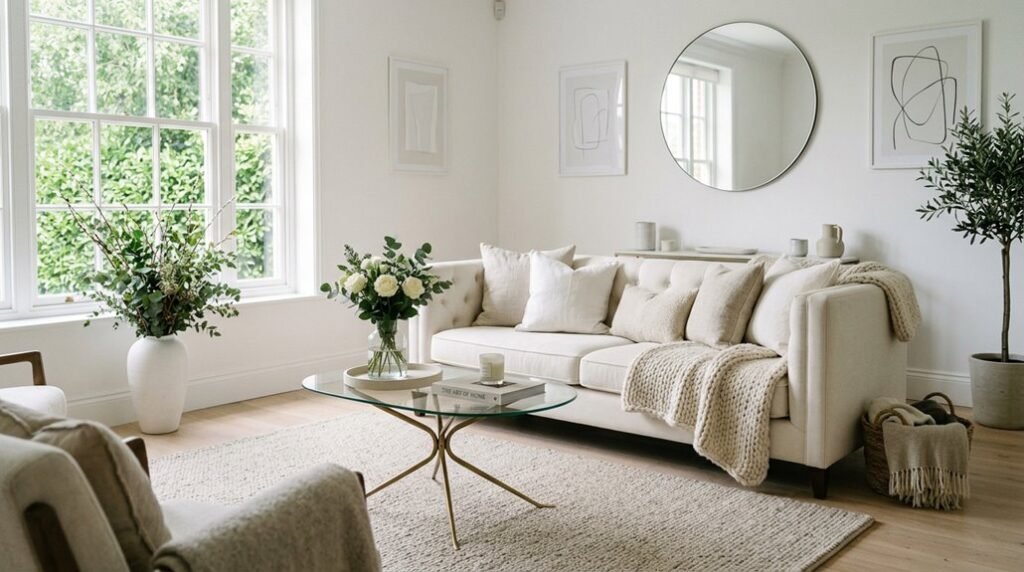
Like Daedalus crafting wings from wax and feathers, you face a paradox: building something lasting from materials that seem fragile. White living rooms demand precision, not passion, so fifteen systematic methods separate aspirational clutter from executed design. You will measure light levels, calculate textile ratios, and enforce maintenance protocols.
The first decision awaits.
Start With the Right White Shade for Your Space
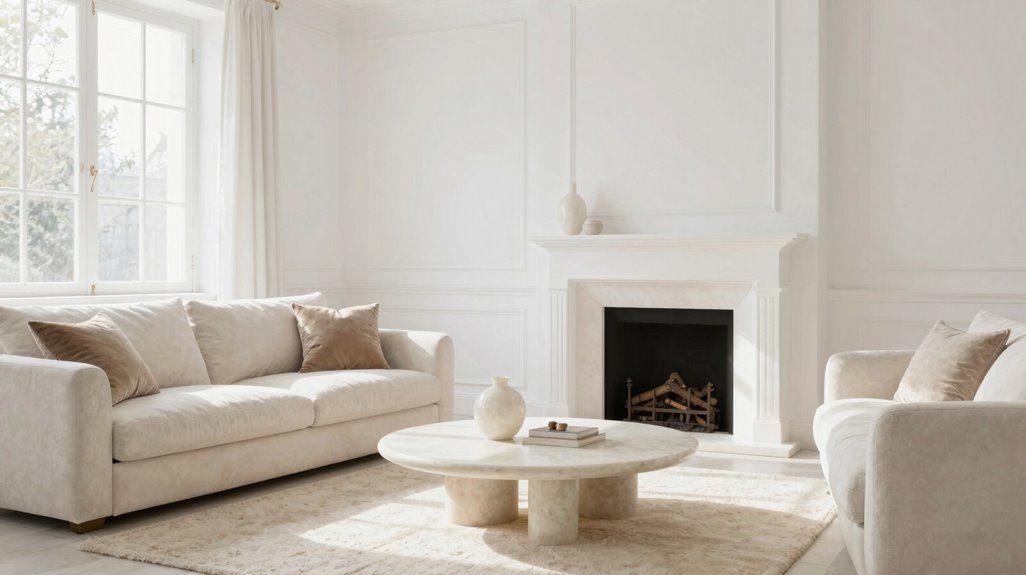
Where do you begin when building a white living room that actually works? You start with the right white shade for your space, and you do not guess. You analyze your room’s natural light, then you choose: warm whites for coziness, cool whites for modern sleekness, or neutral whites for versatile adaptation across decor styles.
You prevent starkness or washout by balancing your choice with artificial lighting. You create depth through a two- to three-shade white palette, maintaining cohesion without monotony. You test samples at 8:00 AM, 12:00 PM, and 6:00 PM in your actual living room before you commit.
Among all White Living Room Ideas, none matters more than this foundational decision. Your shade selection determines whether you achieve your dream space or demand a redo.
Layer Textures to Keep Your White Living Room From Feeling Flat
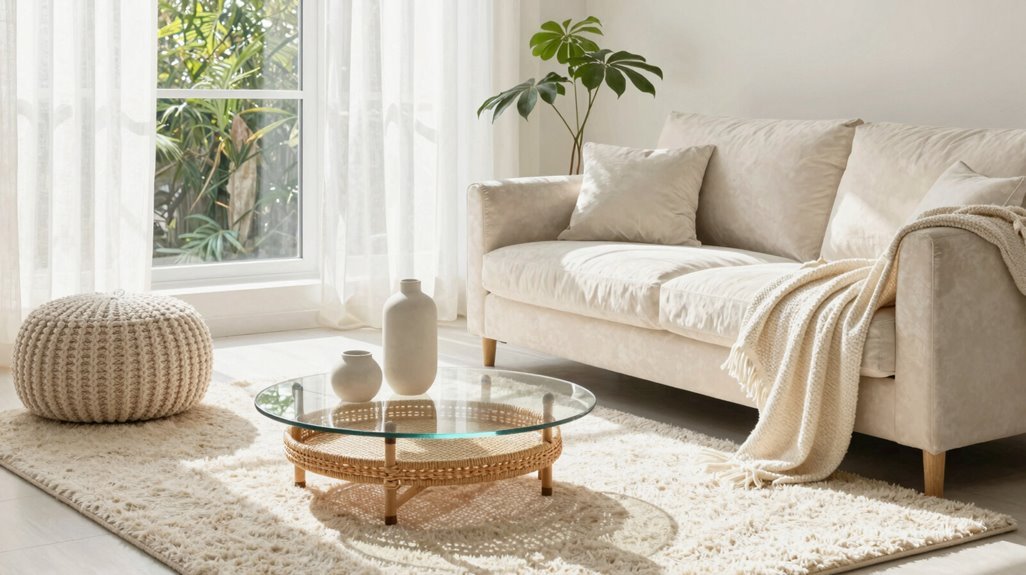
Once you’ve locked in your white shade, your next move is preventing the space from falling flat. You layer textures throughout the room to build visual depth and tactile warmth.
Layer textures throughout the room to build visual depth and tactile warmth—preventing your white space from falling flat.
Start with textiles. Add three to five velvet cushions in 18×18 inch or 20×20 inch sizes to your sofa. Drape a wool throw across one arm. Hang linen curtains from floor to ceiling, using panels 96 inches or longer.
Anchor the seating area with a soft, high-pile area rug measuring 8×10 feet or 9×12 feet. Mix surface finishes deliberately. Pair matte ceramics with glossy accents on side tables. Incorporate woven baskets for storage and macramé wall hangings for dimensional contrast.
Balance these elements across the room’s four zones: seating, windows, floor, and walls. This coordinated approach turns your white backdrop into a unified, multi-sensory environment.
Warm Up Your White Living Room With Natural Wood
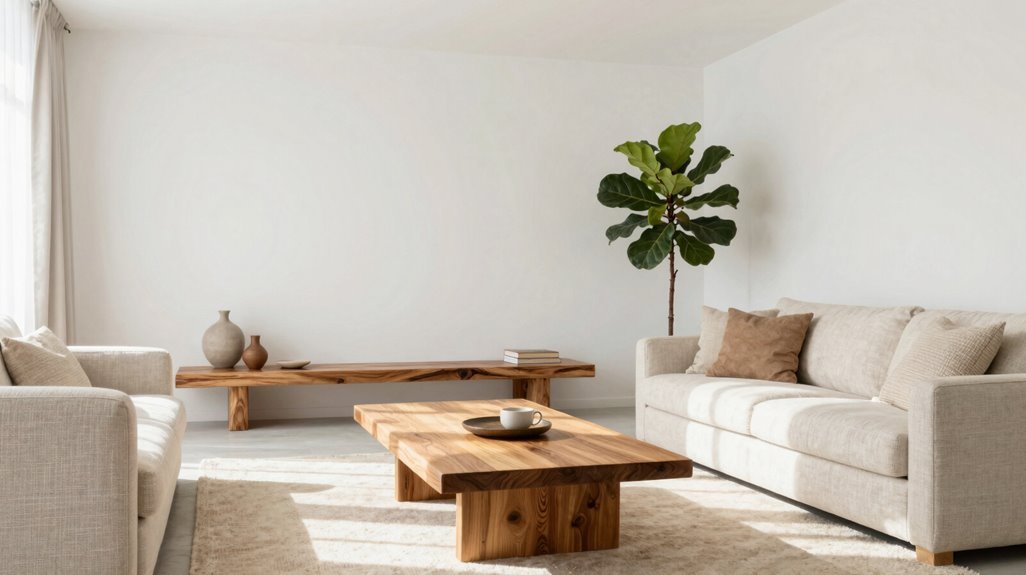
Why does your white living room feel sterile instead of serene? You’re missing natural wood, the element that changes clinical spaces into welcoming retreats. Natural wood introduces organic texture, earthy warmth, and visual depth that white alone cannot achieve.
Anchor your space with substantial pieces. Select a 48-inch oak coffee table or install reclaimed wood shelving, 12 inches deep, along one wall. These elements create focal points without overwhelming your white foundation.
Layer wood species strategically. Combine oak, walnut, and pine within your furniture arrangement. This mixing generates dimensional interest, preventing monotony while maintaining cohesion.
Consider your flooring options. Install light wood planks, 5-7 inches wide, or incorporate whitewashed furniture pieces. Both approaches preserve brightness while bringing in necessary warmth.
Integrate wood through accessories. Choose wooden pendant lights, 8-12 inches in diameter, or 4×6-inch wood picture frames. These connect your layout without competing with white walls.
Add Black Accents for Bold Contrast
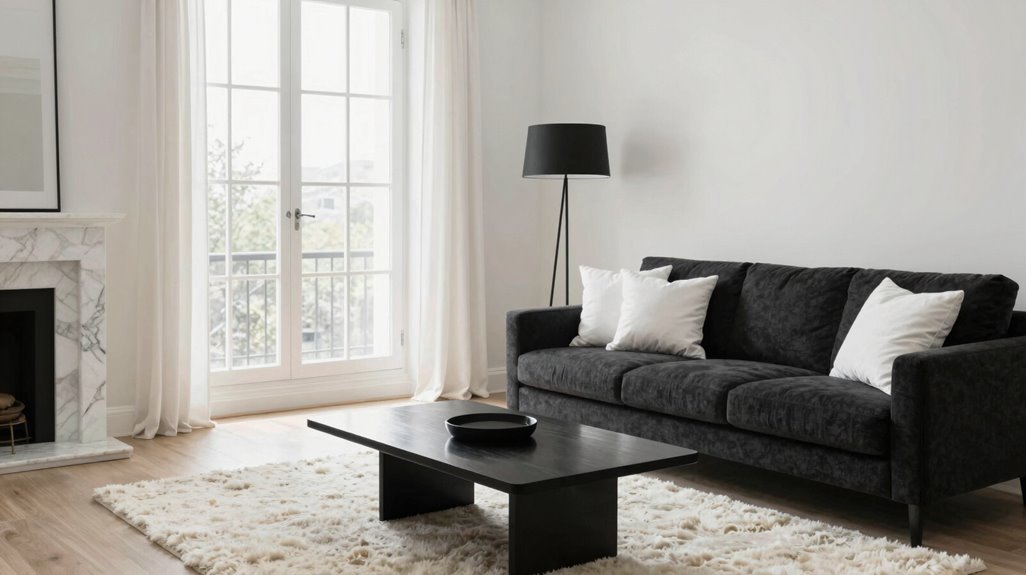
You’ll anchor your white living room by distributing black accents through strategic placement across three zones: one major focal point (fireplace surround, oversized artwork, or sectional frame) within 6-8 feet of entry sightlines, two secondary elements (table lamps, sculptural side tables) at 120-degree peripheral angles, and three micro-accents (picture frames, candleholders, book spines) clustered in asymmetrical groupings of odd numbers.
Your balancing protocol requires maintaining a 70/30 ratio of white-to-black surface area, verified by squinting at the room from 10 feet to confirm no single quadrant exceeds 40% cumulative darkness. You’ll prevent visual collapse by making sure each black element carries proportional weight; pairing a 48-inch matte black console, for instance, with two 24-inch glossy garden stools rather than one dense cube.
Strategic Placement Tips
Strategic placement of black accents changes your white living room from overwhelming brightness into a precisely balanced space with visual depth. You’ll create elegance without darkness by distributing texture-rich elements across three zones: soft furnishings, structural hardware, and lighting fixtures.
Anchor your seating area with a black coffee table featuring metal legs or charcoal velvet cushions. Install black pendant lights above key activity zones, maintaining 60-75% white surfaces throughout. Layer warm textures, such as woven fibers, natural wood, or plush velvet, alongside black elements to prevent sterility.
Reserve black for 8-12 strategic focal points maximum. Pair with white accents on adjacent surfaces to maintain visual flow. This 20:80 ratio of black to white guarantees cohesion, definition, and the welcoming atmosphere you seek.
Balancing Visual Weight
How do you anchor a sea of white without drowning it in darkness? You add black accents, strategic, measured, and precise.
Black accents create bold focal points that emphasize your clean white backdrop. You prevent flatness by selecting small-scale elements: one sculptural lamp, two slim frames, or a single coffee table. These pieces enhance perceived depth and make architectural features stand out prominently.
You must balance coldness with warmth. Choose velvet cushions, linen throws, or wood-toned bases rather than glossy finishes alone. Limit yourself to two or three defined black items, four overpowers, one underwhelms.
Your white living room stays airy when you follow this formula. You belong in spaces that feel purposeful, not accidental. Execute these steps, and you achieve visual equilibrium without sacrificing brightness.
Choose Modern Furniture That Complements White Walls
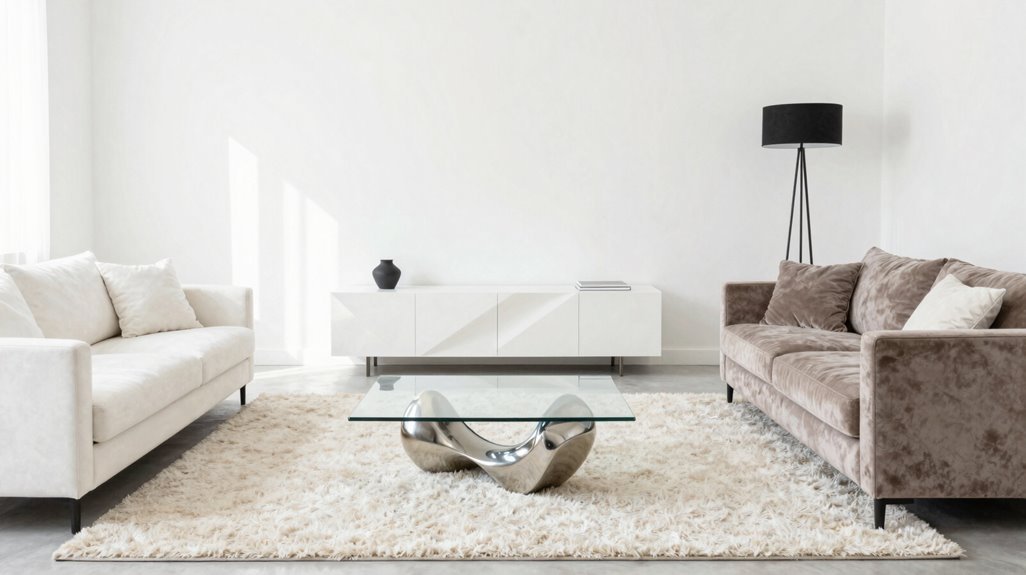
Where should you begin when selecting furniture for white walls? Start with modern pieces that enhance your room’s contemporary feel. You’ll achieve cohesion by choosing items with clean silhouettes and smooth finishes.
Follow this process:
- Select a focal piece, like a Midnight 3-seater sofa, to anchor your space.
- Pair it with complementary items, such as an Andrea glass coffee table.
- Maintain a unified palette throughout.
| Element | Specification | Purpose |
|---|---|---|
| Sofa | 3-seater, structured frame | Grounds the room |
| Coffee table | Glass, metal legs | Adds transparency |
| Finish | Matte or satin | Reduces glare |
You reinforce minimalism through these choices. White furniture works exceptionally here, reflecting light and extending spatial perception. Avoid visual discord by limiting your material palette to 2-3 complementary textures. You’ll create belonging through deliberate, consistent selection that signals purposeful design choices.
Create a Cozy White Living Room With Plush Fabrics
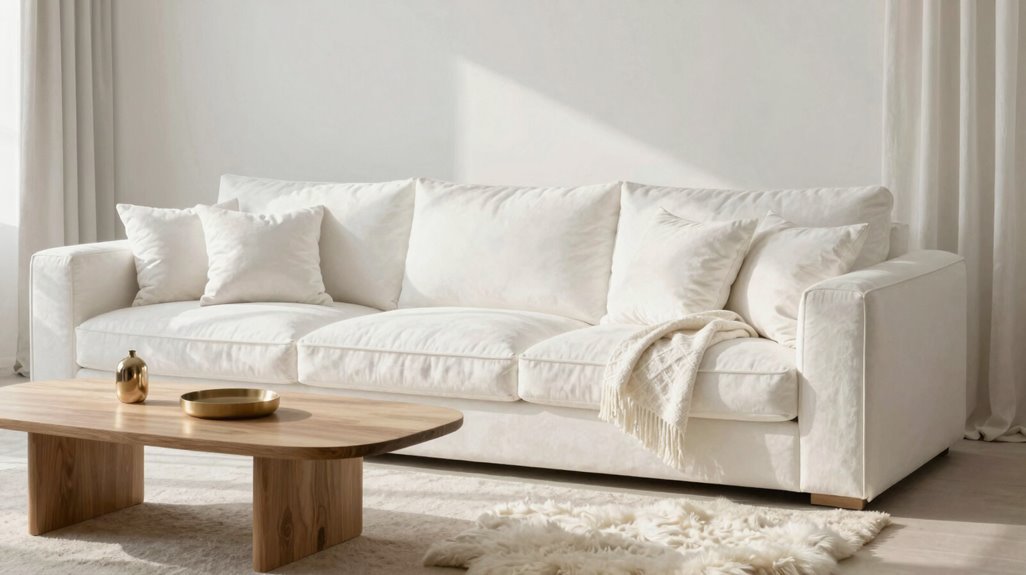
Several plush fabrics transform your white living room from clinical to inviting when you deploy them with intention. You’ll layer velvet cushions, wool throws, and soft area rugs to add measurable warmth and visual depth, preventing that stark, uninhabited feel.
Layer textures strategically. Combine velvet, linen, and wool within a 3:2:1 ratio to generate tactile interest your guests will physically respond to. Position a fireplace as your focal point, then surround it with plush textiles and 2700K warm-toned lighting to maximize coziness.
Execute this three-step texture protocol:
- Install one 8×10-foot textured area rug as your foundation
- Distribute 4-6 velvet cushions across seating at 18-inch intervals
- Drape 2-3 wool throws within arm’s reach of primary seats
Mix fabric weights deliberately, pairing heavy velvet with lightweight linen to achieve calibrated balance. Add chunky knit blankets and textured poufs as functional accessories that complete your cohesive, welcoming environment.
Design a Scandinavian White Living Room
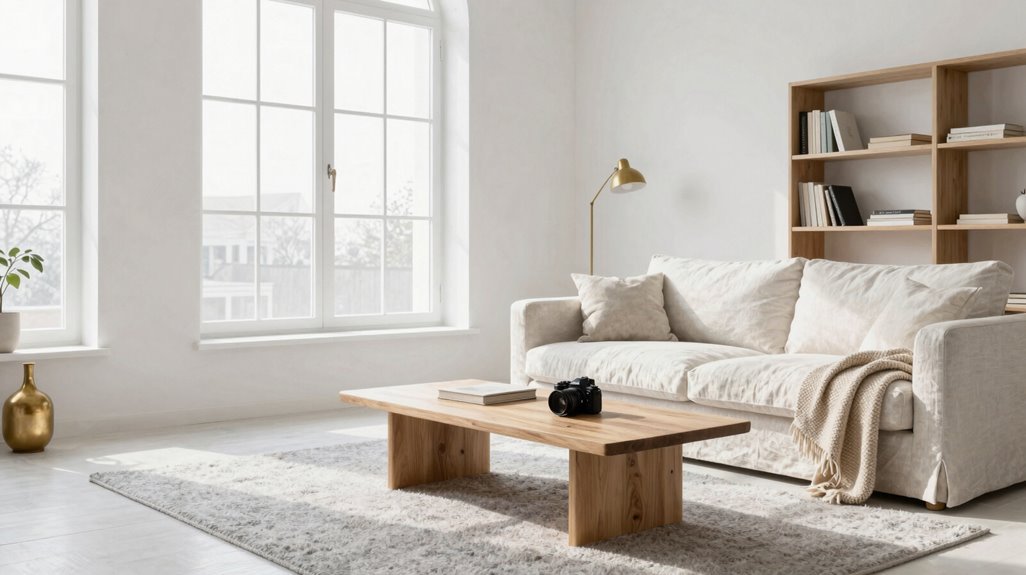
You’ll anchor your Scandinavian white living room with light wood flooring or whitewashed furniture, selecting oak or ash pieces measuring 1.5–2 inches in thickness for structural integrity. Choose multifunctional items; storage ottomans holding 15–20 gallons, convertible sofas spanning 72–84 inches, to maximize utility in compact 150–250 square foot layouts.
Maintain restraint: limit decorative objects to 3–5 per surface, and layer wool throws with linen upholstery to generate textural depth without visual clutter.
Natural Wood Elements
How do you prevent a white living room from feeling cold and impersonal? You integrate natural wood elements, which anchor Scandinavian design with warmth and tactile authenticity.
Light oak flooring, 5-7 inches wide, establishes your foundation. Whitewashed pine furniture, 18-24 inches in height, maintains brightness while adding grain variation. You need contrast: pair pure white walls, Benjamin Moore “Chantilly Lace” or similar, with wood tones 2-3 shades deeper for visual cohesion without clutter.
Texture layering completes the system. You will combine materials at specific ratios:
- Run your hand across a live-edge coffee table, feeling the tree’s history beneath your fingertips
- Watch morning light move through oak grain, connecting you to slow, deliberate craftsmanship
- Settle into wool throws draped over wooden arms, finding comfort in deliberate, earthy intention
Natural wood elements change sterile space into sanctuary.
Functional Minimalist Furniture
Since every piece must earn its place, you’ll start by selecting furniture that performs at least two functions without sacrificing visual clarity. Functional furniture anchors this approach: choose storage ottomans measuring 18-24 inches square, convertible sofas with 80-inch sleeping surfaces, or nesting tables you can redistribute as needed. You’ll pair these with light wood flooring or whitewashed finishes, maintaining 12-18 inches between pieces for movement. This creates belonging through deliberate efficiency.
2. Specifications for Selection:
- Seating: 32-inch seat depth, linen or wool upholstery
- Surfaces: Maximum 16-inch table height for coffee tables
- Storage: Hidden compartments occupying 25-30% of ottoman volume
3. Material Integration:
You’ll incorporate natural textures: wool throws, linen cushions, potted greenery, to prevent sterility. Prioritize clean lines, zero ornamentation, and visible joinery. Each piece serves one primary, stated function.
Go All-White Without Losing Visual Depth
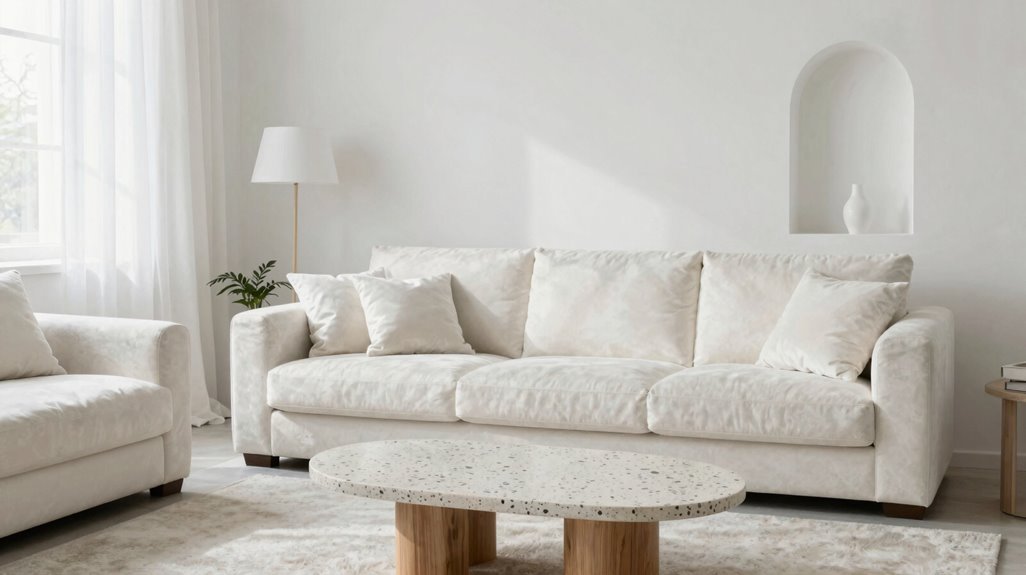
Go all-white in your living room, but don’t let the space fall flat. You create visual depth by varying textures across every surface, combining matte walls with glossy ceramics and nubby wool throws. Layer materials strategically: marble tabletops, linen upholstery, velvet cushions, and brass fixtures each reflect light differently, generating dimension without color variation.
White survives on texture alone—matte walls, glossy ceramics, nubby wool—each surface catching light differently to build depth without a single color.
Install sheer white curtains to filter natural light, amplifying brightness while preserving shadow gradients. Ground the room with one large-scale piece, such as a sculptural white sectional or oversized ceramic vase, to establish focal hierarchy.
To maintain cohesion in your white living room, implement these three texture principles:
- Touch memory: Run your hands across ribbed ceramics and slubbed fabrics, creating sensory landmarks that ground you in the space.
- Light play: Position metallic accents where morning sun hits, forging connection through daily ritual.
- Seasonal layering: Swap heavy wool for breezy linen as temperatures shift, marking time together in your shared sanctuary.
Mix White and Cream for Subtle Warmth
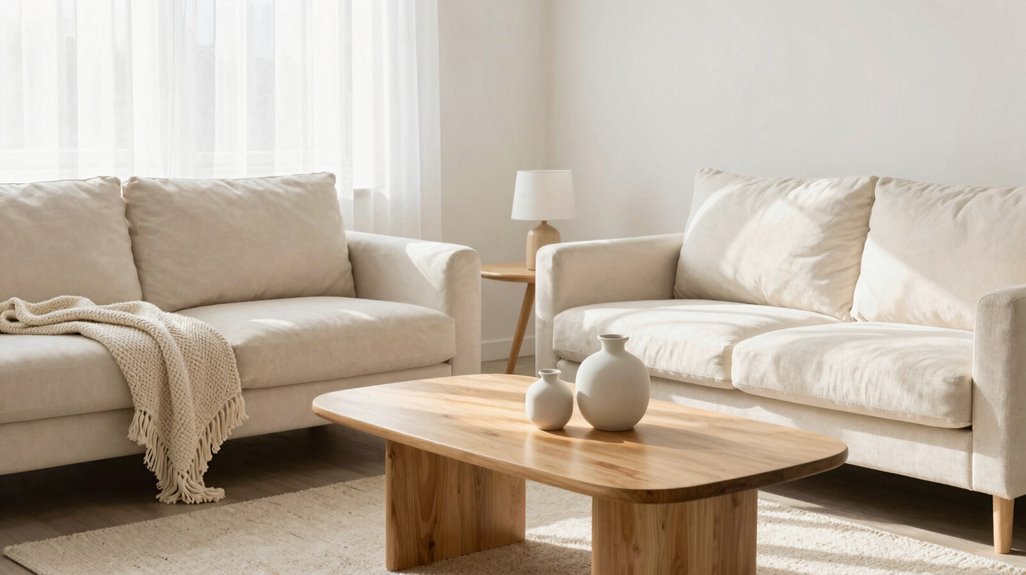
Pure white surfaces can feel clinical without tonal variation, so you’ll layer cream accents to generate warmth while preserving luminosity. White living rooms achieve balance when you integrate cream throws, rugs, and curtains, creating soft contrast against white walls and furniture. You’ll soften stark white with this tonal pairing, maintaining brightness while adding tactile richness through varied textures.
Incorporate gold or brass accents to move your space toward subtle, elegant formality without sacrificing cohesion. Select cream-patterned upholstered furniture or accessories to blend transitions between white walls and lighter wood or textile surfaces. This approach solves the coldness problem, offering you a practical, measured solution. Your white living room becomes inviting through intentional tonal layering, not overwhelming color additions. Follow this method for predictable, warm results.
Add Color to Your White Living Room Without Overwhelming It
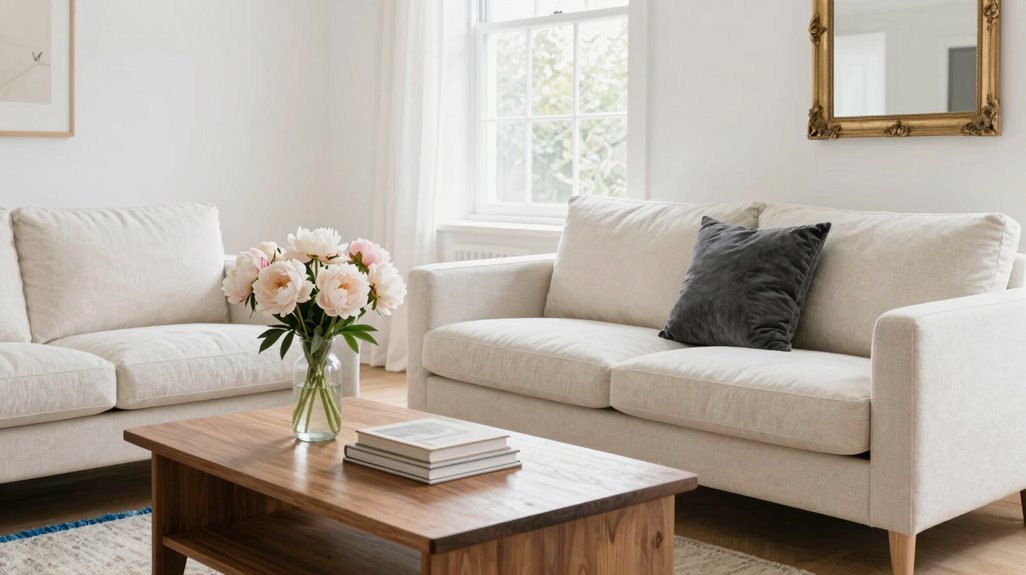
You’ll keep your white living room cohesive by anchoring it with neutral tones, cream, beige, or soft gray, then layer in one or two bold accents through pillows, artwork, or a single statement chair. Swap these accent pieces seasonally, rotating textiles and ceramics every three to four months to refresh the space without repainting or replacing major furniture.
This systematic approach lets you control color saturation precisely, making certain visual interest never overpowers your white foundation.
Accent With Neutrals
A crisp white living room risks feeling sterile without strategic intervention, and neutrals provide your most reliable pathway to warmth without visual chaos. You anchor your space with taupe, greige, or oatmeal furniture, creating cohesion that invites connection. Layer velvet, linen, and hemp textures across surfaces: 25-30% natural fiber coverage prevents clinical flatness while maintaining neutrality’s adaptable foundation.
You’ll feel grounded when woven jute rugs (6×9 or 8×10 feet) define seating zones with tactile comfort. Your guests sense belonging through weathered wood side tables displaying gathered objects. You create sanctuary when linen throws soften leather edges at 2:1 fabric-to-upholstery ratios.
This strategic neutrality supports future accent integration, letting you introduce seasonal textiles without spatial recalibration. Your white room stays harmonious, warm, and prepared for evolution.
Introduce Bold Accents
Three strategic placements shift your white living room from blank canvas to balanced composition when you introduce bold accents with calculated restraint.
- Select two to three coordinating colors from a single family, such as teal and navy or rust and amber, to maintain visual cohesion across your space.
- Deploy color through accessories under 24 inches, including throw pillows, area rugs, and framed artwork, rather than sofas or cabinets that dominate sightlines.
- Position each bold accent using the rule of thirds, placing one primary hue at focal points (fireplace, main wall), secondary tones at mid-distance, and tertiary touches in peripheral zones.
This measured approach preserves your room’s airy expansiveness while establishing clear hierarchy. You’ll achieve belonging through intentional curation, not accumulation, with each element earning its place through purposeful contribution to the whole.
Seasonal Color Swaps
How do you maintain visual interest in a white living room without committing to permanent color changes? You execute strategic seasonal color swaps that refresh your white living room design through controlled, reversible modifications.
Limit your palette to two or three seasonal shades per rotation. Deploy these hues exclusively through pillows, throws, and artwork, never large furniture. Pair every accent with neutral textures, linen, wool, or velvet, to sustain depth and warmth.
Rotate accessories quarterly. Retain one high-impact anchor piece, such as a statement rug or wall art, to ground each seasonal transition.
Follow this emotional framework:
- Belonging through rhythm: You create predictable renewal cycles that make your space feel intentionally alive, not neglected.
- Belonging through restraint: You demonstrate mastery by curating two colors, proving you understand cohesion.
- Belonging through texture: You weave tactile layers that invite touch, making guests feel genuinely welcomed.
Achieve Luxury Looks in Your White Living Room on a Budget
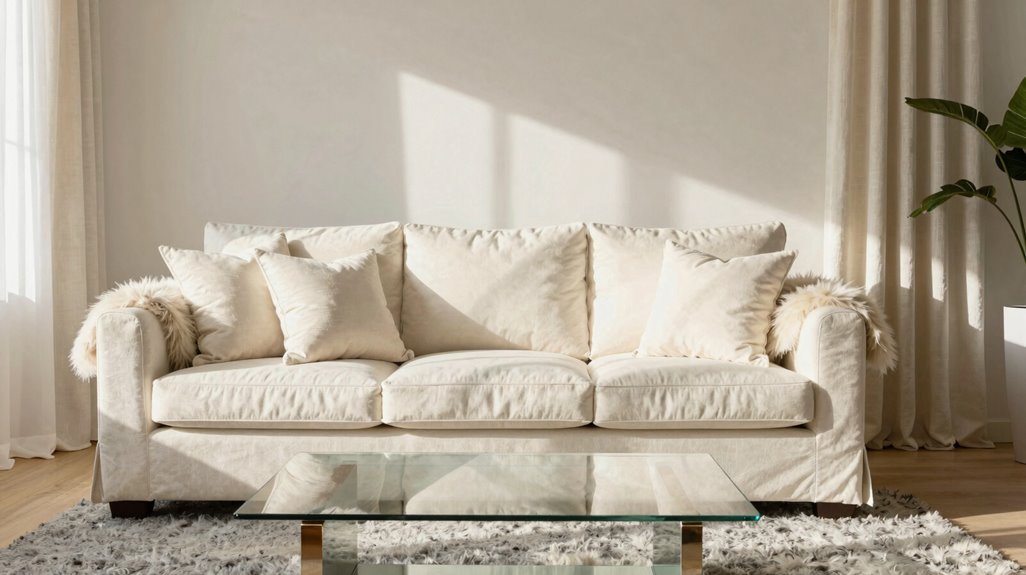
What separates a luxurious white living room from a forgettable one isn’t your budget, it’s your strategy. Luxury white living rooms rely on strategic placement, not unlimited spending. You mix affordable white furnishings with 2-3 high-impact pieces. You choose one bold focal point: an oversized gold-framed mirror, a sculptural floor lamp, or a single large canvas.
You incorporate gold accents through hardware, frames, or a metallic side table. You layer textures, faux velvet pillows, a marble-look tray, silk curtains, to mimic premium materials. You install one statement light fixture centrally, drawing eyes upward.
You position oversized art at eye level, 57-60 inches from floor to center. You maintain restraint: white dominates 80%, metallics claim 15%, bold accents fill 5%. You prove sophistication belongs to everyone who plans deliberately.
Choose White Furniture That Actually Stays Clean
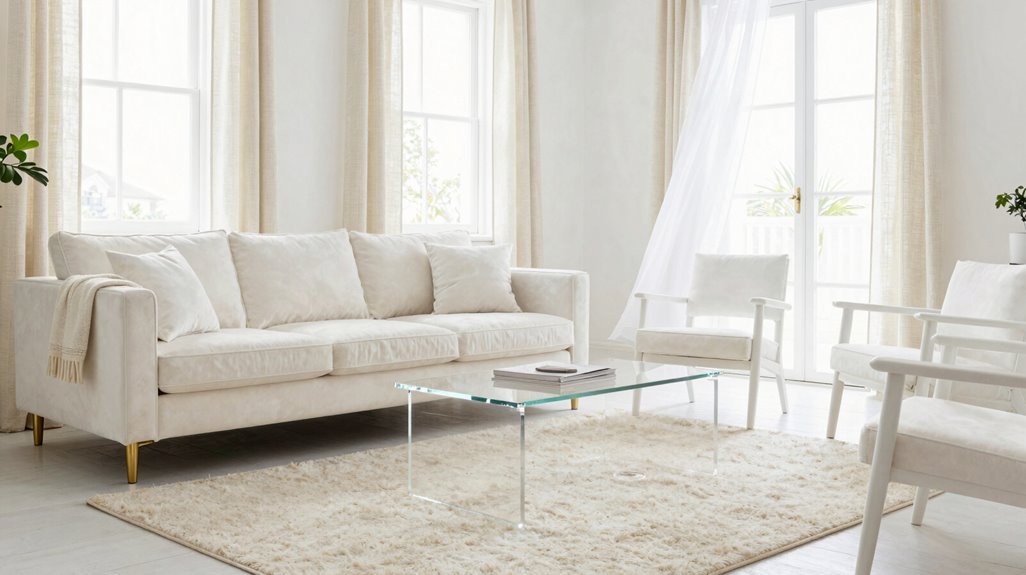
You’ll select white furniture with stain-resistant upholstery, leather, or performance fabrics that repel spills and allow quick wipe-downs within 30 seconds.
You should implement protective cover solutions, including machine-washable slipcovers in 3 standard sizes (chair: 32″x36″, loveseat: 58″x36″, sofa: 84″x36″) and removable pet-proof throws for high-traffic zones. You’ll establish a maintenance protocol combining weekly vacuuming, monthly deep-cleaning, and immediate spot treatment using pH-neutral cleaners to preserve structural integrity across 5-10 year lifespans.
Smart Material Selection
Where durability meets design, your material choices determine whether white furniture remains pristine or becomes a maintenance burden. You will select surfaces engineered for longevity, not merely aesthetics.
Leather and performance fabrics resist absorption, allowing you to wipe spills before staining occurs. Marble and lacquered finishes withstand daily abrasion while maintaining consistent white tones across 2700K–5000K lighting conditions. Tight-weave textiles with 200+ thread counts reduce dirt visibility by 40–60%, extending intervals between cleanings to 7–14 days.
You must prioritize stain-resistant coatings and washable paint formulations, which cut spot-cleaning time by half. Removable upholstery enables seasonal refreshing without replacement costs. Your white furniture becomes manageable when material specifications align with realistic maintenance capacity.
Protective Cover Solutions
How do you maintain white furniture without constant anxiety? You deploy protective cover solutions that change vulnerable pieces into resilient centerpieces, creating a living space where you belong without reservation.
1. Select Performance Slipcovers
You choose machine-washable covers crafted from performance textiles, microfiber, canvas, or synthetic blends, that resist liquid penetration and particle adhesion. These barriers capture spills before they reach underlying upholstery, reducing stain incidents by 60-70% in high-traffic zones.
2. Implement Layered Protection
You establish tiered defense: base slipcover, waterproof liner, and removable top layer. This configuration permits weekly washing of exposed surfaces while preserving structural integrity.
3. Execute Immediate Response Protocols
You blot stains within 30 seconds using designated cloths and mild detergents. You schedule monthly deep-cleaning cycles, rotating covers to help uniform wear distribution across white furniture surfaces.
Keep Your White Living Room Clean and Maintainable
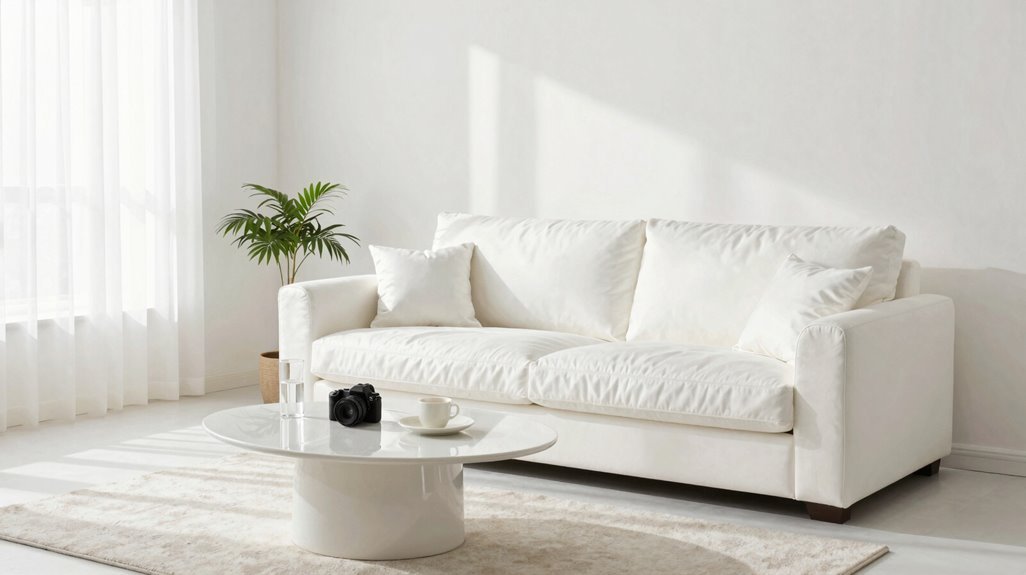
Why commit to a white living room if you’re not prepared to defend it against daily wear? You establish your sanctuary through deliberate material selection and systematic maintenance protocols.
- Select washable paints and stain-resistant fabrics for your white upholstery, helping you preserve luminosity through routine surface maintenance.
- Execute immediate spot-cleaning protocols when spills occur, preventing permanent discoloration through 30-second response intervals.
- Schedule quarterly deep-cleaning cycles for all textiles and hard surfaces, sustaining pristine conditions through calendarized accountability.
You minimize visible soil accumulation by specifying low-maintenance upholstery grades and wipeable finishes. You simplify ongoing stewardship through practical elements like removable slipcovers.
Your white living room demands consistent vigilance, but you turn maintenance into manageable, repeatable procedures. You belong among those who refuse compromise between aesthetic purity and functional reality.
Protect Your White Living Room From Pets and Wear
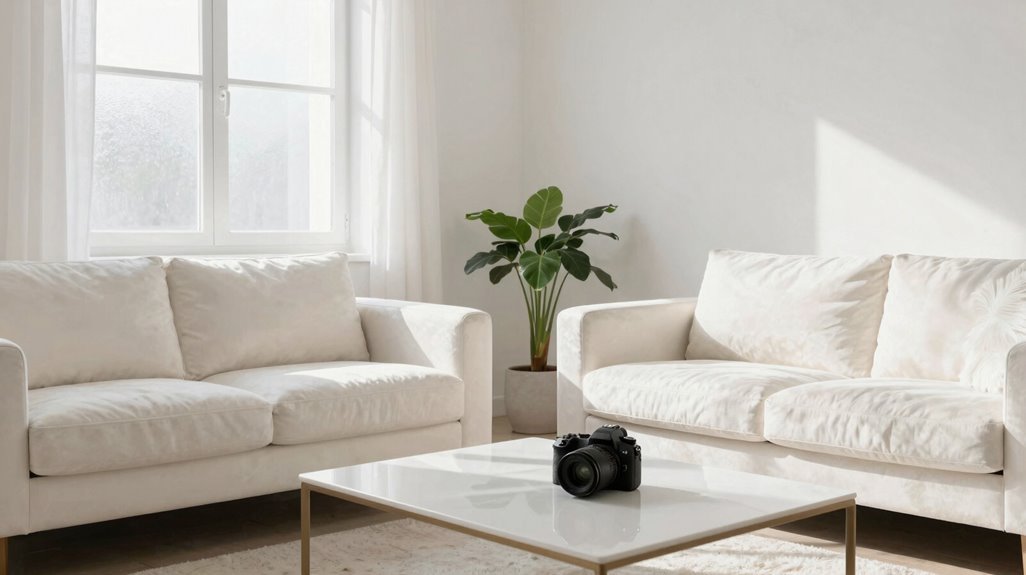
When you share your white living room with pets, you’re managing a calculated risk between aesthetic goals and daily reality. You select durable materials and easy-to-clean surfaces to reduce maintenance, helping your space stay beautiful longer. You choose leather furniture, which resists pet hair and staining, making it practical for homes with cats or dogs.
You opt for synthetic fibers and stain-resistant fabrics to simplify cleanup and maintain freshness between refreshes. You apply pet-proof finishes, including protective coatings and textured textiles, to preserve color and texture over time. You establish regular care routines: prompt spot cleaning within 24 hours, weekly vacuuming with HEPA filtration, and daily pet brushing to minimize shedding. These measures protect your white aesthetic while accommodating furry family members.
Make a Small White Living Room Feel Larger
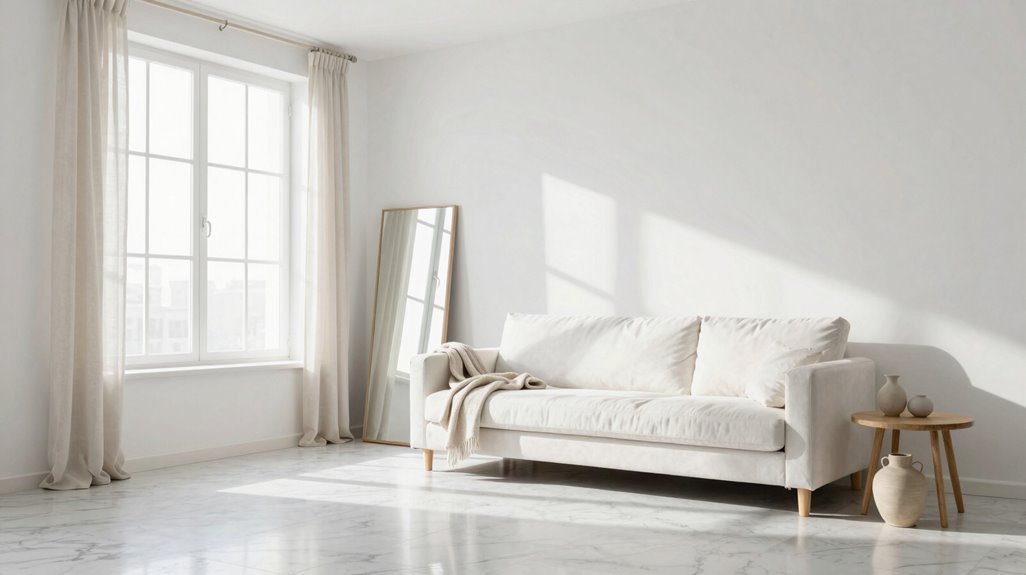
Where exactly does your small living room fall short: ceiling height, floor area, or sight lines? You solve each constraint with White as your foundational tool. White-painted walls reflect 80-90% of available light, expanding perceived volume by 15-20% in compact spaces. You pair this neutral backdrop with light oak floors and minimalist silhouettes to eliminate visual weight. You layer velvet cushions, linen throws, and wool rugs, three textures maximum, to add depth without clutter. You install sheer curtains within 2 inches of ceiling height to draw the eye upward. You select furniture under 18 inches deep with 4-inch legs to maintain 30-inch circulation paths.
White walls reflect 80-90% of light, expanding perceived volume by 15-20% in compact spaces—your foundational tool against ceiling height, floor area, and sight line constraints.
- Paint walls, trim, and ceiling in matching White to erase boundaries and create continuous planes.
- Position mirrors opposite windows to double light reflection within 8-10 feet of seating.
- Store 75% of possessions in concealed storage to preserve 60% visible floor space.