
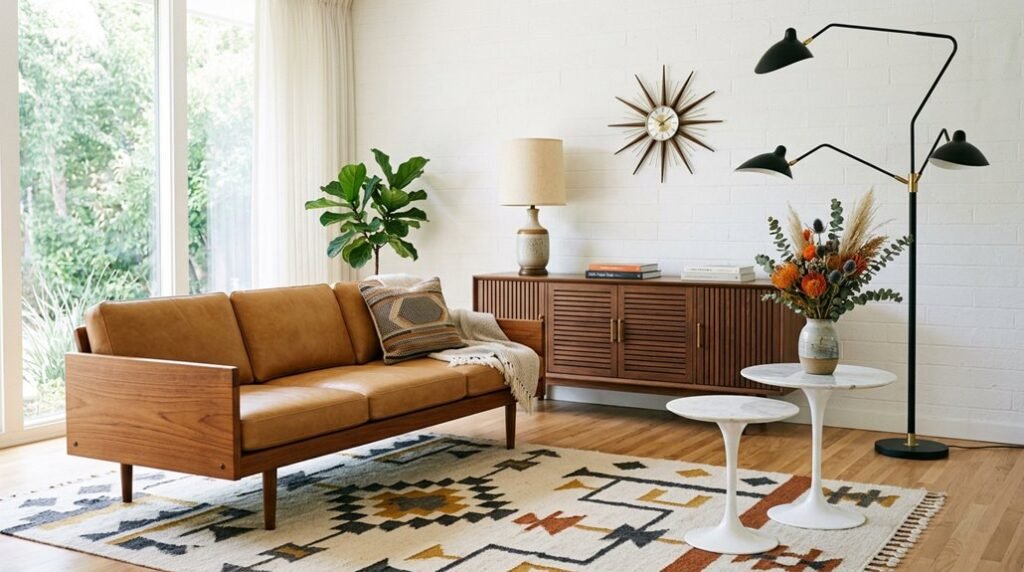
You’ll need precise measurements, specific color percentages, and exact furniture placements to execute Mid-Century Modern correctly.
This guide breaks down 10 essential methods, each with quantified specifications: 14-inch seat heights, 48-inch conversation clearances, and 60-30-10 color distributions.
Without these parameters, your room risks becoming vague pastiche rather than authentic design.
Start With Low-Profile Mid-Century Furniture
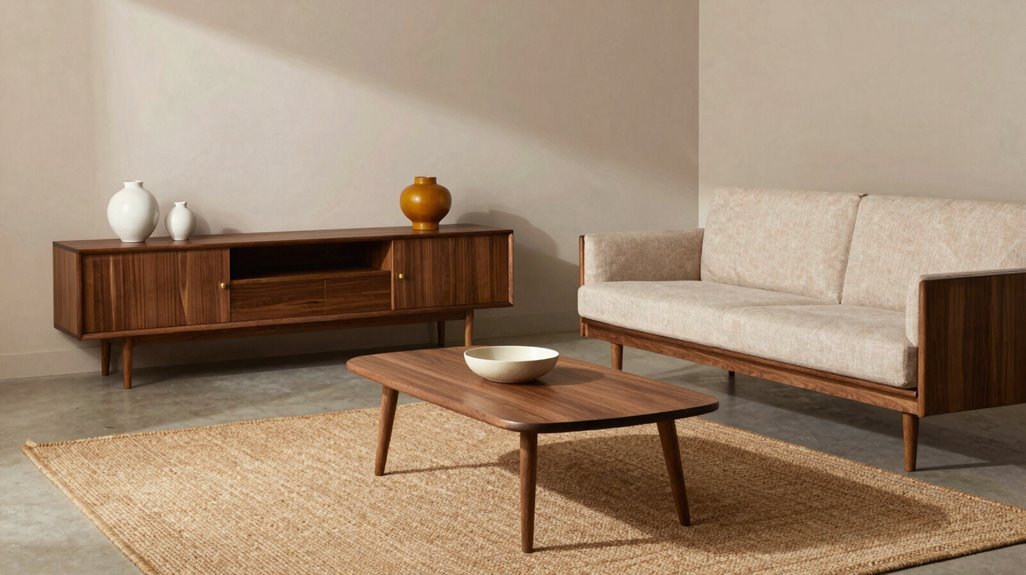
Three decisions anchor your mid-century modern living room: furniture height, line quality, and material selection. You’ll start with low-profile mid-century furniture to establish clean, uncluttered sightlines. This approach emphasizes functional forms over ornamentation, creating spaces where you belong.
Select pieces with straight lines and avoid Chippendale-style feet. These identification cues signal authentic mid-century modern design. Choose wood or metal foundations, keeping silhouettes simple with tapered legs for proper scale.
Anchor your room with one or two standout low-profile pieces: a streamlined credenza, an understated lounge chair. Don’t overwhelm the space. Plan your layout to maintain open sightlines, allowing open-plan flow and easy access to seating, lighting, and storage. You’re building a foundation that works, not just looks good.
Build Your Base With Warm, Wood-Friendly Neutrals
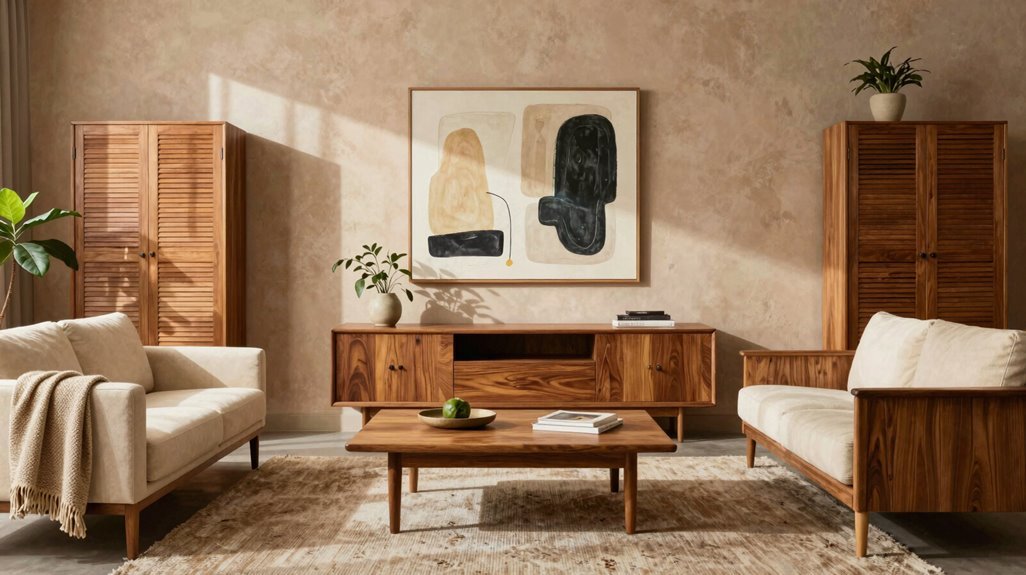
You’ll anchor your room first with wood tones, choosing walnut, teak, or oak ranging from 15-50% of visible surfaces to establish warmth without visual chaos. Select neutral foundations: cream, beige, or warm gray covering 60-70% of walls and large textiles, creating a versatile backdrop for strategic color insertion.
Layer earthy accents through textiles, ceramics, and greenery at 10-15% distribution, making certain each element maintains clean lines and functional purpose.
Anchor With Wood Tones
Why start with anything else when wood tones form the structural backbone of every authentic mid-century modern space? You’re anchoring your entire room when you select consistent wood tones across your major furniture pieces.
1. Select Your Primary Wood Species
Choose walnut, teak, or oak for your foundational pieces. These species define authentic mid-century character and create immediate visual cohesion.
2. Maintain Consistent Tones Across 3-4 Major Pieces
Your credenza, coffee table, and side tables should share identical or complementary wood tones within two shades. This unification prevents visual fragmentation.
3. Pair With Neutral Backdrops
You’ll ground bold accents, mustard chairs, burnt-orange cushions, against these warm wood bases without overwhelming your space.
4. Prioritize Clean-Lined Silhouettes
Select furniture emphasizing simple forms where wood remains the dominant material, not secondary trim.
Your wood-friendly neutrals become the stage; these wood tones become your permanent, structural foundation.
Choose Neutral Foundations
Your neutral foundation acts as the visual stage for every other design decision you’ll make. Start with mid-century neutrals, pale beige, warm ivory, or soft taupe, on walls and large surfaces to anchor your space. These hues complement warm wood tones from your furniture, creating cohesion without competition.
Apply neutral foundations systematically: paint walls in warm, wood-friendly shades, select natural fiber rugs in undyed wool or jute, and choose upholstery in oatmeal or stone linen. This base lets clean-lined silhouettes command attention.
Keep surfaces uncluttered. Limit tabletop items to 3-5 functional pieces per zone. Add controlled color through one bold accent, perhaps a mustard lounge chair or burnt-orange cushion, positioned 6-8 feet from your neutral anchor wall. This measured approach maintains visual balance while honoring mid-century principles of restraint and purposeful design.
Layer Earthy Accents
Where do you begin when the foundation demands both warmth and restraint? You build your base with warm, wood-friendly neutrals that honor mid-century modern principles of clean lines and simple forms.
Anchor your space with wood tones. Select credenzas, coffee tables, or shelving in light oak or warm walnut finishes. These pieces establish visual continuity without overwhelming your room.
Introduce muted greens, terracottas, or ochres through textiles and small decor items. These complements reinforce your wood-based foundation without competing for attention.
Keep surfaces uncluttered. Allow your wood tones to dominate by keeping patterns minimal and spaces open.
You achieve belonging through intentional restraint. Your living room becomes cohesive when every element serves the era’s emphasis on natural materials and functional beauty.
Add Strategic Pops of Mustard, Teal, or Burnt Orange
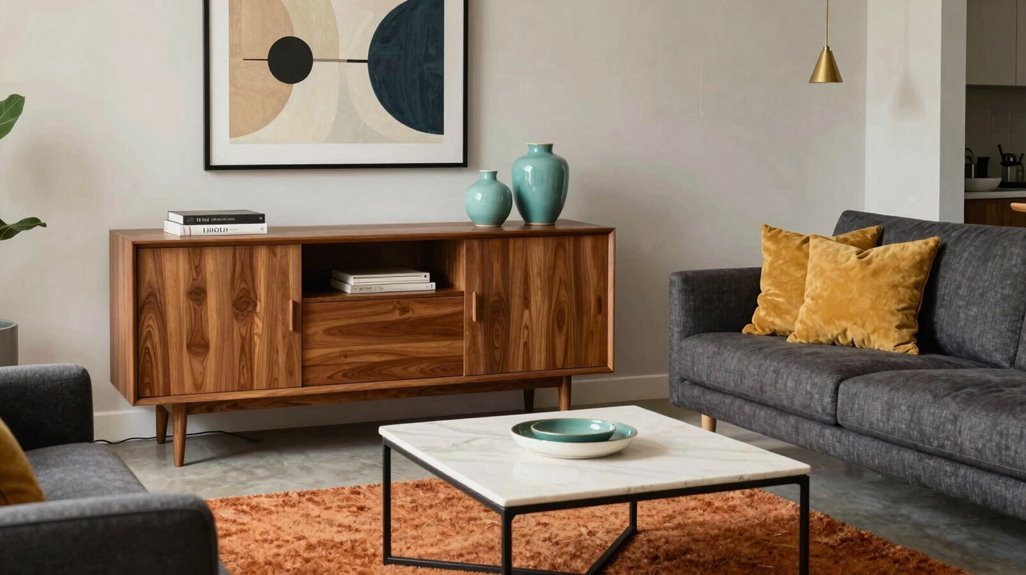
Choose one or two hues from the mustard-teal-burnt orange palette, then deploy them through 1-3 accent pieces sized between 12 and 20 inches, such as a single chair, two throw pillows, or a 5×8 foot rug with colored edges. You’ll anchor these against your neutral base, placing each item within 3 feet of a natural sightline to maximize visual impact without creating competition.
Position teal in smaller doses, vases under 10 inches tall or framed art measuring 16×20 inches, while reserving mustard or burnt orange for larger statements that maintain the room’s cohesive, uncluttered mid-century integrity.
Color Psychology Impact
Deploy strategic color accents to solve visual balance in your mid-century modern living room without disrupting its clean architectural lines. You’re applying the emotional power of color when you select mustard, teal, or burnt orange as accent colors, because these hues trigger specific emotional responses that ground your space in authentic mid-century modern warmth.
You anchor one seating piece, perhaps a single lounge chair or cushion, in mustard or burnt orange. This creates visual weight without clutter. You balance warm wood tones with teal’s cool contrast, maintaining retro authenticity. You pair these accent colors with natural materials: wood, brass, glass. You limit high-contrast combinations to one or two focal pieces.
Your choices feel purposeful, not busy. You preserve the era’s uncluttered, timeless feel through disciplined application.
Accent Placement Strategy
You’ve established which colors trigger the right emotional response, so now you’ll position them with surgical precision. Your accent placement strategy demands one standout piece, perhaps a mustard chair or burnt-orange cushion, to ground the room and introduce that essential mid-century modern color pop.
Ground these bold accents with a neutral backdrop and warm wood tones, maintaining balance and cohesion throughout your space. Place color pops through carefully chosen accessories: pillows, throws, or a rug, avoiding broad swathes that create visual noise.
Pair retro hues with complementary textures, like a velvety teal throw on a neutral sofa, generating depth and tactile interest. Repeat your accent colors, mustard, teal, burnt orange, across 2–3 strategically placed items, weaving a unified palette that turns your living room into an authentic mid-century modern sanctuary.
Anchor Everything With a Clean, Geometric Rug
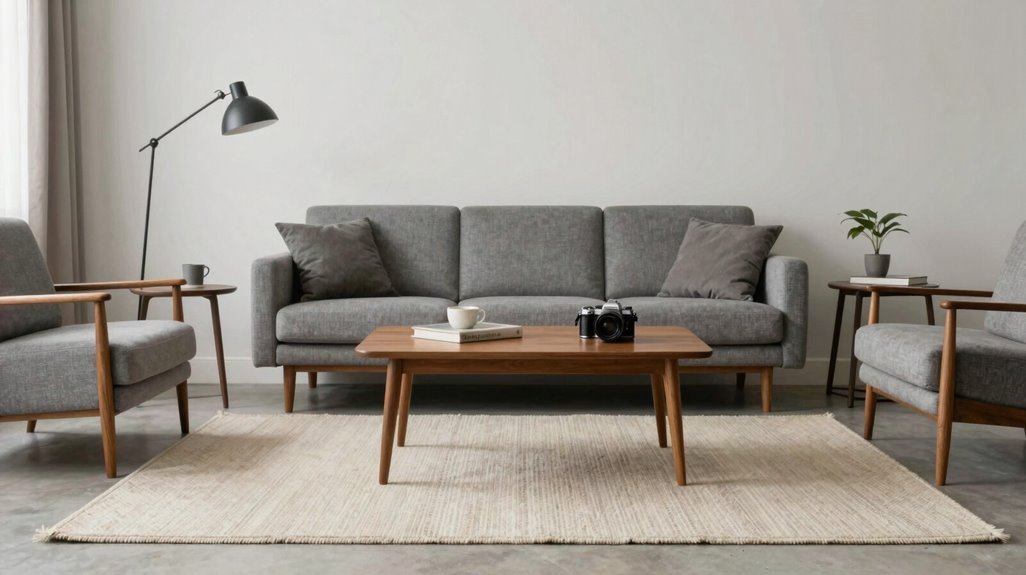
A geometric rug serves as the foundational anchor for your mid-century modern living room, establishing visual order and reinforcing the clean, horizontal lines that define this design period. Select patterns featuring simple motifs, squares, rectangles, or circles, in restrained palettes to preserve uncluttered spaces and prevent visual noise.
Layer strategically: place a smaller geometric rug atop a larger neutral base to introduce depth without disrupting sightlines. Match rug colors to your furniture’s wood tones or metal finishes for cohesion. Avoid dense, repetitive patterns that compete for attention.
This approach grounds your space, creates belonging through intentional order, and honors mid-century modern principles. Your geometric rug becomes the silent organizer, directing movement and unifying every element beneath your feet with purposeful precision.
Arrange Furniture for Conversation and Flow
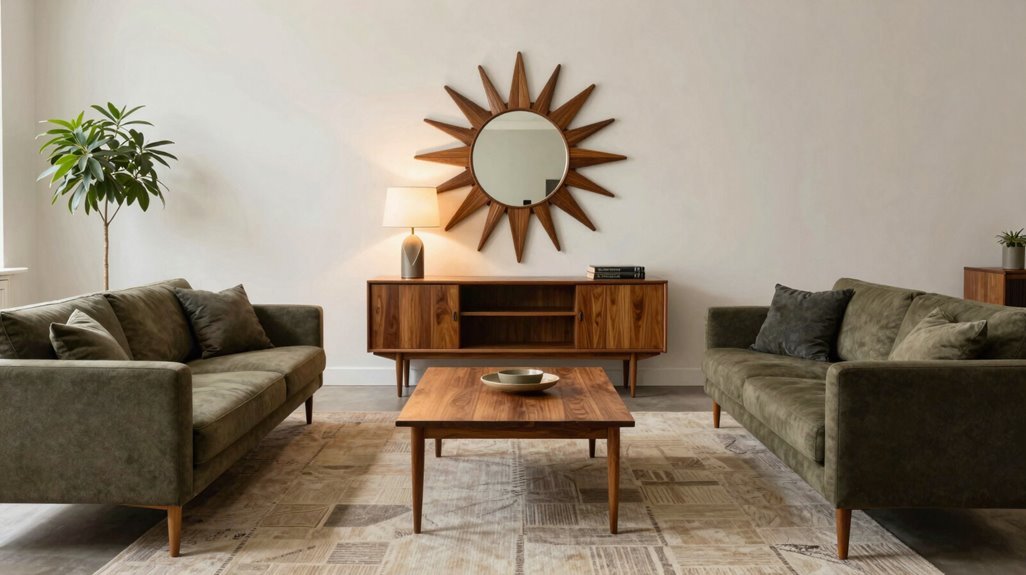
How do you turn a collection of beautiful pieces into a space that actually works for daily life? You start by anchoring your mid-century modern living room with intention.
- Establish a focal point. Position a credenza or iconic lounge chair, like the Eames Lounge Chair, as your central anchor. This guides all subsequent placement.
- Create conversation zones. Arrange seating so chairs sit side-by-side or opposite your sofa, approximately 48 inches apart. This distance invites dialogue without shouting.
- Maintain flow and sightlines. Place the TV peripherally, never as the primary focus. Open visibility between seating areas prevents obstruction.
- Layer rugs strategically. Anchor each conversation zone with rugs, nesting smaller pieces atop larger bases to define boundaries without clutter.
- Preserve clean lines. Eliminate excess. Minimal embellishment sustains the functional, open atmosphere essential to authentic mid-century modern flow.
Soften the Room With Curved Mid-Century Silhouettes
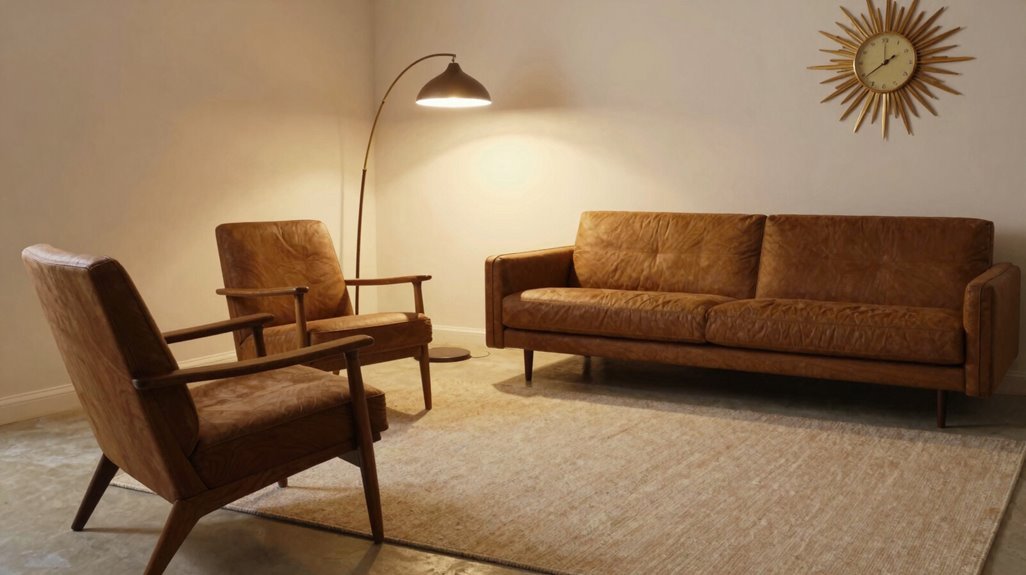
Where does the characteristic rigidity of mid-century modern design begin to feel unwelcoming? You’ll find the answer in spaces dominated solely by straight lines and sharp angles. Curved silhouettes resolve this tension immediately.
1. Select curved furniture strategically. Incorporate kidney- or cocoon-shaped seating, rounded coffee tables, and shell-like chairs to contrast with boxier pieces. These forms preserve clean lines while introducing approachability.
2. Add arced lighting. Position curved floor lamps or arc lamps to create gentle visual guides that direct attention without clutter.
3. Anchor with neutral foundations. Pair curved furniture with warm woods, beige, or gray walls to maintain cohesion and minimize visual noise.
4. Layer tactile materials. Apply velvet, leather, or boucle to curved forms, enhancing warmth while retaining mid-century authenticity.
Layer In Teak, Wool, and Woven Natural Textures
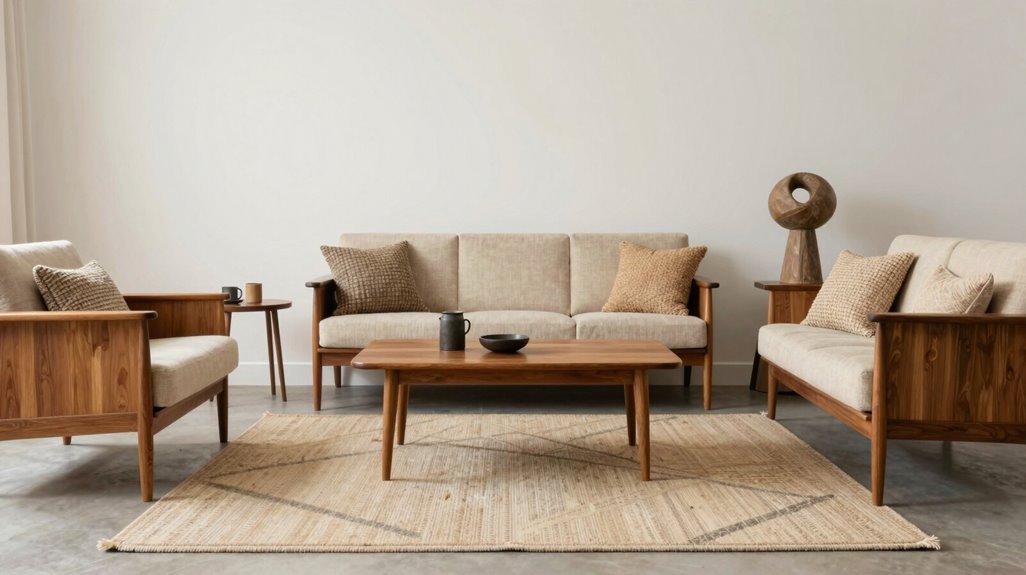
You’ll anchor your mid-century living room by establishing teak wood foundations, which provide warm, natural tones that complement neutral bases and create visual stability. Next, you’ll layer wool textile accents through strategic placement of area rugs, throws, and cushions to introduce texture and coziness without disrupting clean architectural lines. Finally, you’ll weave in natural elements like rattan, jute, and woven baskets to generate organic contrast and tactile depth throughout the space.
Teak Wood Foundations
Why anchor your living room in anything less than the material that defined an era? You establish authentic mid-century modern credibility through teak wood foundations, selecting pieces that showcase durability, warm tone, and rich grain. Your credenzas, lounge chairs, and dining seating gain timeless anchoring from this primary material.
You layer textures strategically, combining teak surfaces with metal accents and neutral fabrics to preserve organic-industrial balance. Your maintenance protocol requires gentle care products and moisture avoidance to protect natural patina development.
Prioritize these three foundation elements:
- Select tapered-leg furniture with visible grain patterns
- Position teak as your dominant wood species throughout
- Integrate woven natural materials at 30% of surface area
You achieve cohesive belonging through deliberate material hierarchy, treating each selection as functional infrastructure rather than decorative choice.
Wool Textile Accents
How do you soften teak’s structural rigidity without compromising geometric integrity? You deploy wool textiles strategically across your mid-century modern foundation. Texture layering demands precision: drape teal-toned tweed throws over sofa arms, position kilim-inspired cushions in odd-numbered clusters, and anchor seating zones with wool rugs measuring 8×10 feet minimum.
You’ll select muted earth tones, beige, taupe, olive, with single bold accents in mustard or burnt orange to preserve palette cohesion. Upholster accent chairs in wool slipcovers that develop patina across 5-10 years of use. Maintain 18-inch clearance between textile clusters and sightlines.
This measured approach shifts rigid frameworks into welcoming spaces you’re proud to inhabit, proving functional design and belonging coexist through deliberate material selection.
Woven Natural Elements
Wool textiles settle your foundation, but woven natural elements complete the structural hierarchy. You anchor your space with teak wood, selecting pieces with warm, natural tones that ground the mid-century aesthetic. Layer woven textiles, baskets, chair upholstery, cushions, to introduce organic pattern without visual chaos. You maintain clean lines by pairing these textures with metal or wood furniture silhouettes. Balance remains critical; you set woven elements against neutral bases of beige and cream to prevent overwhelming the eye.
To execute this integration, follow three structural priorities:
- Position teak wood furniture as your primary anchor, occupying 60% of visible wood surfaces
- Distribute woven textiles across three zones: seating, storage, and accent layers
- Limit organic pattern to 20% of visual field, preserving functional clarity
You achieve cohesion through measured restraint.
Choose Credenzas and Shelving That Display and Store
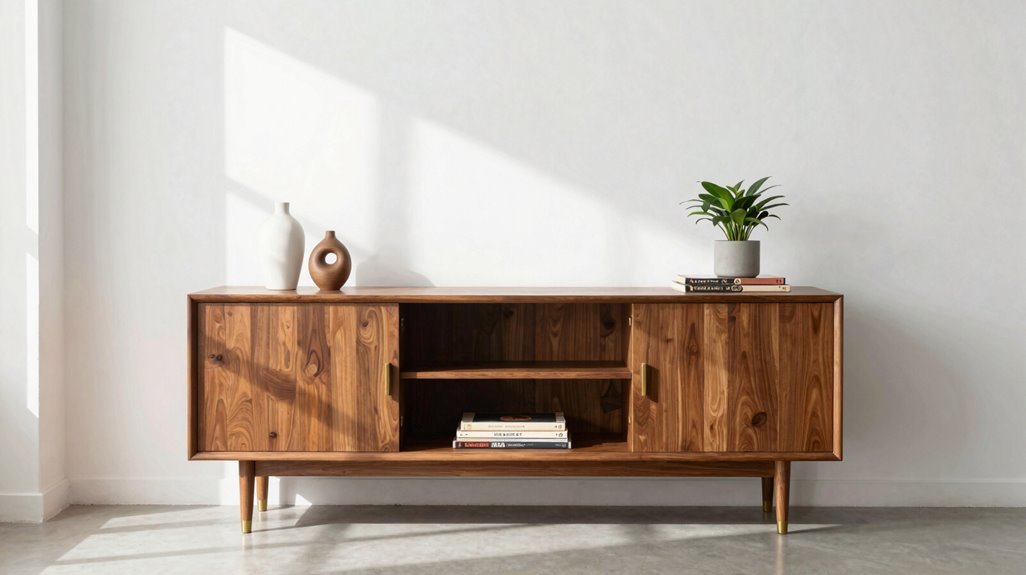
A credenza anchors your mid-century modern living room by merging concealed storage with display-worthy surfaces, giving you 18 to 24 inches of depth and 60 to 72 inches of width to work with. You’ll position this piece beneath a wall-mounted TV or between seating areas, creating a focal point that balances your space. Pair your credenza with dining chairs on either side, or deploy it as a media console with open storage for electronics.
Select credenzas featuring clean lines, tapered legs, and wood-toned finishes to preserve authentic mid-century character. Curate your display surface with books, ceramics, or framed art, while maintaining clutter-free storage below.
| Feature | Specification |
|---|---|
| Depth | 18-24 inches |
| Width | 60-72 inches |
| Leg style | Tapered |
Light the Space With Sputnik or Arc Statement Fixtures
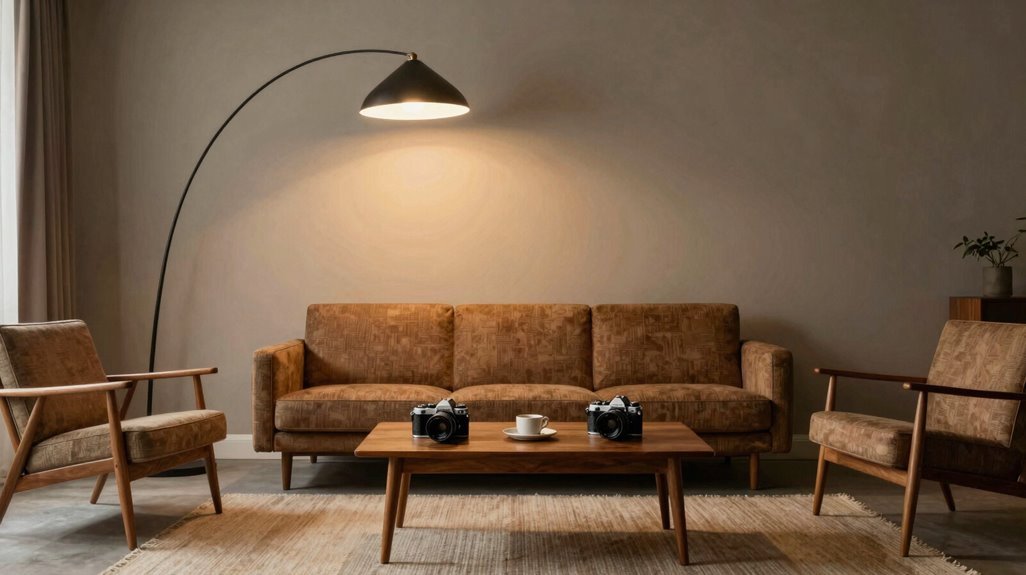
Two iconic fixture styles dominate mid-century modern lighting: the Sputnik chandelier and the arc floor lamp. You’ll anchor your living room with these sculptural pieces that define authentic mid-century lighting.
Anchor your living room with sculptural Sputnik chandeliers and arc floor lamps that define authentic mid-century modern lighting.
Select Sputnik fixtures when you want radiating arms with exposed bulbs creating starburst silhouettes that draw eyes upward. Choose arc lamps for sweeping curved forms that hover above seating, delivering ambient light without glare. Scale matters: position large Sputnik fixtures 7-9 feet above your sofa, and raise arc lamps 5.5-6 feet to clear eye level.
For authentic results, prioritize these finishes:
- Brushed brass for warm, period-accurate foundations
- Brushed chrome for cooler, atomic-era aesthetics
- Matte black for dramatic contrast against wood tones
Pair your selections with existing wood or metal furniture to preserve cohesive mid-century character.
Complete the Look With Iconic Mid-Century Accessories

Once you’ve positioned your statement lighting, you’ll shift focus toward the smaller elements that crystallize your mid-century vision. Select mid-century accessories that anchor your space with purpose, choosing iconic pieces like the Eames Lounge Chair or Noguchi Coffee Table as foundational design accents.
Build your palette systematically: establish neutral walls with warm wood tones, then introduce one bold color accent. Mustard seating or burnt-orange cushions create measured visual interest without chaos. Layer three distinct textures minimum: wood grain, polished metal, and woven textiles including mohair rugs and geometric throw pillows.
Integrate functional accessories that serve daily use: position a bar cart within 4 feet of your seating cluster, or install a streamlined credenza measuring 60-72 inches wide for concealed storage. Balance rigid geometry against organic curves through arched floor lamps and rounded table silhouettes.