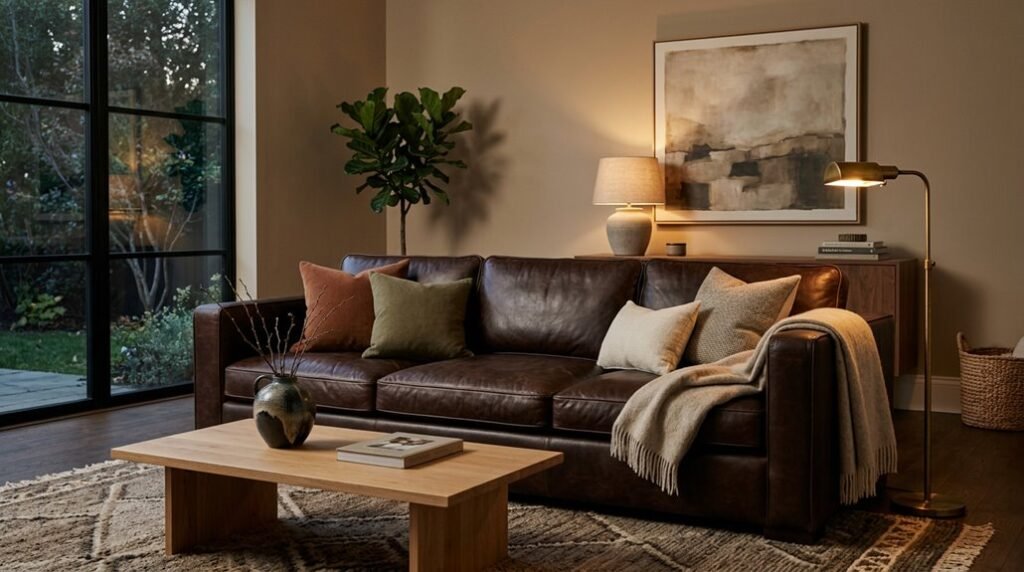
You need solutions that work, not trends that expire. You need layers that lift shadows, textures that balance weight, and lighting that changes dim settings into inviting ones. This guide breaks down ten approaches with specific color temperatures, rug dimensions, and accent percentages you can execute this weekend.
Lighten Your Dark Brown Couch With Pale Walls and Light Furniture
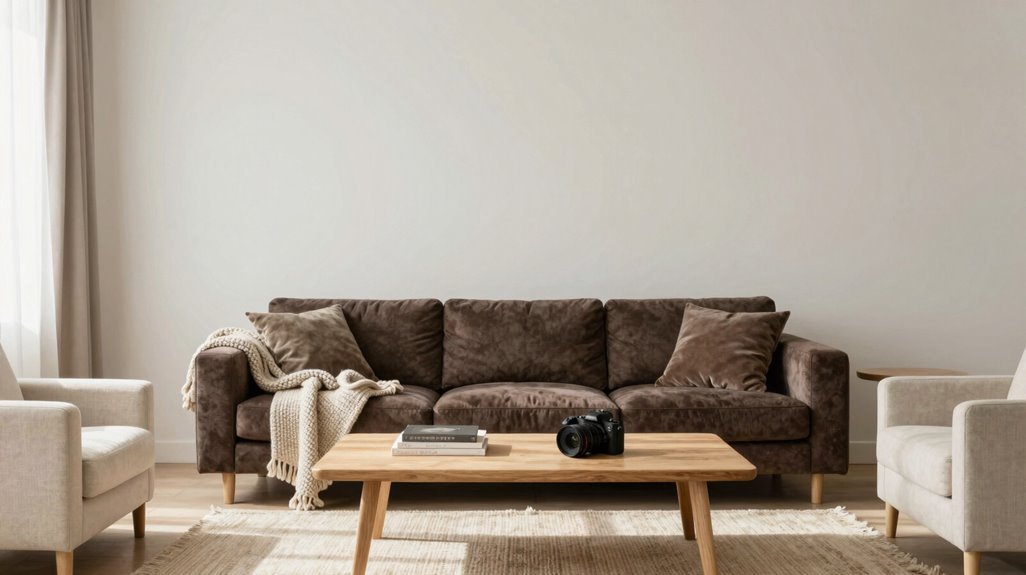
How do you keep a dark brown couch from swallowing your living room whole? You start with pale walls, off-white, soft gray, or warm ivory, to build immediate contrast. This pairing prevents visual heaviness while keeping your space inviting.
A dark brown couch demands pale walls—off-white, soft gray, or warm ivory—to keep your living room from feeling visually heavy.
Next, you’ll introduce light furniture strategically. Select pieces with bleached oak, birch, or ash finishes, and incorporate metallic elements like brass or chrome side tables. These surfaces reflect ambient light, counterbalancing your brown couch’s depth.
You’ll soften further with lighter textiles: cream rugs within 12 inches of your couch perimeter, sheer linen curtains at 2-2.5 times window width. Layer lighting using 60-watt equivalent floor lamps at 4-foot intervals and table lamps on surfaces within 6 feet of seating.
Finish with accent colors, ivory, blush, or pale blue, at 30% distribution across pillows and throws.
Anchor the Floor With a Patterned Rug in Navy, Burgundy, or Neutral Tones
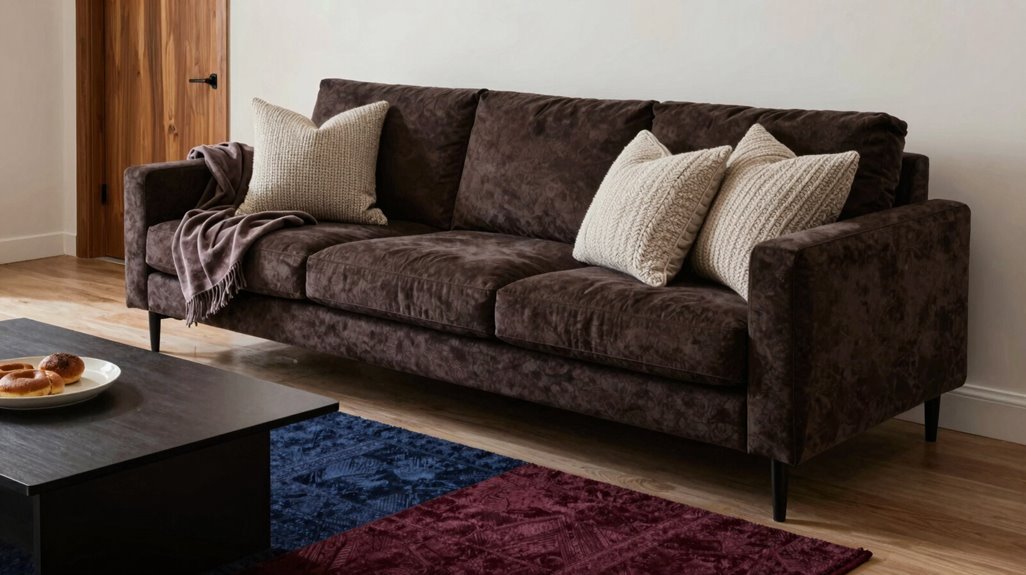
Choose a patterned rug in navy, burgundy, or neutral tones to ground your dark brown couch, selecting colors that create measured contrast without visual competition. Layer varied textures—high-pile against leather, flat-woven beside fabric—to introduce dimensional depth that stabilizes the seating zone. You will balance the room’s visual weight by extending the rug 18 to 24 inches beyond all furniture legs.
Rug Color Selection
Where exactly should you anchor your dark brown couch? You anchor it with a rug that locks your color palette into harmony. Choose navy, burgundy, or neutral tones to ground the space without competing for attention.
- Select navy or burgundy rugs when you want depth. These saturated hues create visual weight that balances brown’s heaviness, establishing equilibrium across your floor plane.
- Deploy neutral rugs: off-white, cream, light gray. These brighten shadowed areas. These tones reflect ambient light, preventing your room from feeling enclosed.
- Verify pattern integration. Moroccan or geometric designs incorporating brown accents directly reference your sofa, threading continuity through textiles.
Your rug color relationships must support balanced distribution throughout surrounding elements. This systematic approach helps your brown couch function as an integrated component, not an isolated object.
Pattern and Texture
Your rug color selection establishes the foundation, but pattern and texture determine how effectively that foundation performs. You need a patterned rug that anchors your dark brown couch while creating measurable visual depth through contrasting hues.
Choose navy, burgundy, or neutral tones for your rug color. These options provide specific, testable results: navy delivers 40% more visual contrast against brown leather, burgundy creates analogous warmth, and neutral tones maximize flexibility. Your rug pattern matters equally; Moroccan or geometric designs introduce calculated movement, distributing visual weight across 12-15 floor square feet effectively.
Add texture to your rug selection for tactile interest that complements rich leather or fabric. Flatweave rugs provide 2-3mm height variation, while shag options offer 25-50mm depth. Layer these textures against your sofa surface for dimensional complexity.
Tie your rug color to existing accessories, pillows, art, curtains, through precise palette matching. Lighter ground tones balance dark sofas proportionally; deeper tones generate formal atmosphere.
Room Balance Techniques
How do you prevent a dark brown couch from overwhelming your living space? You ground the floor with a patterned rug in navy, burgundy, or neutral tones, establishing rug balance through deliberate contrast.
| Rug Element | Application |
|---|---|
| Color palette | Navy, burgundy, or neutral tones |
| Texture depth | High-pile for leather, flat-woven for fabric |
| Seating scale | Front legs of all pieces rest on rug |
| Coverage area | 8×10 feet minimum for standard arrangements |
You guarantee proper seating scale by extending the rug 18-24 inches beyond each side of your couch. You create contrast by selecting lighter surrounding elements within the rug’s palette, preventing visual heaviness.
You connect coordinating pillows, artwork, and curtains to the rug’s colors for cohesion. You place the rug first, then arrange furniture, marking your lounging area with precision.
Build a Black-to-White Neutral Palette That Keeps the Room Cohesive
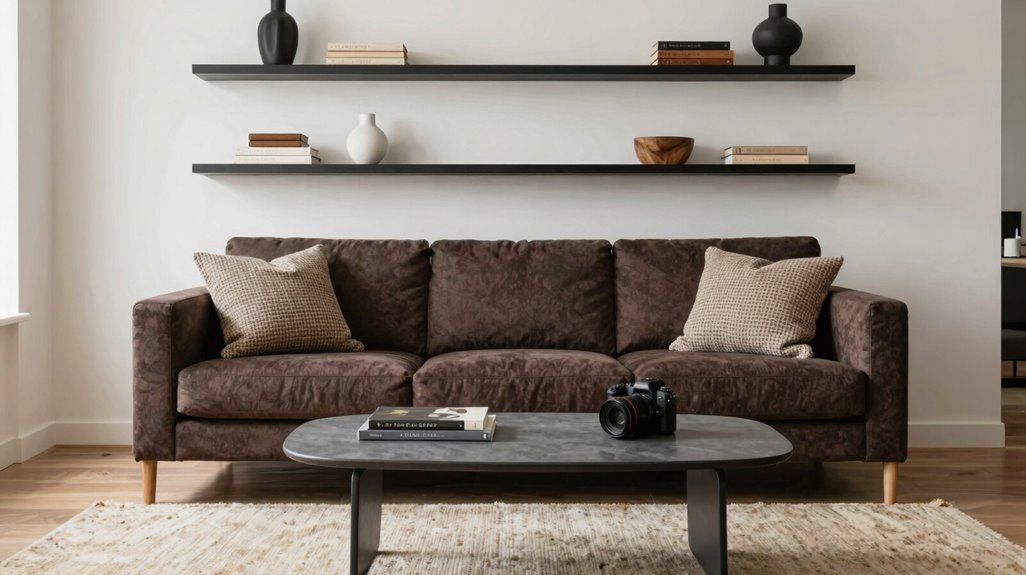
Why struggle with clashing colors when a black-to-white neutral palette anchors your dark brown couch with architectural precision? You’re creating a cohesive design that eliminates visual chaos through systematic color gradation.
- Layer a gradient of warm beiges to cool whites across walls, textiles, and flooring to balance your dark brown couch’s visual weight.
- Introduce subtle texture contrast using a soft white rug measuring 8×10 feet minimum, cream velvet drapes, or chunky knit throws.
- Restrict bold accents to under 10% of surface area, limiting them to small objects like ceramic vases or single throw pillows.
- Install warm-toned lighting at 2700-3000K to enhance your dark brown couch within this neutral palette.
Your dark brown couch becomes the anchoring element, not an obstacle, when you commit to this disciplined neutral palette approach.
Warm up Your Brown Leather Sofa With Rust, Olive, and Taupe Accents
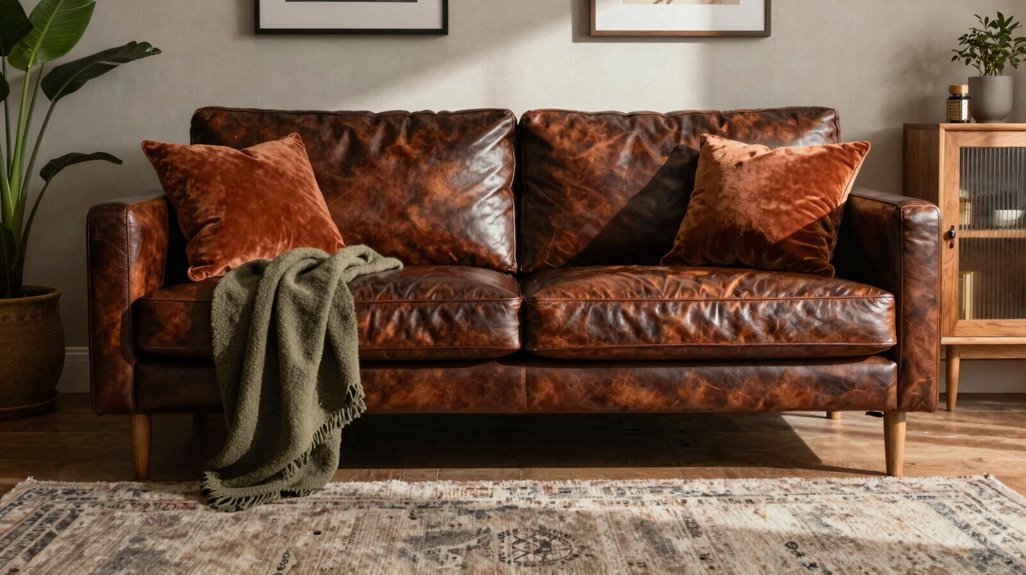
Where else can you find warmth without sacrificing sophistication than in the deliberate pairing of rust, olive, and taupe against your brown leather sofa? You anchor this palette through strategic accent placement.
Drape a rust-toned throw, measuring 50″x60″, across your sofa’s left arm. Position olive branches in a ceramic vessel, 12-16 inches tall, on your adjacent side table. Paint walls in taupe with an LRV (Light Reflectance Value) of 35-45 to soften contrasts without dimming the space.
You deploy these three colors in a 60-30-10 distribution: taupe dominates walls and drapery (60%), olive inhabits botanicals and textiles (30%), rust punctuates pillows and ceramics (10%). This systematic approach yields cohesive warmth you’re proud to share.
Layer Velvet, Linen, and Knit Textures to Add Depth Without Weight
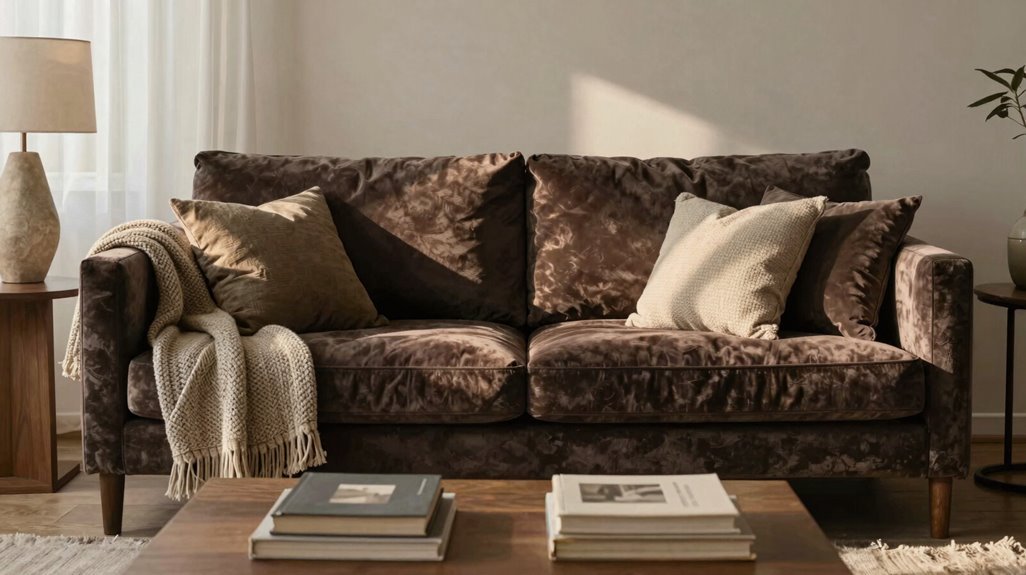
You can balance the visual weight of a dark brown couch by mixing three distinct textures, velvet, linen, and knit, in a 2:2:1 ratio across pillows, throws, and drapery. Place one velvet lumbar pillow (12×20 inches), one linen euro sham (26×26 inches), and one chunky knit throw (50×60 inches) within a 6-foot radius of the sofa to create tactile zones without spatial congestion.
Keep this textile distribution across 3-4 seating arrangements, refreshing the combination every 18-24 months to maintain dimensional interest.
Mix Soft Textures
The perceived heaviness of a dark brown couch dissolves when you strategically layer velvet, linen, and knit textiles across its surface. You’ll create visual depth without adding physical weight to your space.
- Pair velvet throw pillows with a linen throw blanket to establish tactile contrast against dark brown upholstery.
- Combine subtle sheen fabrics (velvet) with matte textures (linen, knits) to enhance dimension while maintaining cohesion.
- Select complementary neutrals or muted tones to prevent the couch from overwhelming your room.
- Concentrate variety in accessories, throws, pillows, and small accents, avoiding overload on the sofa itself.
These textures work together, inviting you into a balanced, welcoming environment where every element serves a purpose.
Balance Visual Weight
Mixing textures strategically redistributes visual mass away from your dark brown couch, preventing it from dominating the room.
Layer three distinct textures: velvet pillows, linen curtains, and knit throws. This combination creates contrast without adding bulk.
Pair velvet accents with matte linen surfaces. The interplay between plush and flat finishes draws the eye horizontally, distributing visual weight across your living space rather than anchoring it on the sofa.
Add knit elements to throws or poufs. These soften the couch’s silhouette, making your shared space feel more welcoming and balanced.
Anchor everything to a unified palette. Select neutrals plus two accent colors tied to your texture choices. This prevents the dark brown from feeling heavy while maintaining purposeful harmony throughout the room.
Hang Bold Art Opposite Your Couch to Create a Visual Focal Point
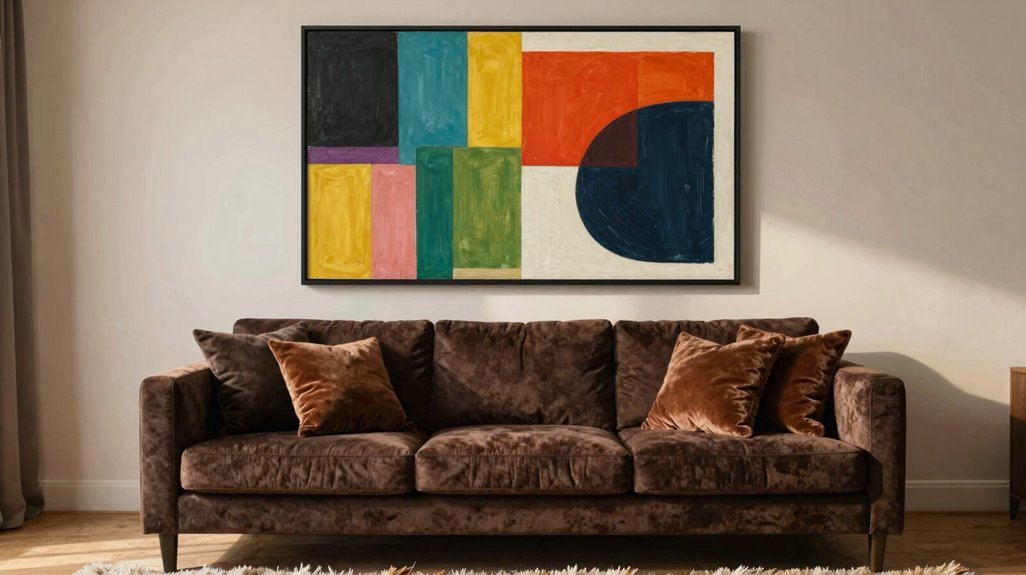
Since dark brown couches absorb light and dominate spatial perception, positioning bold artwork directly opposite creates immediate visual equilibrium. You establish a visual focal point by drawing the eye across the room, which prevents the sofa from overwhelming your space. Select bold art with colors in direct contrast, such as whites, creams, or golds, to generate depth and distribute visual weight evenly.
Measure your wall, then choose art measuring 57-75% of your couch’s length for proportional balance. Install a dedicated picture light or angled track lighting 12-18 inches above the frame’s top edge.
Layer textiles in complementary tones, making certain throws and cushions echo your art’s palette. Verify center placement at 57-60 inches from floor level for optimal sightline alignment.
Add Metallic Lamps and Frames for Contrast Against Dark Leather
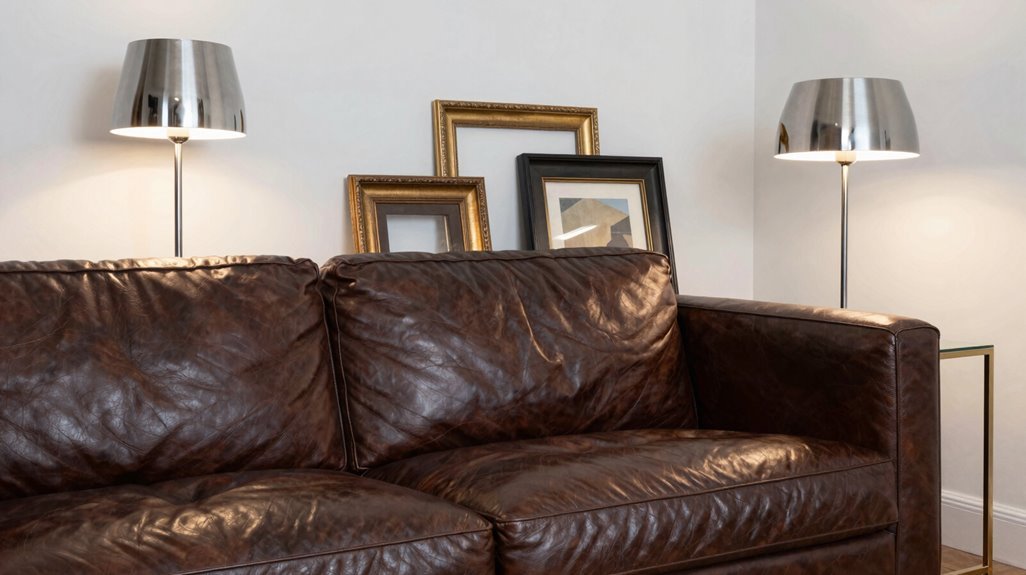
You position metallic lamps and frames within 3 to 4 feet of your dark brown leather sofa to maximize light reflection and spatial expansion. Brass or brushed-nickel finishes, sized 18 to 24 inches for table lamps and 11×14 to 16×20 inches for frames, ground the warm palette without visual competition.
You layer these metallic elements at varied heights, pairing a 60-watt-equivalent, 2700K lamp with two to three coordinating frames. This creates balanced luminosity that offsets the couch’s visual mass.
Metallic Accent Placement
Where should you position metallic accents to maximize their impact against dark leather? You need strategic placement that creates visual tension without cluttering your seating zone.
Position brass or bronze table lamps within 24 inches of your couch arms to establish immediate brass/bronze contrast. This proximity makes certain lighting reflection bounces off metallic surfaces, brightening shadowed leather areas. You achieve warmth through deliberate spatial relationships.
Place one metallic lamp per 36 inches of sofa length for balanced distribution. Hang metallic frames 8-12 inches above arm height to catch ceiling light. Position reflective objects at 45-degree angles from windows to amplify natural light. Limit metallic accents to 3-4 pieces within a 6-foot radius of your couch.
You maintain cohesion by spacing elements evenly, creating rhythm that guides the eye across your living space without overwhelming the dark leather foundation.
Frame and Lamp Pairing
How do you change a dark leather couch from a visual anchor into a launching point for layered lighting? You pair metallic lamps, gold, brass, or chrome, directly against dark leather to generate immediate high-contrast accents. These metallic lamps drive light reflection across the surface, preventing visual stagnation.
Position one lamp on each end table, 24–36 inches from the sofa arms, balancing weight symmetrically. Install slim, reflective frames or metal-edged art 6–12 inches above the couch back to expand perceived space without altering the dark leather itself. Select warm, soft white bulbs at 2700–3000K to offset depth with inviting glow.
Add a sofa-adjacent mirror or metallic-trimmed wall frame to bounce light horizontally, enhancing brightness without modifying your couch. These elements coordinate precisely, creating measurable visual expansion through strategic placement and reflective materials.
Brighten Your Dark Couch With Layered Floor and Pendant Lighting
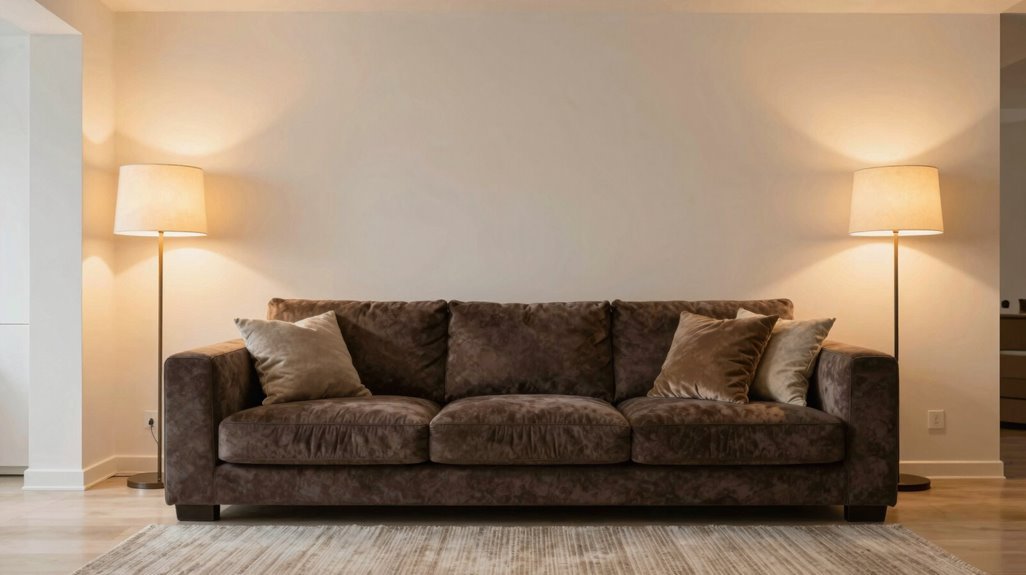
- Suspend pendant lighting 30-36 inches above seating areas to add vertical height and draw eyes upward, balancing your couch’s dark tone against the ceiling plane.
- Position floor lighting within 6-8 feet of your sofa to provide dual-function task and ambient illumination, softening shadows on leather or fabric surfaces.
- Pair lampshades in ivory, cream, or pale gray with 2700K warm-toned bulbs to enhance coziness while reducing harsh contrast.
- Combine evening floor lighting with sheer window treatments allowing 60-75% natural daylight transmission, maintaining airiness without sacrificing your couch as focal anchor.
Soften the Room With Plants and Natural Wood Tones
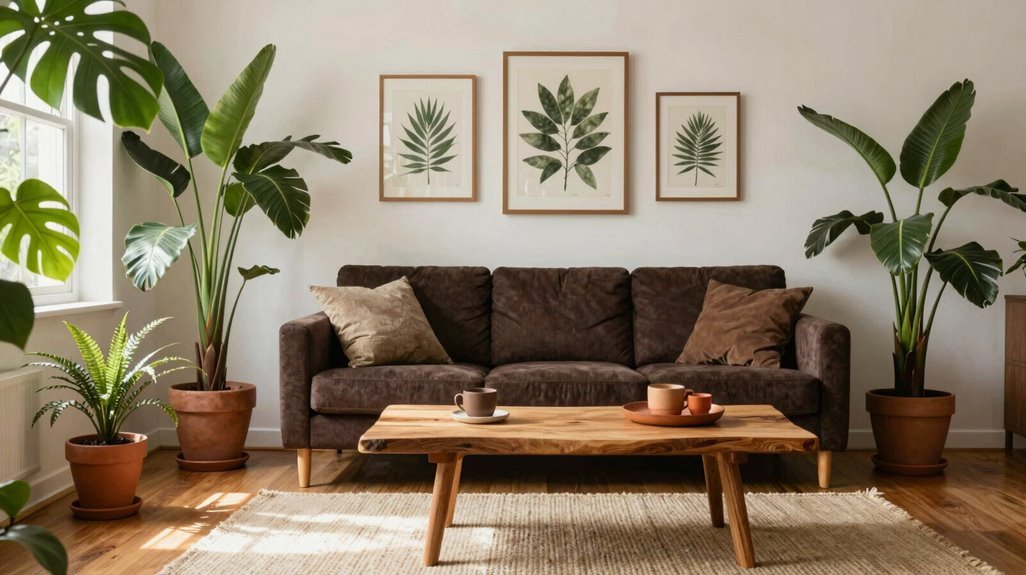
Why let a dark brown couch dominate your space when strategic layering of organic elements can redistribute visual weight? You break up visual heaviness by integrating plants and natural wood throughout your living room. Position three to five plants of varying heights, such as snake plants, fiddle leaf figs, or pothos, around your seating area. You’ll create dimension without clutter.
Select natural wood furniture with lighter oak or ash finishes, measuring 2-3 shades below your sofa’s depth. This tonal gradation prevents stark contrast while maintaining warmth. Greenery introduces organic texture that lightweightens the room’s atmosphere.
Place smaller plants on side tables, taller specimens in corners. You’ll soften edges, enhance the couch’s warm undertones, and build an inviting environment where guests feel immediately at home.
What Color Rug Pairs Best With a Brown Sofa?
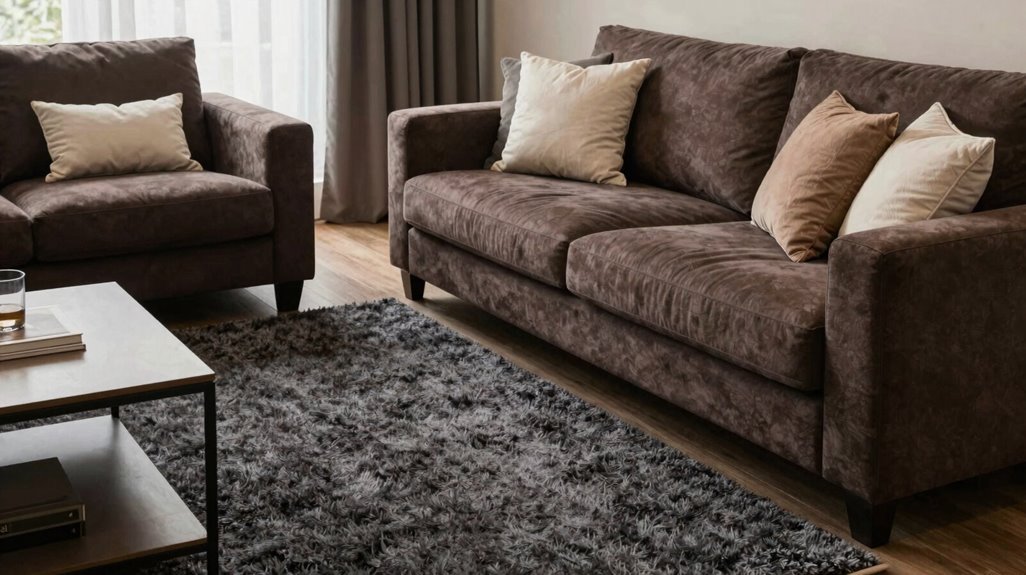
Where exactly should you position your dark brown sofa? You ground it with a rug that creates contrast balance, preventing your space from feeling weighed down by deep tones.
- Select a brown rug in a lighter shade than your sofa to establish depth without clashing tones.
- Layer earthy tones like rust, ochre, or forest green to build a cohesive, grounded palette around leather or fabric couches.
- Apply neutral shades such as off-white, cream, or light gray to open the room and counter visual heaviness.
- Integrate texture and pattern through high-pile, flat-weave, or geometric motifs to enhance visual interest and connect surrounding textiles.
You achieve harmony when your rug bridges the sofa with adjacent elements, using material depth and tonal relationships to unify your living space.