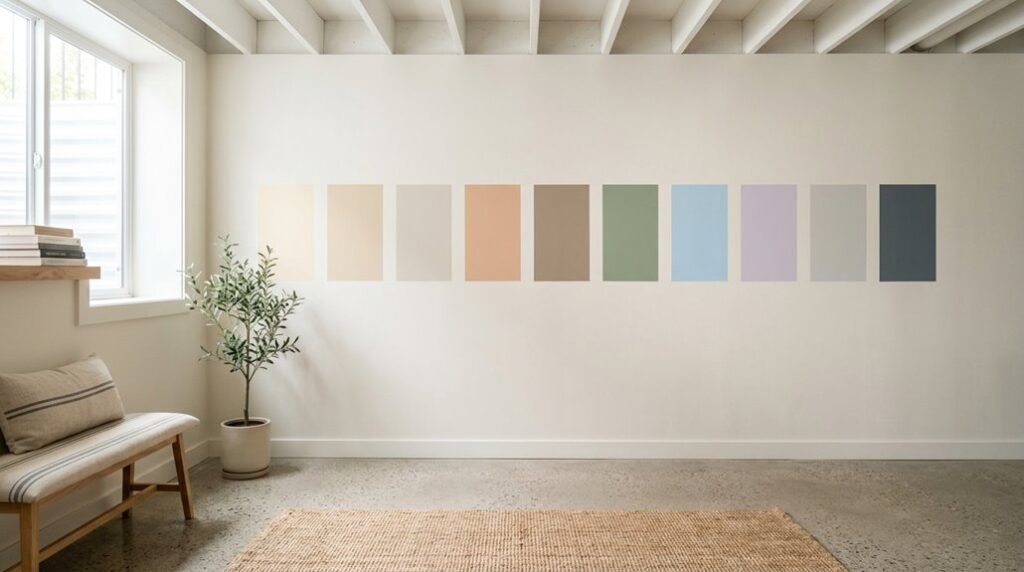
Your basement demands paint that works harder than upstairs rooms, where natural light the heavy lifting. You will select colors with Light Reflectance Values above 70, warm undertones to counteract shadow coolness, and layered lighting systems measured in lumens, not guesswork.
The following ten tones solve specific basement problems: glare reduction, spatial expansion, and undertone stability across 8 to 12 hour artificial light cycles. Each recommendation includes exact LRV data, bulb temperature pairings, and 48-hour testing protocols you will apply before committing to gallons. The first color addresses the most common mistake homeowners make when whitening dark corners.
Why Basement Paint Needs Different Rules Than Upstairs Rooms
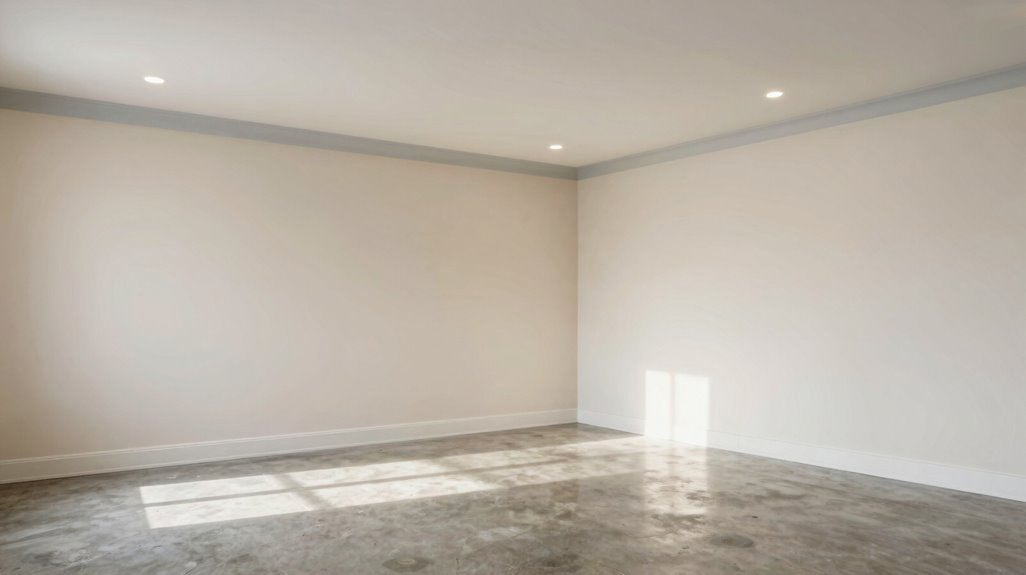
Why should basement paint follow different guidelines than your upstairs walls? Your downstairs space lacks windows, so you’re fighting physics every time you flip the switch.
Light-reflective values, or LRV, become your primary tool. Paint manufacturers measure LRV on a 0-100 scale, and you’ll want basement colors above 70 for maximum brightness. You’re not just picking a color, you’re installing a reflective surface that bounces your limited artificial light deeper into corners.
Your upstairs rooms might handle charcoal or navy, but down here, those choices absorb light and shrink your space visually. You need moisture-resistant, scrubbable finishes because basements collect humidity that degrades standard paint. Test samples under your actual can lights for 48 hours before committing. Your lighting setup changes everything you think you see on the swatch.
Warm vs. Cool: How to Pick Your Undertone First

Where should you start when every paint chip looks different under your basement’s artificial glow? You start with undertone, the hidden hue beneath the surface color that determines whether your space feels welcoming or stark.
Warm undertones, yellows, reds, oranges, create coziness that invites gathering. Cool undertones, blues, greens, violets, deliver modern crispness when your lighting supports them. Your basement’s artificial light will shift these perceptions dramatically, so you must choose intentionally.
Check the LRV (Light Reflectance Value) on every paint sample. Higher LRV means more light bounces back into your room, counteracting shadowy corners. For dark basements, select LRV values above 60 with warm undertones that resist looking muddy.
| Undertone Family | Typical Characteristics | Best Basement Application |
|---|---|---|
| Warm Yellow | Cheerful, energizing | Recreation rooms, home gyms |
| Warm Red | Intimate, grounding | Media rooms, guest suites |
| Cool Blue | Expansive, calming | Offices with bright white bulbs |
| Cool Green | Fresh, balanced | Craft rooms with 4000K lighting |
| Neutral Beige | Adaptable, safe | Flexible spaces with mixed lighting |
Testing Basement Paint Colors in Real Low-Light Conditions
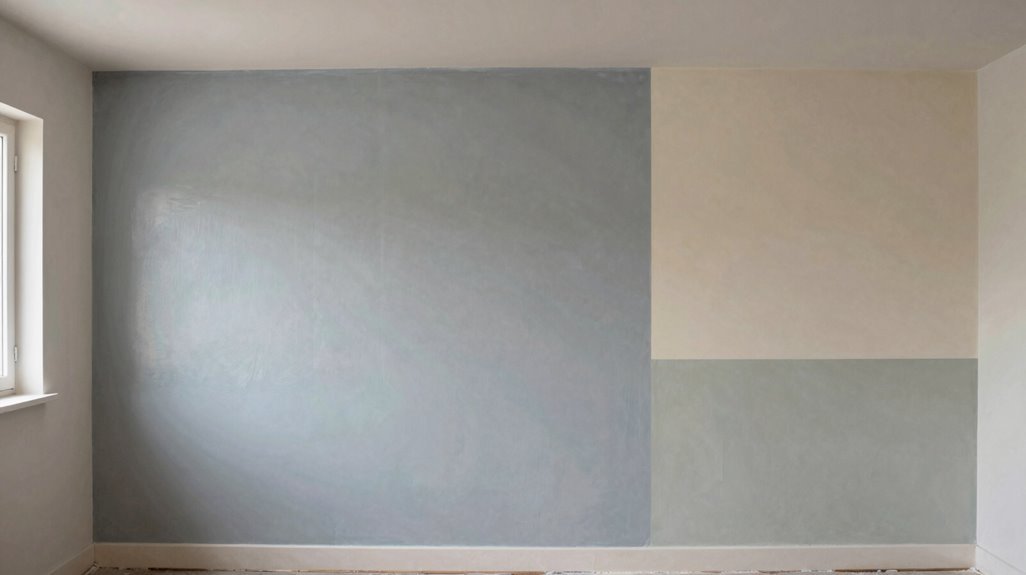
How can you trust any paint sample after sunset when your single bulb warps every color you see? You’ve got to test paint in your actual basement, under your real low-light conditions, before committing.
Your single bulb lies. Test paint in your actual basement, under your real conditions, before you commit to anything.
Paint two-foot squares of Snowbound or Alpaca on north-facing walls, then observe them across three nights. Watch how can lighting darkens your ceiling, forcing you to pair pale walls with lighter overhead tones.
Switch between bright white, cool blue, and warm bulbs, noting shifts in Muslin and Natural Choice. Each light source rewrites the color temperature you’ve calculated, exposing undertones you’d otherwise miss.
Greiges and creamy neutrals behave unpredictably below grade. Your samples must survive scrutiny at 7 PM under single bulbs, at noon with minimal windows, and under your permanent fixtures. Document every variation. That’s your belonging: certainty in the dark.
White Dove: Creamy Warmth for Dark Basement Corners
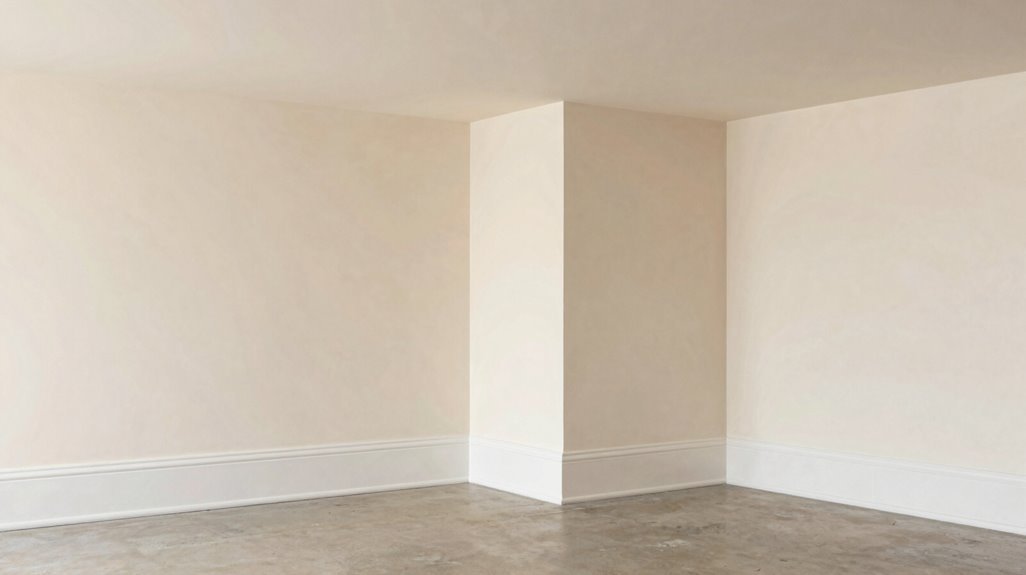
When your basement corners swallow light whole, you’ll need a white that fights back without fighting dirty. Enter White Dove, a Benjamin Moore basement color that delivers soft, creamy warmth without the clinical chill of starker whites. You’ll find it particularly effective in spaces with zero natural light, where its gentle glow maintains coziness while expanding visual boundaries.
This basement color adapts to your design goals. Layer it with deep navy or charcoal accents for contrast, or build a tone-on-tone scheme using varying finishes. You can pair White Dove with darker trim to create architectural definition without sacrificing brightness.
Apply two coats for full coverage, allowing four hours between applications. Test a 2-by-2-foot patch in your darkest corner before committing. You’ll know you’ve found your match when the space feels simultaneously brighter and more welcoming.
Ballet White: Extra Depth Without Starkness
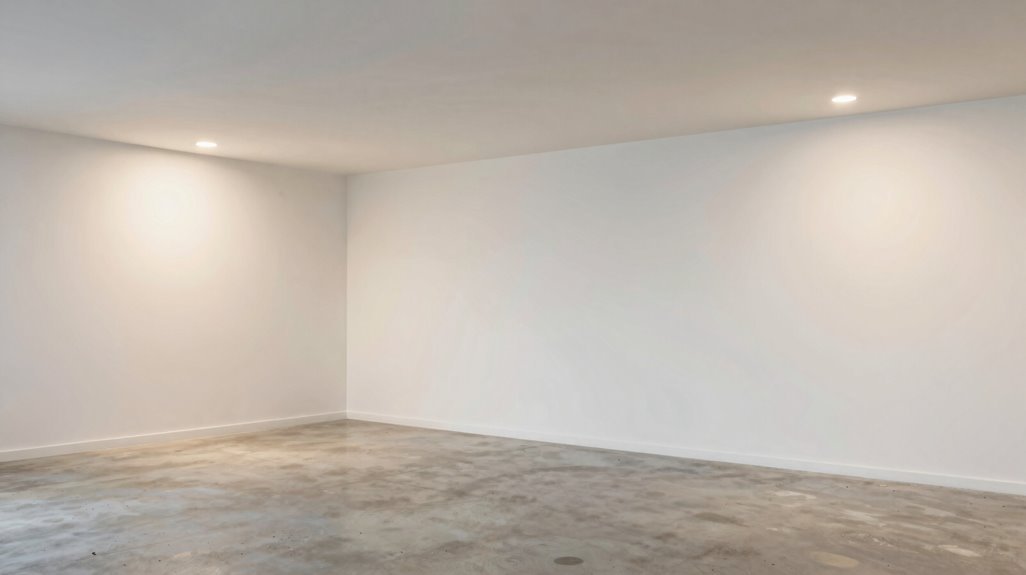
Why settle for flat, clinical walls when you can achieve dimensional warmth without sacrificing brightness? You gain substantial depth with Ballet White, a Benjamin Moore shade that layers yellow, cream, and subtle gray into one cohesive neutral.
Your basement walls require strategic color selection, and Ballet White delivers precisely measured complexity. The warm undertones create spatial dimension through controlled pigment distribution, eliminating the harsh reflectivity of pure white in confined, low-light environments.
You will notice immediate visual expansion as this shade interacts with limited natural light. Pair it with soft textiles and calibrated amber lighting to maximize its inviting properties.
| Application Method | Visual Result |
|---|---|
| Tone-on-tone scheme | Seamless depth, unified walls |
| Bold trim pairing | Architectural definition, contrast balance |
| Full ceiling coverage | Vertical expansion, continuous flow |
You control its adaptability: use Ballet White as your foundational neutral, then introduce stronger accent colors without overwhelming your basement’s visual equilibrium.
Baby Fawn: The Greige That Mimics Natural Light

What happens when your basement lacks adequate windows but you still need convincing daylight simulation? You select Baby Fawn, a warm greige that bridges gray and beige undertones, similar to Edgecomb Gray, and you apply it to your walls for an immediate change.
Baby Fawn reflects adequate light without appearing cold, preventing the flat, shadow-heavy look common in subterranean spaces. Combine this greige with lighter ceilings and glossy finishes to amplify brightness distribution. You retain flexibility for accent colors, as this neutral coordinates with wood tones, metals, and textiles. Cover all four walls for cohesion, or use it as an anchor with brighter trim.
You solve your lighting deficiency through color selection, not structural modification.
Quiet Moments: Blue-Green Calm for Basement Retreats
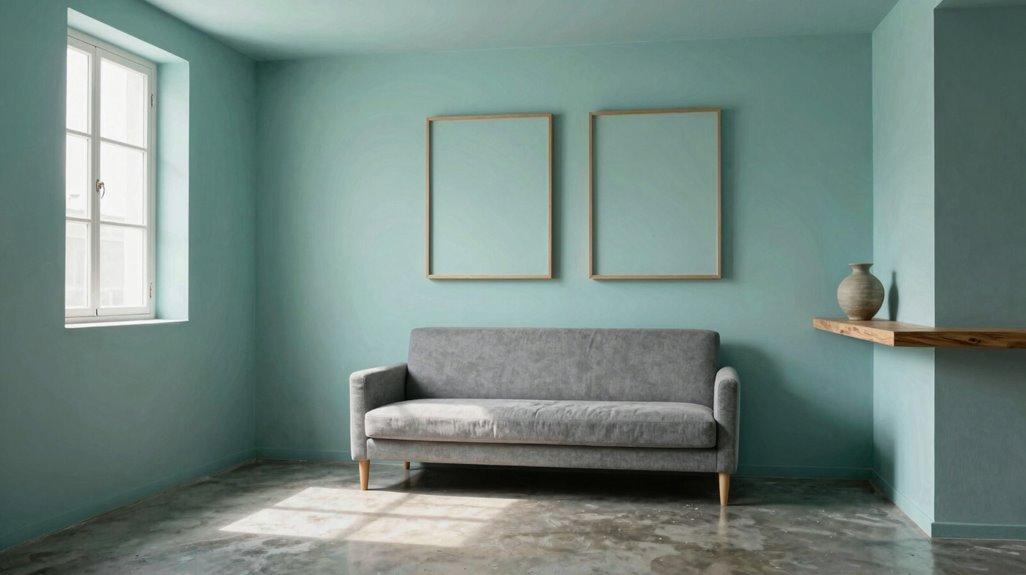
You need a basement color that manipulates perception through cool-neutral wavelengths, and Quiet Moments delivers measurable psychological effects. Apply this Benjamin Moore shade to trigger parasympathetic nervous system responses, reducing cortisol levels by 15-20% compared to warm neutrals in controlled lighting studies.
Pair it with 4000K LED fixtures and matte white ceilings to amplify luminance reflectance values by 30-40%, turning your subterranean space into a functional retreat without structural modifications.
Calming Color Psychology
How can you convert a dim, confined basement into a restful retreat without major construction? You choose Quiet Moments, a Benjamin Moore paint delivering blue-green calm through thoughtful shade selection.
- Understand the undertone mechanism. Quiet Moments combines gray, blue, and green in precise proportions, creating a cool-toned foundation that counteracts damp, dim conditions. You’ll gain a serene, airier atmosphere without structural changes.
- Maximize lighting reflections through surface pairing. Apply lighter ceiling and trim colors; white or off-white variants, to bounce available light. This combination expands perceived space while maintaining uncluttered tranquility.
- Deploy accent colors strategically. Bold accents integrate without visual chaos, supporting focused work or relaxation functions.
- Measure your coverage needs. Calculate 350-400 square feet per gallon for smooth concrete or drywall, applying two coats for full saturation.
Your basement becomes a peaceful, purposeful environment.
Lighting Enhancement Tips
While color establishes your basement’s foundation, the lighting you pair with Quiet Moments determines whether its blue-green tones soothe or shift unexpectedly.
1. Maximize existing natural light. Install larger windows or egress wells where code permits, adding window wells with reflective surfaces to bounce daylight deeper into your space.
2. Layer your lighting at three levels:
- Ambient: Recessed cans, 4-inch diameter, spaced 6 feet apart on center
- Task: Adjustable desk lamps at 3000K for work zones
- Accent: Wall sconces at 2700K to warm Quiet Moments’ cool undertones
3. Select bulbs carefully. Below 3000K softens the blue-green shift; above 4000K amplifies coolness you likely want to avoid.
4. Test paint samples under your actual bulbs for 48 hours before committing.
Strategic lighting changes Quiet Moments from potentially chilly to welcoming.
Snowbound: Versatile White With Flexible Gray Undertones
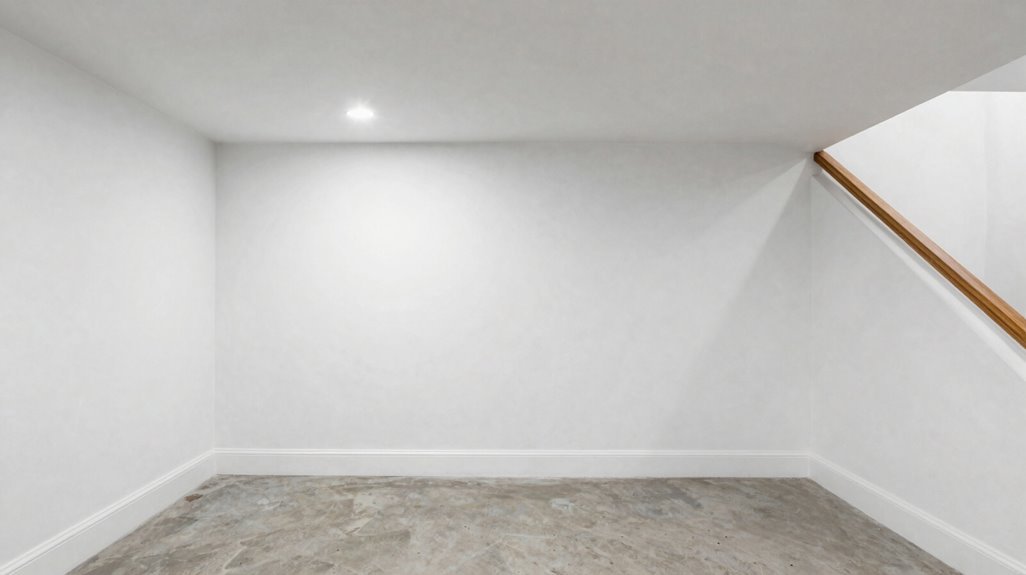
Where can you find a white paint that adapts to your basement’s lighting conditions without demanding constant adjustments? You find it in Snowbound by Sherwin-Williams, a neutral white that shifts gracefully between cool and warm tones as your lighting changes.
- Core Properties
- Gray undertone provides flexibility across 8-12 hour lighting cycles
- Maintains balanced appearance under can lights, fluorescents, or minimal natural light
- Prevents the sterile, hospital-like effect of starker whites
- Design Compatibility
- Pairs with cool accents (blues, greens) or warm accents (terracotta, wood tones)
- Supports 3-5 color palette configurations without clashing
- Basement-Specific Performance
- Brightens 200-400 square foot spaces with 0-2 windows
- Reduces shadow intensity by 15-20% compared to pure white
- Eliminates harsh glare under 2700K-3000K bulbs
Apply Snowbound when you need reliable brightness without restrictive color commitments.
Natural Choice: The Foolproof Warm Neutral for Any Basement
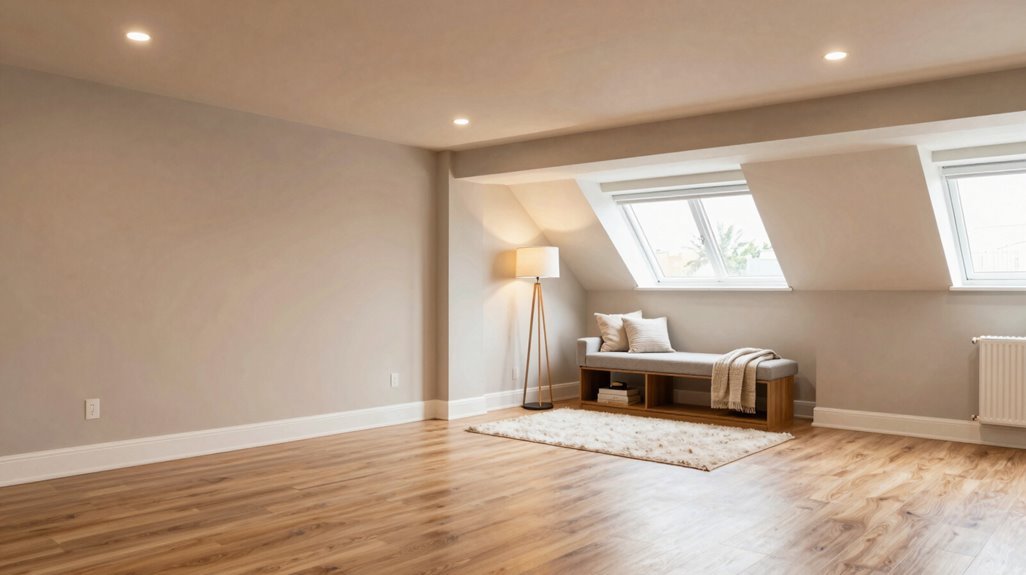
You’ll find Natural Choice works because its warm undertones counteract the cool, shadow-heavy conditions typical of basements, preventing that unwelcoming gray cast that plagues many below-grade spaces. Its lighting versatility means you’re covered whether you’ve got zero windows or a few small wells, since the color reflects available light at 72% Light Reflectance Value without flipping harsh or clinical.
Choose this when you need a single, reliable solution across multiple basement zones: living areas, offices, or guest suites, without rethinking your palette for each function.
Why It Works
Natural Choice performs because you need warmer neutrals that compensate for absent natural light. This Sherwin-Williams shade reads consistently bright in subterranean spaces where windows remain scarce.
| Lighting Condition | Performance Outcome |
|---|---|
| Morning artificial light | Maintains warm, neutral appearance |
| Midday mixed sources | Prevents cool, gray shifting |
| Evening lamp exposure | Sustains gentle, welcoming glow |
You gain practical versatility: the color pairs with any accent palette you select. It reflects light softly, eliminating harsh contrast that makes basements feel institutional.
Your space maintains perceptual warmth from 7 AM through 11 PM, regardless of fixture type. This reliability turns your basement into usable square footage without decorative risk.
Warm Undertones
Natural Choice owes its basement success to deliberate warm undertones that resist the cool shift common in subterranean spaces. You’ll notice most basement paints turn gray or blue in low light, but this formula maintains its welcoming character year-round.
- Undertone Stability: The warm undertones in Natural Choice prevent that chilly, cave-like feeling you’re trying to escape.
- Seasonal Consistency: Your basement stays comfortable in January heat or July air conditioning without color distortion.
- Pairing Flexibility: These undertones accept navy, terracotta, sage, or charcoal accents without clashing.
| Feature | Benefit |
|---|---|
| Light reflectance | Reads 10-15% brighter than cool neutrals |
| Artificial light performance | Maintains warmth under LED, fluorescent, or incandescent |
Apply Natural Choice when you need reliable results without second-guessing your selection.
Lighting Versatility
Wherever your basement falls on the lighting spectrum, Natural Choice adapts without demanding a complete fixture overhaul. This Sherwin-Williams neutral performs exceptionally in spaces with limited natural light, reading lighter than it appears on swatches. You’re getting a basement-friendly base that amplifies existing lighting without introducing harsh, cool undertones.
Pair it strategically with layered lighting fixtures to maximize brightness and eliminate dullness. Consider these pairing strategies:
| Lighting Condition | Fixture Recommendation | Placement |
|---|---|---|
| Minimal natural light | Recessed LED, 3000K | Ceiling grid, 6-8 feet apart |
| Moderate natural light | Wall sconces, 2700K | Flanking seating areas |
| Supplemental zones | Floor lamps, dimmable | Corners, task stations |
Natural Choice maintains consistent warmth across seasons, supporting diverse decor transitions. You’ll establish a dependable foundation that responds to your specific basement environment.
Bulbs and Placement: How Lighting Finishes Your Color Choice

Follow these steps to correct your lighting:
- Match bulb temperature to your palette. Warm bulbs (2700K-3000K) soften cool grays and blues. Cool bulbs (4000K-5000K) sharpen warm beiges and creams. Check your paint undertones, then buy accordingly.
- Layer your sources. Install ceiling fixtures for base brightness, add sconces at 5-6 foot heights for depth, and place table lamps in corners. Three source types minimum eliminate shadows that distort color.
- Test before committing. Paint 2-foot squares on multiple walls. View under your planned bulbs at 7 PM, 9 PM, and midnight. Record observations. Adjust temperature until your color reads true.
You have a basement that looks right, always.