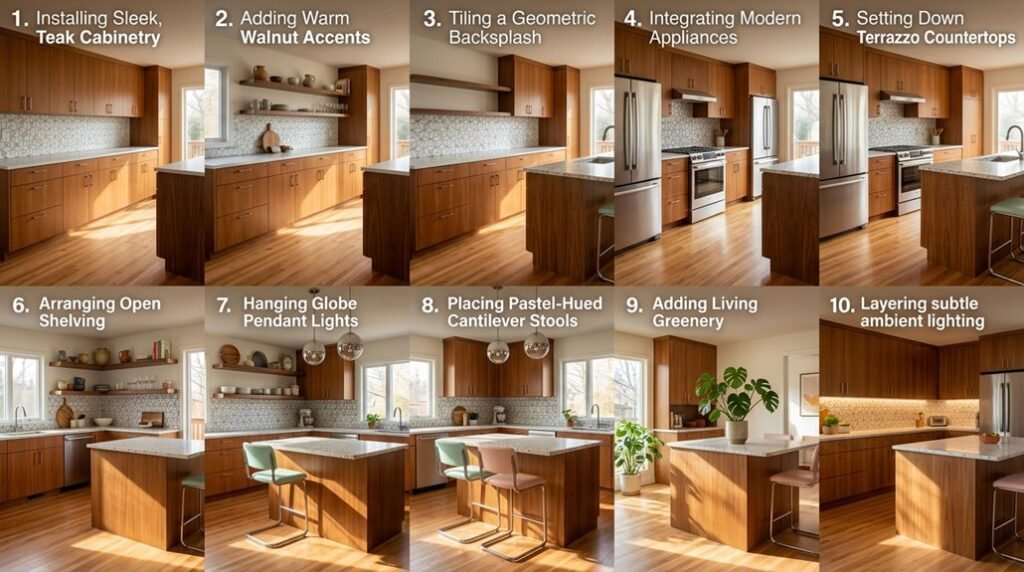
You don’t need a massive budget or vintage originals to nail mid-century modern style.
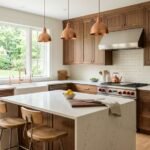
In 10 structured steps, you’ll build a kitchen with flat-panel walnut cabinetry, period-appropriate color blocking, and lighting schemes that actually function for daily cooking.
Each section gives you measurable specs, material grades, and hardware clearances so decisions happen fast and mistakes cost less.
Choose Flat-Panel Cabinets: The Mid-Century Modern Kitchen Foundation
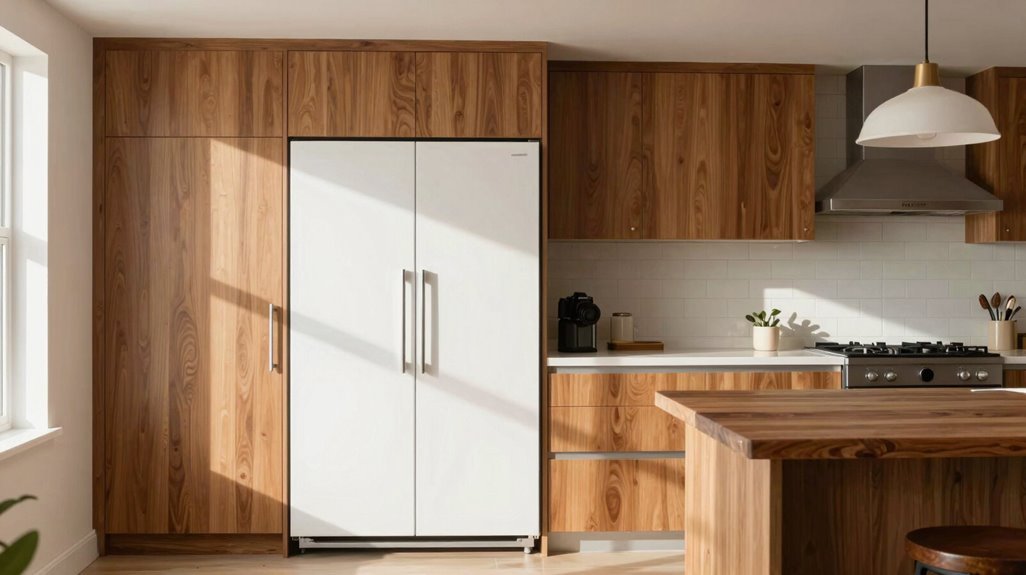
Flat-panel cabinets anchor your mid-century modern kitchen with the clean, unbroken lines this style demands. You’ll select flat-panel cabinetry because it delivers the streamlined, push-like surfaces that define this era’s graphic simplicity. Choose minimal hardware, integrated pulls or barely-there handles, so you maintain crisp, uncluttered cabinet fronts without visual interruption.
You’ll find two primary flat-panel options: full-slab fronts for maximum minimalism, or slim-profile frames that add subtle dimension while preserving the aesthetic. Both variations support your open-plan goals, pairing well with continuous countertops and open shelving for cohesive storage flow.
Your flat-panel cabinetry will typically feature natural wood veneers, walnut, teak, or oak, to generate warmth and create an uncluttered backdrop for accent pieces. This foundation establishes visual continuity, letting you layer period-appropriate elements without competing focal points.
Select Walnut, Teak, or Oak for Authentic Warmth
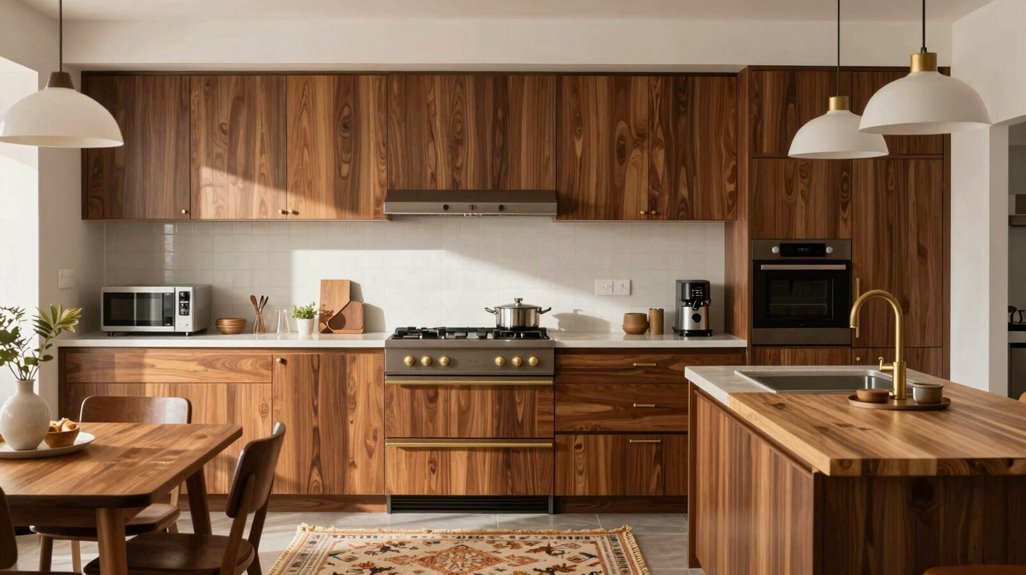
Three signature woods, walnut, teak, and oak, deliver the authentic warmth that separates genuine mid-century modern kitchens from imitations. You select walnut for floor-to-ceiling cabinetry, creating substantial storage within open, streamlined layouts. You choose teak for furniture and veneers, achieving the era’s characteristic golden-brown glow and durable, high-end appearance. You incorporate exposed ceiling beams or slat wood details to enhance authenticity and add visual depth.
| Wood | Primary Application | Key Characteristic |
|---|---|---|
| Walnut | Cabinetry, paneling | Rich, dark grain with timeless warmth |
| Teak | Furniture, veneers | Golden-brown glow, exceptional durability |
| Oak | Flooring, accents | Prominent grain, versatile light-to-medium tones |
You pair these wood surfaces with bold color accents to achieve signature contrast. You favor authentic materials over synthetic alternatives, helping your kitchen reflect true mid-century craftsmanship and earn its place among discerning enthusiasts.
Which Retro Colors Work Best? Mustard, Olive, and Teal
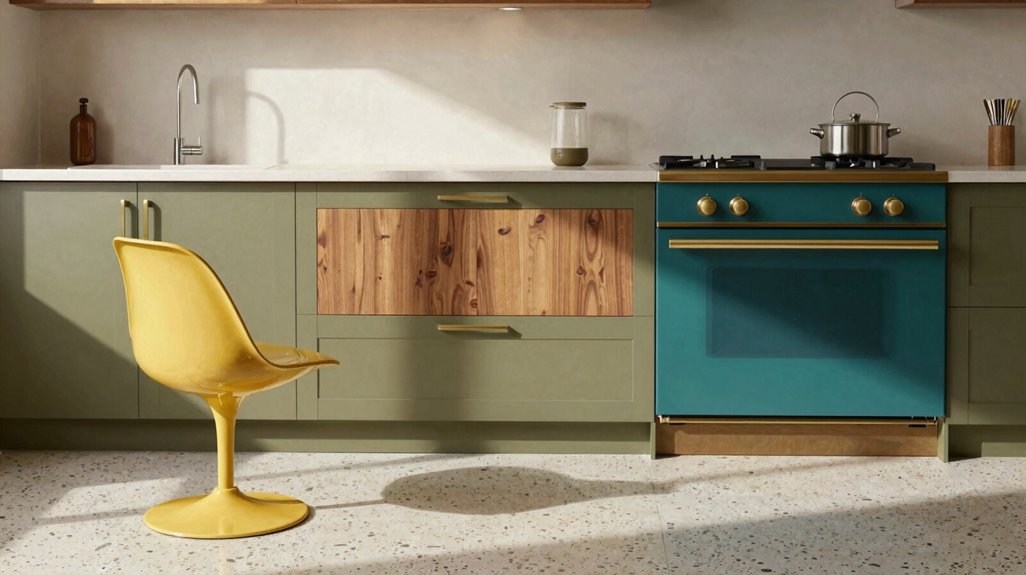
You’ll establish your color palette foundation by selecting one dominant retro hue, mustard, olive, or teal, and anchoring it against walnut or neutral cabinetry with precise 60-30-10 distribution ratios. Apply these colors as strategic accents through backsplashes, cabinet faces, or small appliances, so each placement maintains visual hierarchy without competing with your wood tones.
Reinforce period authenticity by pairing your chosen palette with brass hardware, black-and-white geometric textiles, or ceramic tile patterns that reference 1950s–1960s design specifications.
Color Palette Foundations
The foundation of any mid-century modern kitchen rests on a carefully calibrated color strategy, one that balances nostalgic vibrancy with functional restraint. You’ll anchor your space with neutral bases, creams, warm grays, or soft whites, then layer in three core retro accents. Mustard yellow and olive green pair naturally with walnut cabinetry and brass hardware, creating warm, period-appropriate contrasts that feel authentic. Teal delivers bold complementary energy when applied to cabinetry panels, tile installations, or small appliances.
| Color Role | Primary Application | Ideal Pairing |
|---|---|---|
| Neutral Base | Walls, countertops | Cream, warm gray, soft white |
| Mustard Yellow | Accents, accessories | Walnut cabinetry, brass hardware |
| Olive Green | Cabinetry, textiles | Terrazzo backsplashes, wood tones |
You’ll reinforce your palette through patterned backsplashes or terrazzo surfaces without overwhelming the spatial composition.
Accent Application Techniques
Once you’ve established your neutral foundation, you’re ready to distribute color accents with intentional precision across fixed and movable elements. You deploy Mustard strategically across three primary zones: backsplash tiles spanning 18-24 square feet, cabinetry fronts on 2-4 upper or lower units, or small appliances including toasters and stand mixers.
You position olive green as your grounded counterpart, applying it to cabinetry bases or tiled details measuring 12-16 linear feet, which balances bolder selections with earthy, natural tones. You introduce Teal as your cooler counterpoint, limiting it to wall art pieces of 24×36 inches maximum, hardware finishes on 8-12 pulls and knobs, or single accent cabinetry units. You pair all three with brass hardware and white or neutral surfaces to maintain era-appropriate cohesion.
Pick Minimal Hardware to Let Wood Grain Stand Out
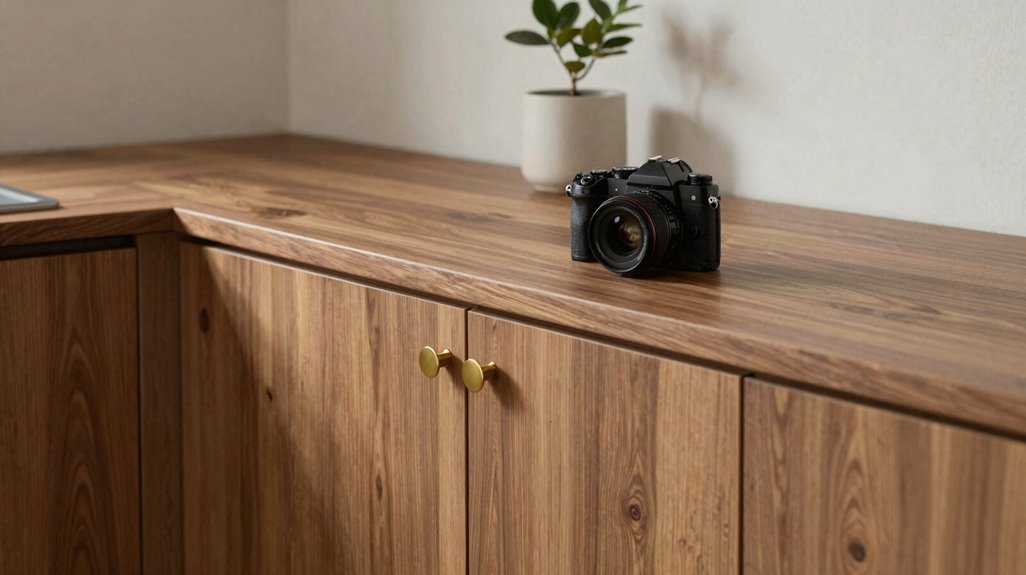
You’ll resolve the knob versus pull debate by choosing slim, horizontal pulls under 3 inches or foregoing visible hardware entirely through integrated finger pulls and push-to-open mechanisms. Invisible hardware options, including routed channel pulls along door edges or recessed grips on drawer fronts, eliminate visual interruption so walnut or oak grain patterns dominate your cabinetry facade.
Select flat-panel slab doors in full-overlay construction, measuring 0.75-inch thickness minimum, and restrict any metal accents to 1-inch maximum projection to maintain the wood’s primacy as your kitchen’s defining material element.
Knob vs. Pull Debate
Hardware selection commands careful consideration when you’re aiming to preserve the defining characteristic of mid-century kitchen design: uninterrupted wood grain visibility across flat-panel slab cabinets. In mid-century modern kitchens, you’re choosing between two hardware approaches that serve distinct visual purposes.
Knob vs. Pull: Your Decision Framework
- Knobs: You install small, round or square brass or chrome knobs, typically 1 to 1.25 inches in diameter, to create subtle focal points on each door. You’re drawing attention to individual cabinets while preserving warmth, especially against walnut or teak.
- Pulls: You select slim, integrated pulls running 6 to 12 inches along drawer lengths. You’re emphasizing horizontal linearity and visual flow, which expands perceived openness.
Your knob vs. pull choice determines texture perception. Knobs isolate each surface; pulls unify planes. For authenticity, you favor knobs on upper cabinets, slim pulls on lower drawers, maintaining grain dominance throughout.
Invisible Hardware Options
Why let hardware compete with your cabinetry’s most valuable asset? You’ll keep wood grain dominant by selecting flat-panel slab cabinetry with concealed hardware, letting walnut or teak speak without interruption.
- Choose integrated solutions: Install push-to-open mechanisms or rail pulls that disappear into cabinet edges, maintaining clean mid-century silhouettes.
- Select minimal metals: When hardware proves necessary, specify brushed brass or antique bronze pulls under 3 inches, spacing them uniformly at 6-inch intervals to honor slender mid-century lines.
- Test combinations: Request sample boards pairing your wood species with three hardware finishes, making certain selections remain visually subordinate to grain patterns.
Your cabinetry deserves center stage. By treating hardware as functional necessity rather than decorative feature, you’ll achieve the unified, period-authentic kitchen that connects you to mid-century design heritage.
Wood Grain Focus
Where should your eye land first when entering a mid-century kitchen? On the wood grain, naturally. You’re creating space where warm walnut or teak cabinetry commands attention, not competing hardware.
Choose flat-panel slab doors in walnut, teak, or oak with vertical grain running floor-to-ceiling. You’ll minimize visual interruption by selecting integrated pulls or touch-latch mechanisms, keeping surfaces nearly hardware-free.
Exposed beams, slat partitions, or wood-paneled walls reinforce this material hierarchy. Balance your wood-forward foundation with strategic color accents, mustard, olive, or deep blue, in textiles or small appliances. These complements enhance grain visibility without visual competition.
Your mid-century kitchen succeeds when natural wood textures dominate. Strip away ornamental distraction, let grain patterns flow uninterrupted, and you’ll achieve authentic period cohesion that welcomes everyone inside.
Light the Space With Globe Pendants or Sputnik Chandeliers
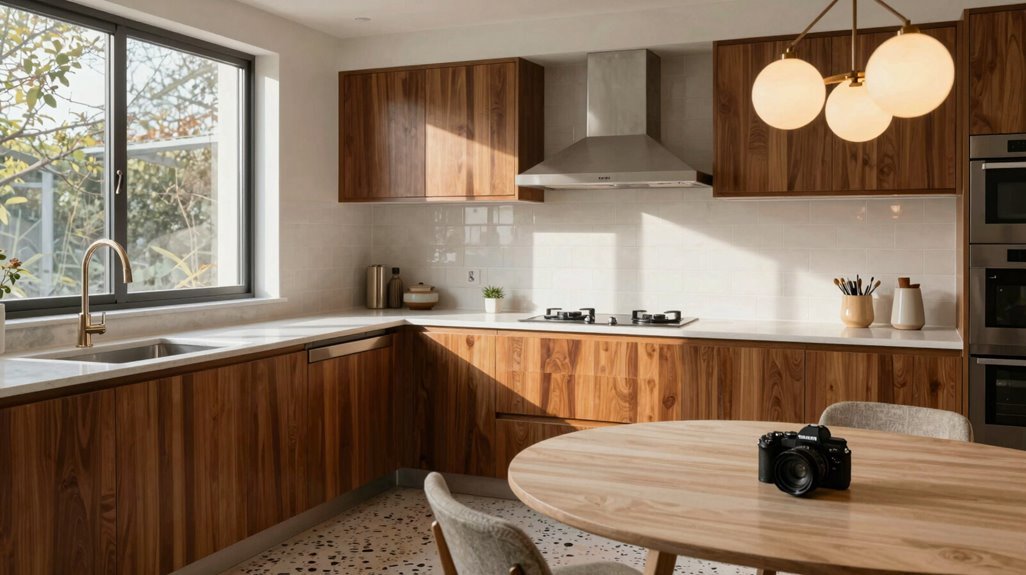
How do you anchor a mid-century kitchen’s vertical character without overwhelming its clean, horizontal lines? Use globe pendants or sputnik chandeliers as your retro focal points.
1. Select Your Fixture Type
Choose globe pendants for spherical glass shades that cast diffuse, warm light across counters. Opt for sputnik chandeliers when you want metal rods radiating from a central core, delivering dramatic, dynamic overhead illumination.
2. Position for Function
Hang fixtures 30-36 inches above islands, distributing light evenly over work surfaces. Maintain open sightlines to adjacent dining and living areas.
3. Coordinate Materials
Pair your selection with warm wood tones and brass hardware. This reinforces the era’s metallic-accented palette, creating visual continuity throughout your space.
Balance Open Shelving With Closed Cabinets for Visual Calm
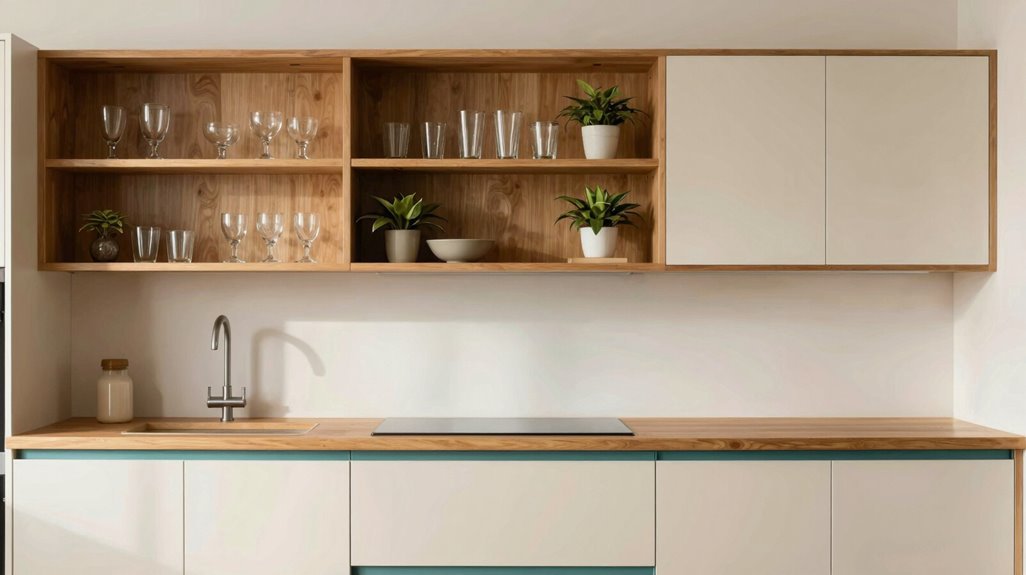
You need to mix storage types strategically by pairing 12-18 inch deep open shelves with flush-mounted flat-panel cabinets to anchor visual weight at room perimeters. Position open shelving at 60-66 inches from the floor or at cabinetry ends, while maintaining clean lines through consistent 3/4-inch material thickness and unified brass hardware sets.
Limit displayed items to 5-7 curated pieces per linear foot of shelving, keeping exposed contents under 30 percent of total storage volume for prime visual equilibrium.
Mix Storage Types
Why settle for storage that overwhelms when you can engineer visual balance instead? You blend Mid-century open shelving with closed slab cabinets, creating storage that breathes.
- Position 2-3 open shelves adjacent to base and wall cabinets, spacing them 12-18 inches apart for visual rhythm.
- Install continuous countertops and a 36-inch island to unify storage types, maintaining 48-inch aisle clearance.
- Limit open display to 15-20% of total storage, concentrating near sinks or cabinetry ends.
- Select warm walnut or teak tones, pairing with 3-inch brass pulls for cohesion.
This measured approach prevents visual chaos while honoring mid-century principles. You achieve accessible prep space, streamlined lines, and deliberate display zones without sacrificing the clean aesthetic that defines the era.
Anchor Visual Weight
Where does the eye settle when open shelves compete for attention against solid cabinetry?
You balance the visual weight by pairing open shelving with closed cabinets in measured ratios. Mount open shelves beside or above low cabinets to echo horizontal spacing, creating rhythmic intervals that stabilize the room. You vary shelf depths: 8 inches for dishes, 12 inches for plants, and align edges precisely with cabinet boundaries to reduce perceived heaviness.
Conceal utilitarian items behind slab-front doors while displaying curated retro glassware and selected dishware on open shelving. This 60/40 split between closed and open storage prevents visual overload. You maintain intentional gaps between display objects, allowing negative space to breathe. The result: calibrated tension between exposure and concealment, delivering the visual calm your Mid-Century kitchen demands.
Maintain Clean Lines
Visual weight, once balanced, still risks dissolving into chaos without disciplined edges. You maintain clean lines by pairing open shelving with closed slab cabinets, limiting displays to three to five curated items per shelf. Install flat-panel fronts with minimal hardware, positioning open storage at eye level near islands or sinks for cohesive flow.
Pair walnut or oak tones with monochromatic interiors, keeping consistent spacing of 12 to 18 inches between shelves. Align cabinet edges flush across all planes. This Mid-century discipline removes visual interruption, prioritizing functionality through deliberate restraint. You’ll achieve visual calm through these measured choices, creating a kitchen that welcomes you into its orderly, purposeful space without demanding emotional labor from its inhabitants.
Add Geometric Tile or Terrazzo for Period Texture
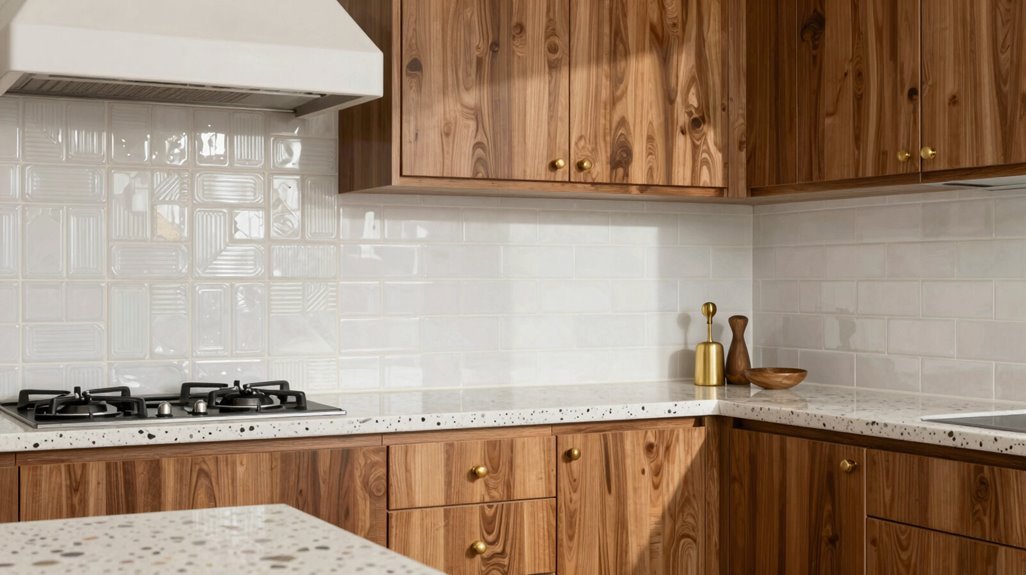
How do you anchor a mid-century kitchen in its era without overwhelming the space? You add geometric tiles or terrazzo for period texture that grounds the room in its historical moment. These materials deliver visual interest through pattern and materiality, not ornament.
Black-and-white checkered floors catching morning light through steel-framed windows. Terrazzo chips of coral, jade, and amber suspended in polished cement underfoot. Geometric tiles forming hexagonal honeycombs behind your range. Speckled surfaces echoing the era’s optimism against warm walnut cabinetry.
Terrazzo offers palette-rich, speckled surfaces that pair with brass hardware. Geometric tiles create bold backsplash statements. Source authentic reproductions from ModWalls or Clayhaus Ceramics. Renters, apply stick-on versions for non-permanent updates. You achieve period authenticity through material selection, not excess decoration.
Include a Round Dining Table With Classic Tapered Legs
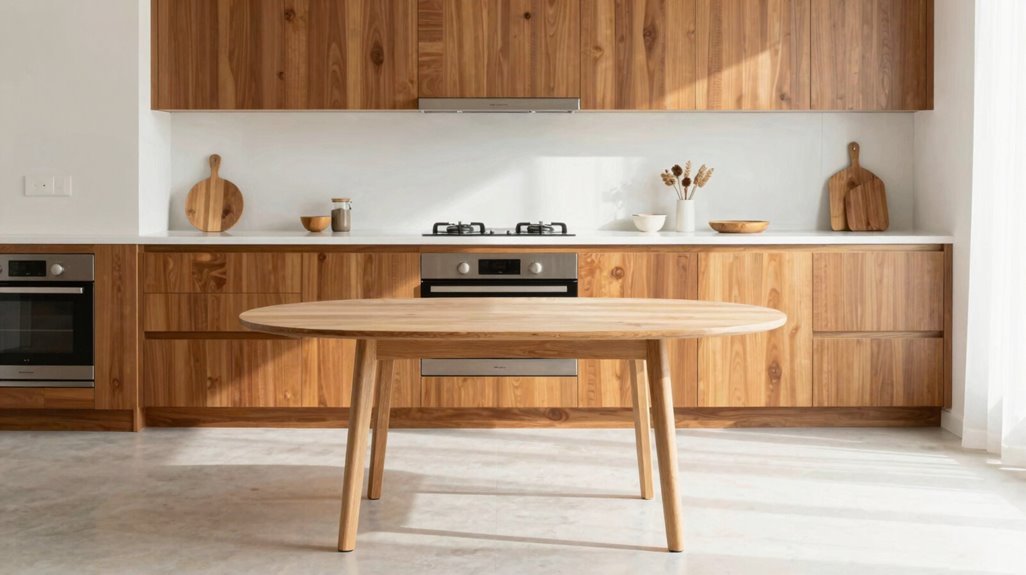
Once you’ve established your period-appropriate flooring and backsplash, you’ll need furniture that reinforces the mid-century modern narrative without disrupting spatial flow. Select a round table with classic tapered legs, the hallmark silhouette that anchors your kitchen’s functional core while promoting intimate dining and effortless circulation.
A round table with tapered legs anchors your kitchen’s functional core while promoting intimate dining and effortless circulation.
- Choose warm walnut or teak tones with minimal ornamentation, echoing your space’s emphasis on natural materials and honest construction.
- Pair your round table with slim, geometric chairs to preserve clean sightlines and visual balance with surrounding cabinetry.
- Position centrally within open-plan layouts, creating cohesive transition between living and dining zones.
Consider extendable round table models measuring 42-48 inches in diameter, expanding to 60-72 inches for guest accommodation. This versatility preserves your mid-century silhouette while solving daily use requirements through mechanical leaf systems.
Use Clerestory Windows and Plants for Indoor-Outdoor Flow
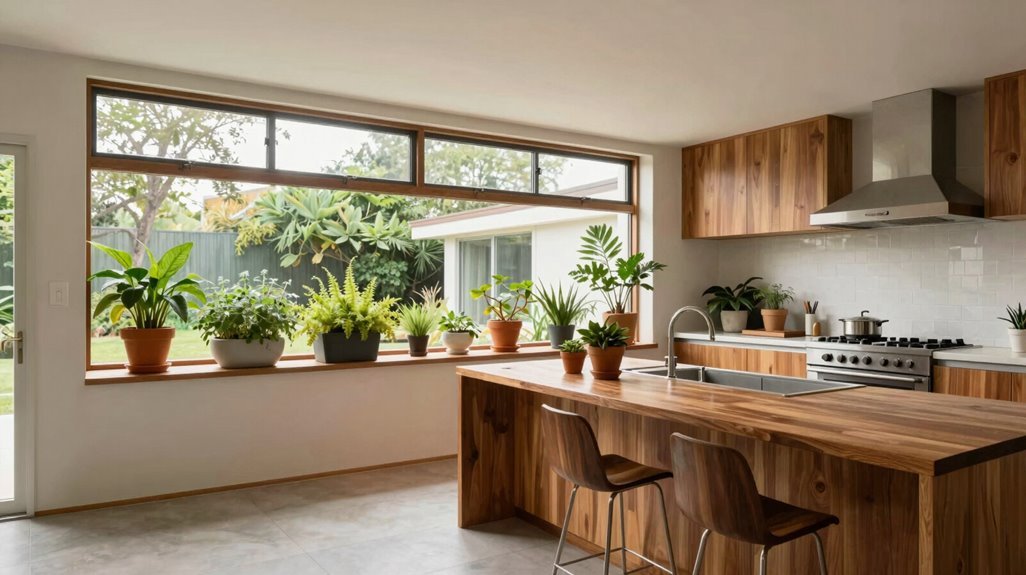
Your furniture establishes the groundwork, yet the walls and windows above determine how your kitchen breathes and connects to the outdoors. Install clerestory windows to raise the eye line, maximize natural light, and preserve wall space for storage or art. These high, narrow openings blur interior and exterior boundaries, enhancing indoor-outdoor flow without sacrificing cabinetry or decor.
Pair glazing with warm wood tones and minimal hardware to maintain clean, uncluttered lines. Position plants on ledges or nearby shelves to create vertical interest and strengthen the connection to nature. Consider expansive glass panels below the clerestory when possible to maintain daylight penetration while ensuring privacy and energy efficiency. These layered elements turn your kitchen into a unified, light-filled environment.
- Morning light streaming through narrow upper panes onto your countertop
- Ferns and trailing pothos bridging the gap between interior shelving and distant treetops
- Warm walnut cabinetry framing bands of sky above your prep zone
- Shadows of leaves dancing across tile floors as afternoon sun shifts westward
Curate Accessories in One Color Family for Cohesion
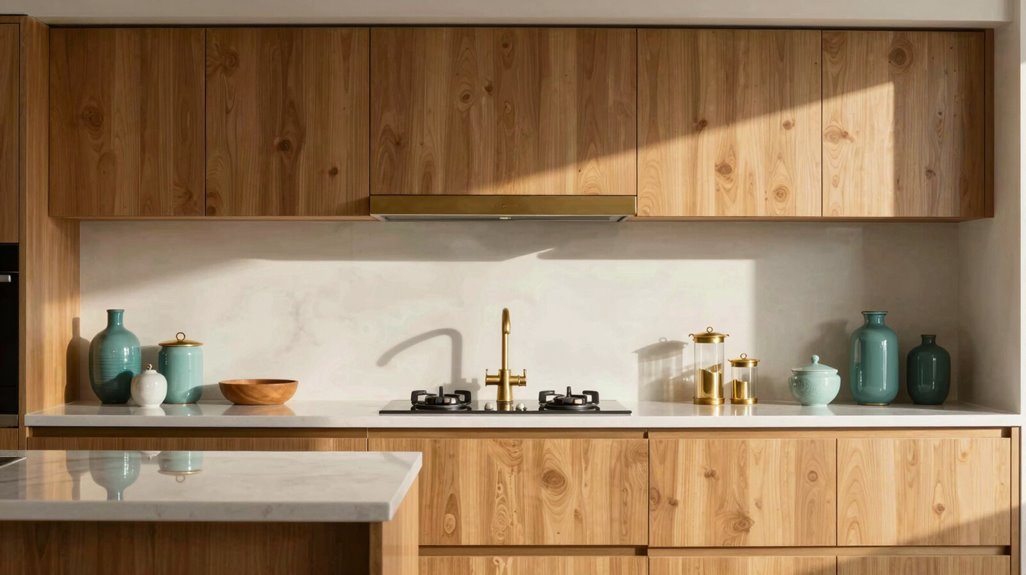
Where might visual disarray begin to undermine your carefully planned mid-century space? Often, it starts at the intersection of your kitchen cabinet fronts and scattered décor.
You curate accessories in one color family to establish cohesion. Select yellow, olive, or blue items: vases, vessels, candles, textiles, that echo classic mid-century palettes. You place these across shelves, tables, and countertops, creating unified visual rhythm against your wood cabinets.
You pair bold retro pieces, such as geometric ceramics or glassware, with neutral backdrop elements like walnut cabinetry and brass hardware. You maintain balance by keeping everything within your chosen family.
You vary textures; matte ceramics, glossy vitrified glass, woven fabrics, add depth without introducing new colors. You limit pattern mixing to single-color geometric rugs with matching-toned cushions. You preserve an uncluttered, deliberate aesthetic that feels complete.