
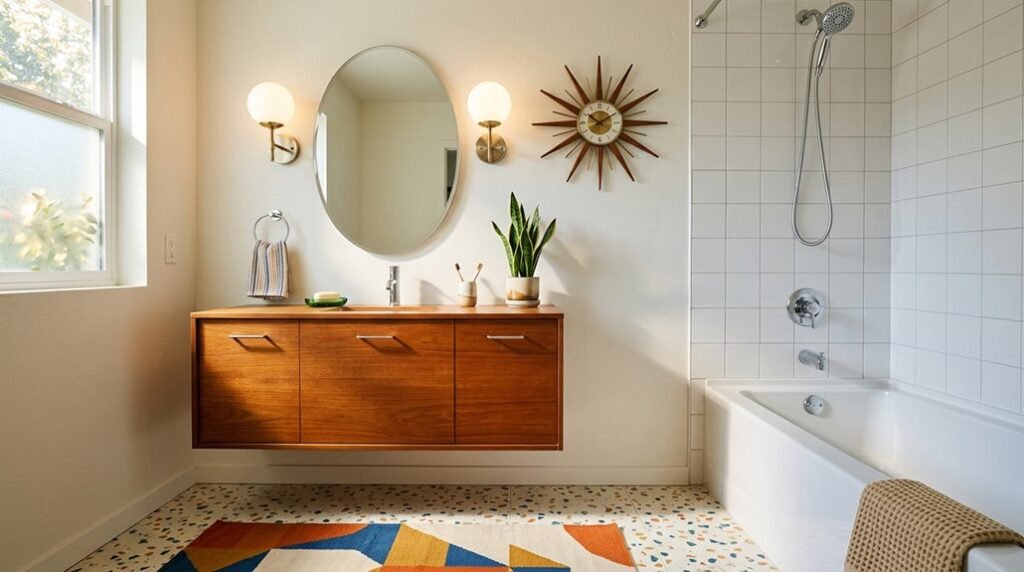
Homes built between 1945 and 1969 now account for over 20% of U.S. housing stock, yet most owners struggle to update bathrooms without destroying period character. You need a system that balances preservation with function, and these seven methods deliver measurable results.
The first tip involves color ratios you’ve probably never calculated.
Bold Wall Colors That Make Vintage Yellow Fixtures Shine
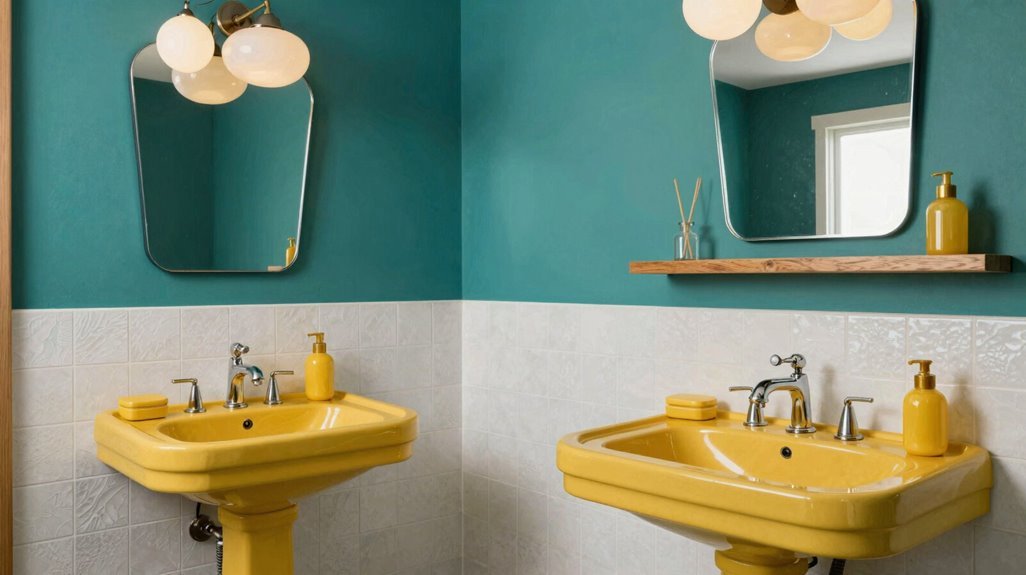
You have three primary strategies for pairing bold wall colors with vintage yellow fixtures, and each depends on your renovation scope and desired contrast level.
Strategy 1: High-Contrast Pairings
- Apply deep navy or charcoal to create retro punch
- Maintain 60-40 ratio: 60% bold wall, 40% yellow fixture visibility
Strategy 2: Neutral Foundations
- Select muted off-white or warm beige for cohesion
- Let yellow fixtures dominate as focal points without competition
Strategy 3: Period-Accurate Coordination
- Match walls with mid-century materials: white subway tiles, wood vanities
- Add emerald green or teal accent walls to echo 1950s palettes
For your mid-century modern bathroom design, balance saturation with existing lighting. Choose matte or eggshell finishes to reduce glare and maintain polished vintage aesthetics without requiring fixture replacement.
Geometric Floor Tiles That Anchor Retro Bathrooms
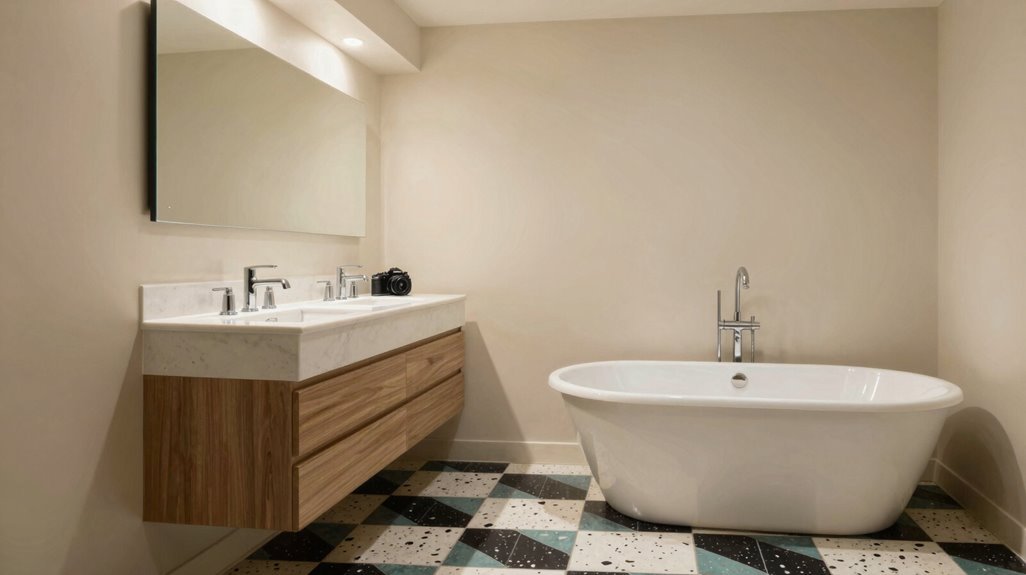
You’ll anchor your retro bathroom by selecting bold geometric patterns, chevrons, hexagons, or interlocking shapes, in ceramic or encaustic-look tiles measuring 4×4 to 8×8 inches. You must coordinate grout color with precision: match charcoal or cream grout to tile edges for a unified appearance, or contrast with white grout at 1/8-inch width to emphasize pattern geometry.
You’ll achieve period authenticity by restricting palettes to olive, mustard, muted blue, or neutral pairings, making certain there’s visual hierarchy between floor and wall surfaces.
Bold Pattern Selection
Where exactly should a retro bathroom’s visual weight settle? You’ll find your answer in geometric floor tiles, the definitive anchor for mid-century spaces. These bold patterns, chevrons, diamonds, honeycomb, create immediate visual hierarchy through repetition and scale.
Select your color palette from period-authentic options: butter yellow, teal, navy, or crisp white. Each hue carries specific retro associations, so choose based on your existing fixtures and desired atmosphere. You’ll balance these commanding floors by pairing them with simple white subway or neutral wall tiles, keeping the pattern as your center of attention without visual competition.
For compact bathrooms, deploy micro-tiling or small-scale geometric motifs. These maintain pattern impact while preserving spatial openness. During installation, align grout lines precisely with cabinetry edges and fixture centers. This symmetry reinforces the intentional, organized geometry that defines authentic mid-century design.
Grout Color Coordination
How precisely should grout lines function within your geometric floor pattern? Your grout color coordination determines whether bold shapes recede or dominate the visual field. You must decide between contrast and cohesion.
Pair light tile with charcoal grout to create authentic mid-century definition. Match grout to tile for seamless, uninterrupted surface continuity. Select warm gray or beige to soften complex, busy patterns. Maintain consistent texture and color across all adjacent tiles.
You seal grout properly because porous ceramic and natural stone absorb pigments from surrounding fixtures. You avoid visual clutter in compact bathrooms by unifying line work throughout. Your pattern rhythm depends on this technical execution. High-contrast combinations, like blue tile with navy grout, amplify retro impact when you seek statement flooring. Control the outcome through deliberate selection.
Warm Wood Vanities for Mid-Century Contrast
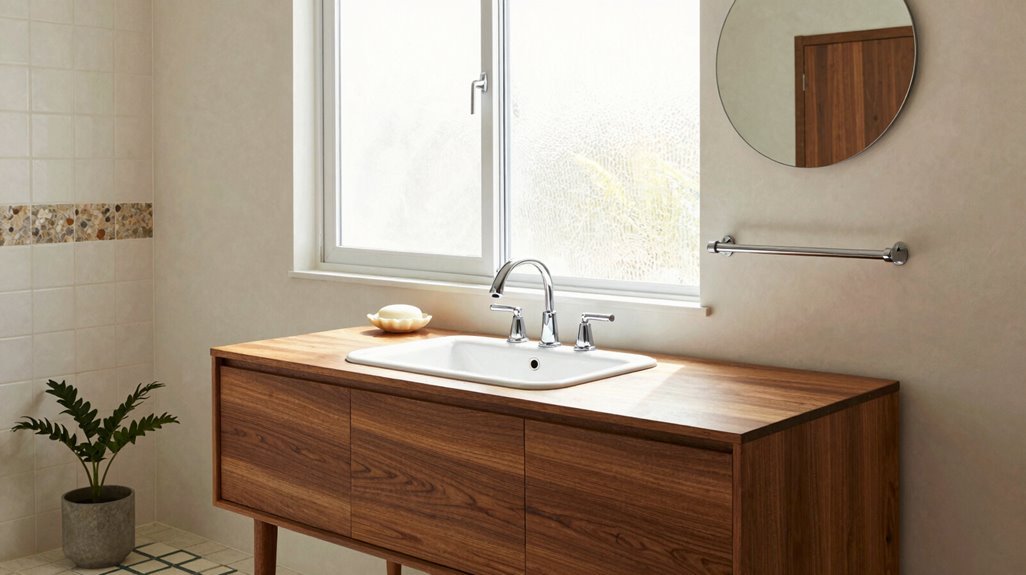
Why settle for sterile when you can anchor your bathroom with purposeful warmth? In your mid-century modern bathroom, select a vanity with traditional wood veneer in walnut or teak, positioning it as your focal point against white subway tiles for crisp, timeless contrast.
Anchor your mid-century bathroom with purposeful warmth: a walnut or teak vanity against crisp white subway tiles creates timeless, intentional contrast.
Choose fluted wood details or vertical slats to add texture, rhythm, and visual height in compact spaces. Pair your wood sink vanity with chrome or brass hardware and white countertops, balancing organic warmth with clean, era-appropriate lines.
Consider reclaimed wood cladding for sustainability and reinforced retro aesthetic. Maintain period authenticity with minimalist storage and curved or round-edged hardware, ensuring modern practicality without visual compromise.
These elements create belonging through deliberate choices, solving your organizational challenges with measurable, period-correct solutions.
Lighting Shapes That Feel Retro, Not Dated
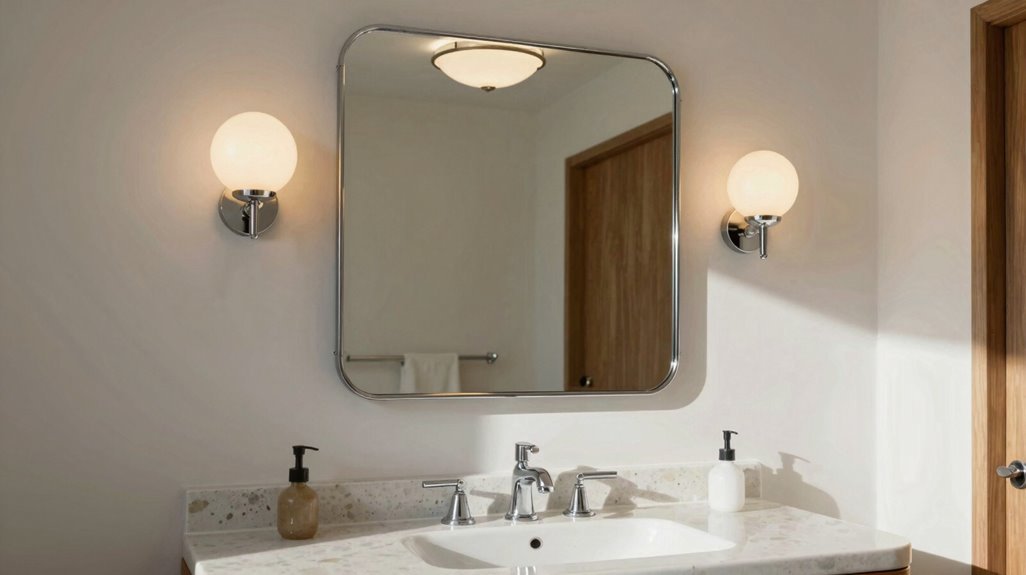
What shapes should your lighting take to signal mid-century authenticity without sliding into obsolete cliché? You anchor your scheme with pendant lights that carry rounded or geometric forms, wall sconces in brass or chrome, and center pendants that echo mid-century silhouettes. You place task lighting near mirrors and vanity to emphasize functionality while maintaining the era’s clean lines. You layer ambient, task, and accent levels to enhance textures like wood, tile, and stone.
You select fixtures with curved edges, globe or dome shades, and slim profiles to align with mid-century minimalism. You deploy warm 2700–3000K lighting to complement butter-yellow fixtures, wood tones, and brass hardware.
Your mid-century lighting choices include:
- Pendant lights with rounded or geometric forms
- Wall sconces in brass or chrome finishes
- Center pendants echoing mid-century silhouettes
- Globe or dome shades with slim profiles
Mirrors and Hardware With Authentic Period Details
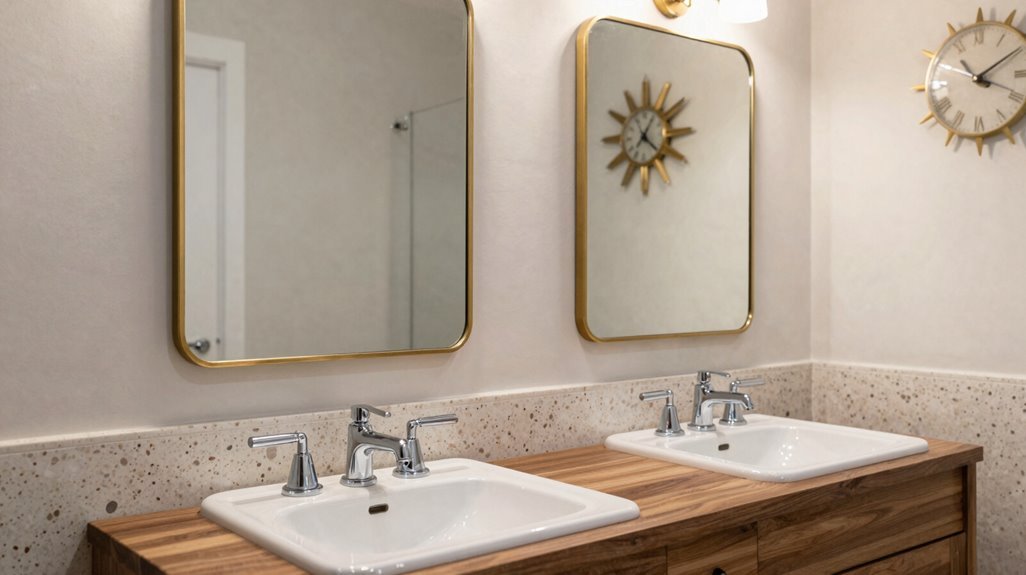
You’ll select mirrors and hardware that lock in your bathroom’s retro credibility through precise shape and finish coordination. Anchor your vanity with period-perfect ovals, sunbursts, or wood-framed rectangles measuring 24–36 inches wide. Lock in cohesion via brass or chrome hardware repeating those metallic notes. Your material consistency across these elements eliminates visual fragmentation, delivering mid-century authenticity in measurable, replicable terms.
Period-Perfect Mirror Shapes
When you’re selecting mirrors for a mid-century bathroom, you’ll need to match frame materials and silhouettes to the era’s restrained aesthetic. Mid-century mirrors typically showcase simple wooden, natural, or metal frames that emphasize clean lines and minimal ornamentation, creating visual harmony with your existing fixtures.
You’ll want to consider these essential shape categories:
- Curved frames that break up strict geometry and add soft, organic contrast to angular fixtures
- Sunburst mirrors serving as bold gold accent statements against blue or neutral tile backgrounds
- Standard shapes paired with aligned faucets to reinforce symmetry, a core mid-century principle
- Floor-length mirrors that amplify light and space, enhancing airiness in compact bathrooms
Select frames measuring 24-36 inches wide for standard vanities, making sure the scale feels proportionate. You’ll achieve period authenticity through deliberate shape coordination.
Authentic Hardware Finishes
Mirror shapes establish your bathroom’s visual foundation, but hardware finishes determine whether those forms read as authentic period pieces or modern approximations. You’ll want to select brass, chrome, or gold-tone hardware finishes that match your mirror frames and sink fixtures. Choose round-edged pulls and streamlined knobs typical of 1950s-1960s design.
Pair brass hardware finishes with white subway tiles, or polish chrome against dark wood vanities for period-correct contrast. Coordinate your hardware finishes across all elements. Towel bars, drawer pulls, and faucet fixtures must share identical tones.
Install sunburst mirrors with simple metal frames, or select wooden-framed alternatives with clean lines. Match these to era-appropriate integrated vanities featuring concealed storage. Your hardware finishes must align with sink and vanity selections, creating cohesive, uncluttered spaces that fellow enthusiasts will immediately recognize as authentically mid-century.
Vanity Storage That Respects Mid-Century Lines
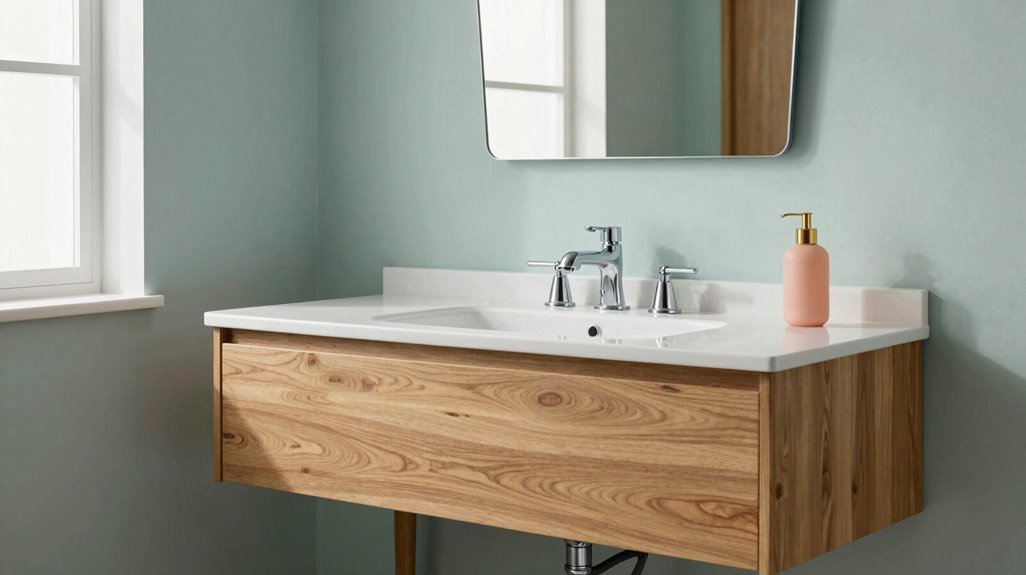
Because mid-century bathrooms demand visual harmony between form and function, your vanity storage must resolve the tension between daily utility and period authenticity through deliberate material and spatial choices. In Mid-Century modern bathroom design, you let a traditional wooden vanity ground the space, letting clean lines and warm wood tones contrast crisp white subway tiles while commanding visual attention.
- Select a compact vanity footprint, typically 18-24 inches deep, to preserve era-appropriate spatial proportions
- Conceal storage behind flat-panel doors or within dovetailed drawers to maintain minimalist surfaces
- Install chrome or brass hardware with rounded edges for period-correct detailing
- Balance closed cabinetry with open shelving or slim integrated compartments to sustain streamlined silhouettes
You achieve cohesion when every storage decision reinforces the era’s disciplined elegance without sacrificing daily practicality.
Final Styling Touches for Cohesive Retro Appeal
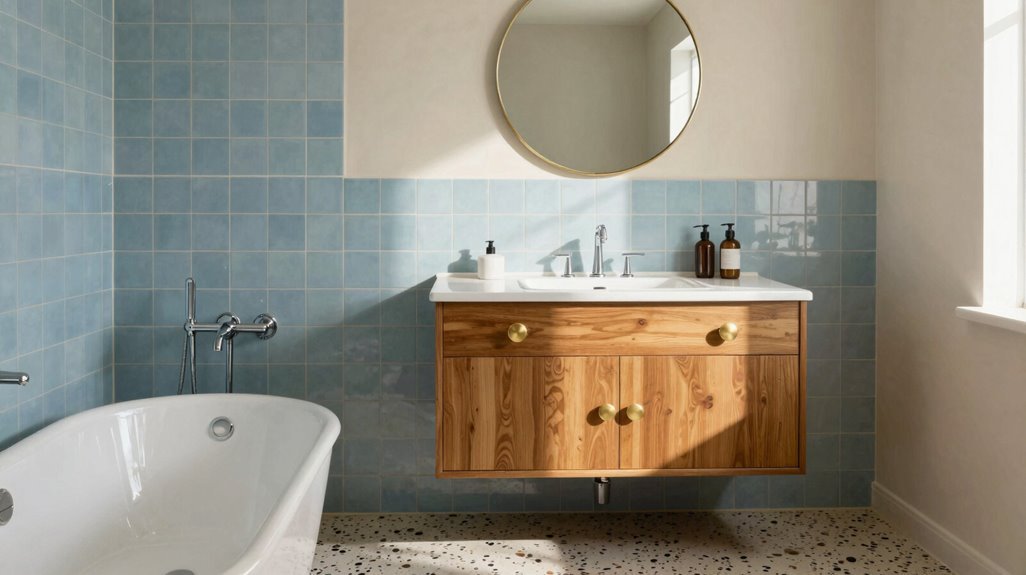
Every final styling decision you make must resolve the tension between visual cohesion and functional clarity, turning your bathroom from a collection of period pieces into an integrated mid-century composition. Anchor your mid-century modern bathroom with warm woods or brass accents against white or pastel walls, repeating period palettes for unity. Employ symmetry: two identical oval mirrors, centered faucets, one statement vase. Layer vanity lighting with ambient ceiling fixtures, creating refined, gallery-like illumination. Select one bold accent color, blue vanity or blush-pink sink, keeping surrounding elements neutral. Install open shelving or concealed storage, preserving clean lines while displaying curated vintage pieces.
| Element | Specification | Function |
|---|---|---|
| Wood tone | Walnut, teak, oak | Warmth, period authenticity |
| Metal finish | Brushed brass, matte black | Cohesive hardware unity |
| Mirror shape | Oval, 24–30 inches wide | Symmetrical balance |
| Accent color | Single saturated hue | Visual focal point |
| Storage type | Open shelf, 12-inch depth | Display without clutter |