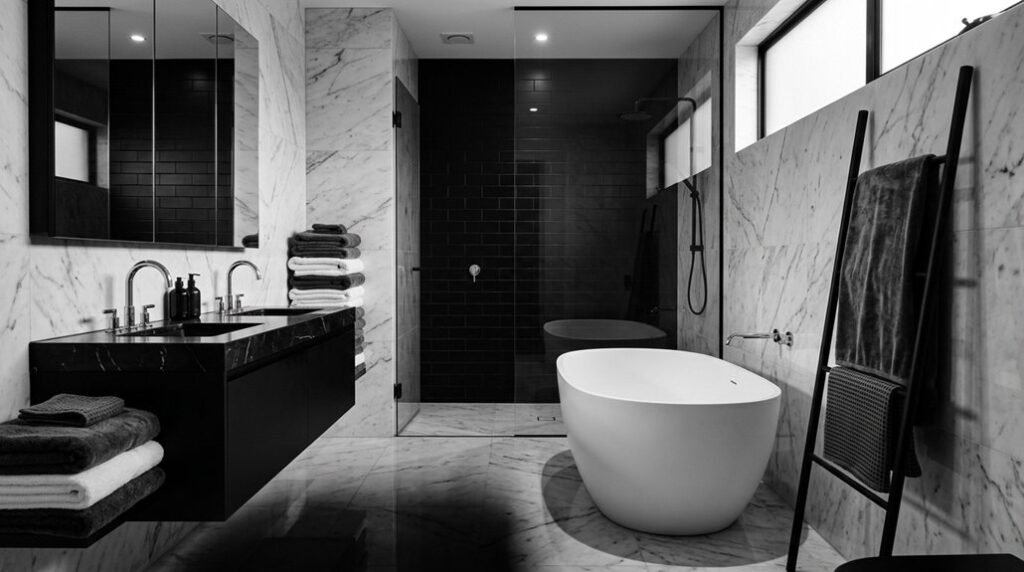
Like Newton splitting light, you must first divide your bathroom’s tones into measurable ratios: 70/30 white-forward, 60/40 black-forward, or balanced 50/50 splits. Your choice determines every subsequent decision: tile size, fixture finish, and lighting placement. Get this balance wrong, and you’ll waste $3,000-$8,000 on corrections.
You’ll need three specific strategies.
Choose Your Black and White Balance: White-Forward, Black-Forward, or 50/50
How do you decide which black and white balance suits your bathroom? You start by assessing your space’s natural light and your functional priorities.
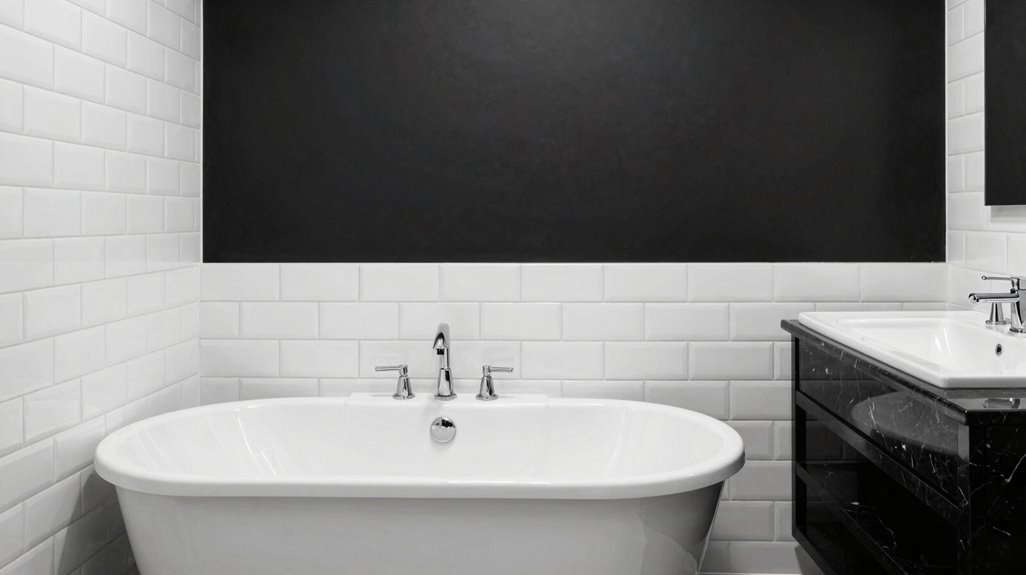
1. White-forward approach: You maximize cleanliness and brightness when you dominate with white walls and surfaces. You pair white subway tiles with frameless mirrors to reflect light, then add black accents for controlled contrast.
2. Black-forward approach: You create drama when you use bold black walls or fixtures as your backdrop. You install a black floating vanity with brass accents, then balance with white countertops and fixtures.
3. 50/50 balance: You achieve modern minimalism when you distribute black and white equally across textures and furnishings. You combine marble floor tiles with alternating dark and light elements for high-contrast equilibrium.
Choose based on your maintenance tolerance and spatial dimensions.
Pick Your Vibe: Spa-Calm, Graphic-Bold, or Transitional
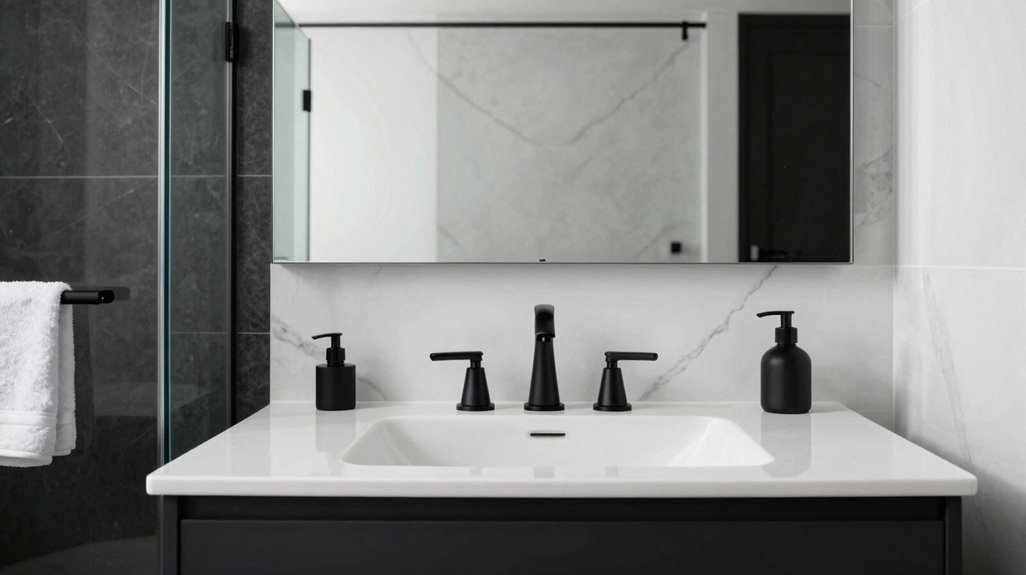
You’ll select your bathroom’s operational mode by committing to one of three functional categories: spa-calm serenity (low-stimulation, marble-focused), graphic-bold statements (high-contrast, pattern-driven), or transitional balance (hybrid elements, mixed-metal compatibility). Each category demands specific material specifications, fixture selections, and spatial arrangements that determine your project’s procurement schedule.
Match your selection to daily usage patterns, maintenance capacity, and resale value requirements before advancing to detailed specification tables.
Spa-Calm Serenity
The spa-calm approach turns a black-and-white bathroom into a functional retreat through deliberate material restraint and spatial clarity. You achieve spa-calm serenity by anchoring your space with white subway tiles on walls and marble surfaces on floors or vanities.
Install a freestanding tub as your focal point, positioning it near natural light when possible. Pair black vanities or fixtures with brass accents to introduce warmth without disrupting monochrome harmony. Build a walk-in shower with frameless glass and floor-to-ceiling tile to maintain visual flow.
Layer your lighting: install dimmable task fixtures, ambient ceiling sources, and accent lights at 2700K for evening relaxation. Add natural textures through wood stools or woven storage. This systematic approach delivers measurable tranquility through controlled contrast and purposeful material selection.
Graphic-Bold Statements
Graphic-bold statements demand precision, not excess, to achieve their high-contrast impact. You anchor this bold vs. graphic tension with a black freestanding tub against white subway tiles, letting brass fixtures punctuate the monochrome field. You scale up with oversized frameless mirrors that amplify spatial drama without clutter.
You layer marble veining and hex patterns to build visual complexity, keeping metallics disciplined: brass or polished nickel only. This high-contrast approach rewards your confidence: every element earns its place.
| Element | Specification | Function |
|---|---|---|
| Tub | Matte black, 67-inch freestanding | Focal anchor |
| Wall tile | White subway, 3×6, stacked | Clean ground |
| Floor | Black hex mosaic, 1-inch | Pattern density |
| Fixtures | Unlacquered brass | Warm punctuation |
| Mirror | Frameless, 48×36 inches | Scale amplification |
Transitional Balance
Transitional Balance
How do you reconcile the tension between stark contrast and quiet restraint? You choose Transitional Balance, and you pick your vibe among three distinct paths: Spa-Calm, Graphic-Bold, or Transitional.
1. Select your direction:
| Vibe | Core Strategy | Key Materials |
|---|---|---|
| Spa-Calm | Muted contrast, white dominance | Marble, soft textures |
| Graphic-Bold | Maximum black-and-white contrast | Graphic tiles, bold patterns |
| Transitional | Balanced hybrid | Subway tiles, brass accents |
2. Execute your plan:
If you want Graphic-Bold, you install herringbone tiles and statement fixtures. If you prefer Spa-Calm, you layer white surfaces with restrained black elements. For true Transitional styling, you combine white square tiles with brass accents and natural wood.
3. Unify your space:
You add brushed brass or matte black taps, floor-to-ceiling mirrors, and layered lighting. These elements bridge your chosen contrast levels, helping your black-and-white bathroom function as a cohesive, sophisticated system.
Match Materials to Your Style: Farmhouse, Modern, or Organic
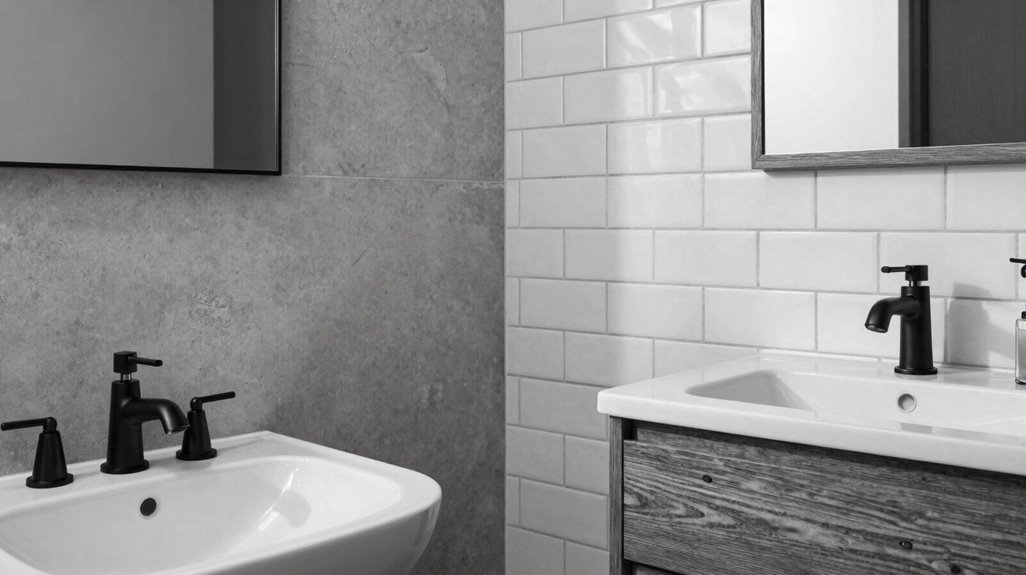
You’ll anchor your farmhouse charm in black shiplap walls, bright-white cabinetry, and honed stone floors, then layer woven baskets and wood towels for essential texture.
For modern edge, you’ll deploy brass fixtures, a black vanity, and white surfaces, centering the space around a black freestanding tub.
Choose your approach based on whether warmth or contrast drives your daily routine.
Farmhouse Charm Essentials
Because farmhouse charm relies on intentional material selection, you’ll need to coordinate every surface, fixture, and accessory with your specific style variant before purchasing anything. Your black and white palette demands balance through wood accents and natural textures that soften stark contrasts. Select warm lighting fixtures between 2700K and 3000K to maintain inviting atmosphere, and install vintage hardware with oil-rubbed bronze or matte black finishes.
Layer woven textures through baskets, rugs, and window treatments to add tactile depth. For modern farmhouse, pair sleek black fixtures with white subway tile and reclaimed wood vanities. Choose organic variants with stone vessel sinks, linen shower curtains, and untreated pine shelving. Document your material selections in a checklist, verifying each element complements your chosen farmhouse expression before finalizing orders.
Modern Edge Elements
Where should you begin when selecting materials for a modern black and white bathroom? Start with your core identity, then execute with precision.
1. Define Your Material Framework
Match your black and white palette to one of three proven structures:
| Style | Vanity | Wall Tiles | Accent Hardware |
|---|---|---|---|
| Farmhouse | Wood vanity | White subway tiles | Matte black fixtures |
| Modern Edge | Floating black vanity | High-contrast tiles | Brass hardware |
| Organic | Reclaimed wood vanity | Natural stone tiles | Brushed nickel |
2. Execute High-Contrast Tiling
Anchor your space with deliberate contrast. Install black floor tiles against crisp white wall tiles, or invert for a strong visual shift. Brass hardware delivers measurable impact against monochrome surfaces.
3. Integrate Transitional Elements
Blend white subway tiles with a black vanity and brass hardware. This achieves timeless function with contemporary precision, solving your design problem through categorical material matching.
Size Your Tile Right for Your Bathroom’s Dimensions
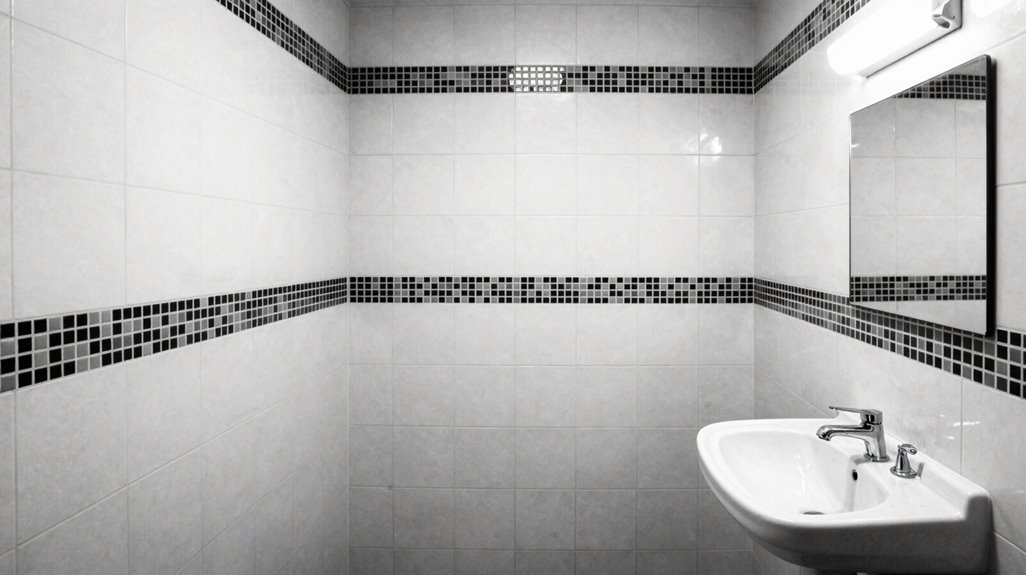
How do you avoid a cramped, chaotic bathroom or one that feels cold and cavernous? You size your tiles right for your bathroom’s dimensions. In Black and White Bathrooms, tile scale determines spatial perception. You select small tiles, such as subway, penny, or mosaic, for compact powder rooms under 40 square feet, where numerous grout lines create visual texture without overwhelming.
You choose medium-format tiles, 12×12 to 12×24 inches, for standard 5×8 foot bathrooms, balancing installation efficiency with proportion. You install large-format tiles, 24×48 inches or larger, for expansive master baths exceeding 100 square feet, minimizing grout and amplifying contemporary sophistication.
You run floor tiles parallel to the longest wall to elongate space. You stack wall tiles vertically to raise ceiling height, or horizontally to widen narrow layouts. You match grout to tile color for a continuous flow, or contrast it for deliberate grid definition. Your bathroom design succeeds when tile dimensions respect spatial boundaries.
Build Depth With Layered Patterns and Textures
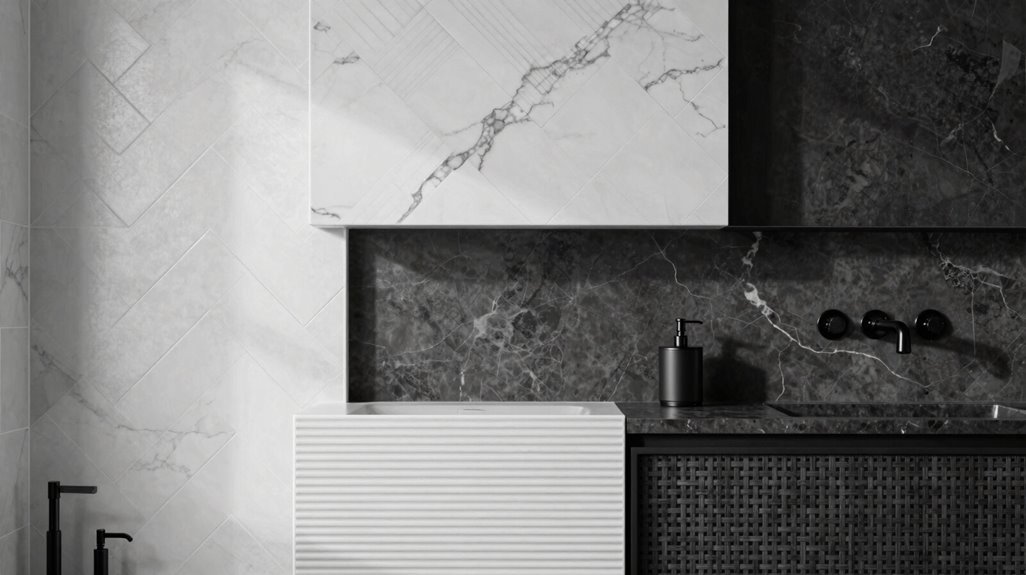
Why does a flat black-and-white bathroom feel lifeless when you’ve matched the colors perfectly? You’re missing depth through layered patterns and texture.
Perfect color matching means nothing without the depth that layered patterns and texture provide.
Start with your foundation: pair black tiles with white tiles in contrasting formats. Install 3×6 subway tiles vertically, then add 1-inch hexagon mosaic as your accent band. You’ll create visual rhythm without chaos.
Next, work with your grout. Choose dark grout with white tiles to define each unit, or light grout with black tiles to soften edges. This single decision changes spatial perception dramatically.
Finally, stack three distinct textures minimum: glossy wall tile, matte floor tile, and woven natural elements. Your contrast becomes dimensional, not just chromatic. The result reads intentional, sophisticated, and complete.
Balance Dark Walls With Warm Wood and Natural Fibers
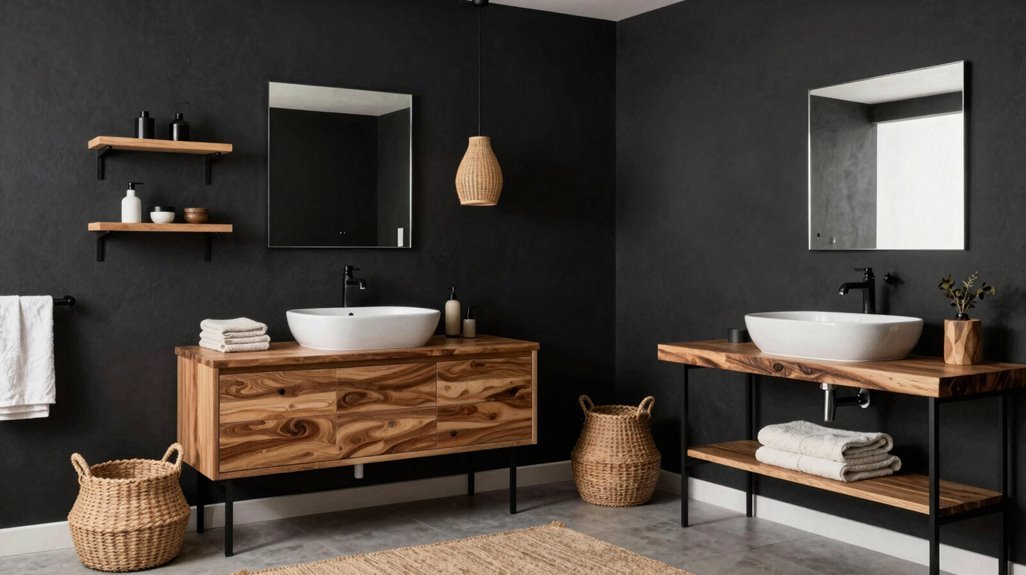
When you’ve committed to black walls, you’re managing a high-contrast environment that risks visual heaviness without strategic intervention. Counter this by introducing warm wood elements that create organic contrast against the monochrome backdrop.
- Install a light oak vanity measuring 36-60 inches wide, or mount floating shelves 8-12 inches deep to break up the expanse of black walls.
- Layer natural fibers throughout your bathroom: woven seagrass baskets (2-3 per room), linen towels in oatmeal tones, and jute or sisal rugs measuring 24×36 inches minimum.
- Add one fresh floral element, hydrangeas in a ceramic vessel, every 5-7 days for subtle color variation.
These textures convert stark contrast into balanced warmth, merging modern moodiness with rustic comfort in your black-and-white bathroom.
Mix Metals That Shine Against Black and White
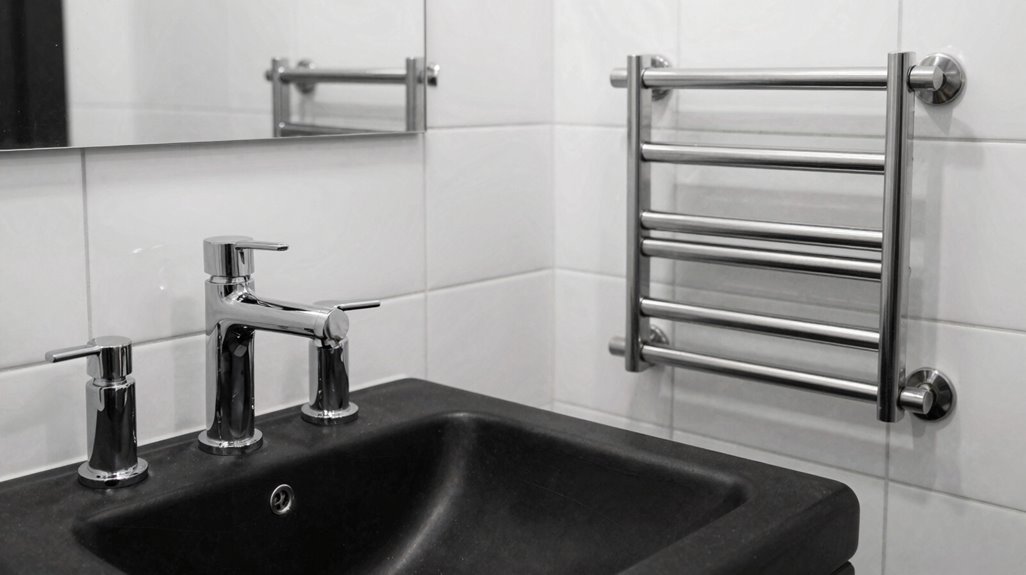
Once you’ve softened your black walls with wood and fiber, you’re ready to introduce metallic elements that amplify the room’s sophistication without overwhelming its restraint. You’ll achieve this by deploying mixed metals across three key zones: vanity hardware, plumbing fixtures, and mirror framing.
Install brass hardware on cabinet pulls and drawer knobs for warmth, then pair polished nickel faucets at every sink to establish visual rhythm. Select frameless mirrors with thin brass or black borders, measuring 24–36 inches wide, positioned 4–6 inches above your backsplash line. This combination anchors your bold monochrome scheme while signaling refined taste.
Your contemporary bathroom gains timeless dimension when you balance 60% cool metals against 40% warm tones, guaranteeing cohesion without uniformity.
Use Marble Veining to Soften Stark Contrasts
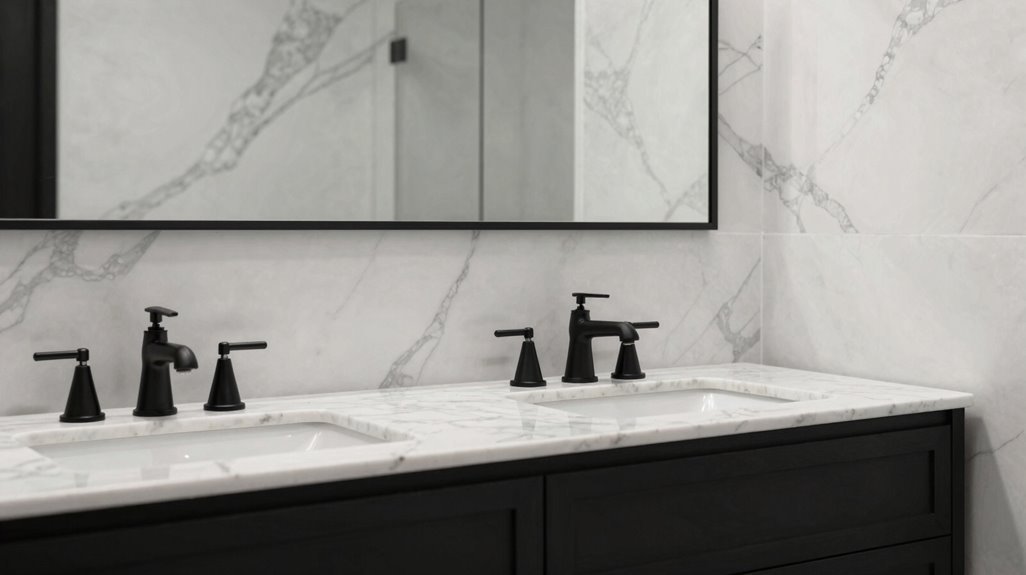
How do you prevent a black-and-white bathroom from feeling flat and clinical? You introduce marble veining, which softens stark contrasts through organic, flowing patterns that break rigid lines.
Veined marble creates a luxurious foundation when you apply it across worktops, splashbacks, or shower walls. White marble slabs with black veins serve as focal accents, or you cover full surfaces for cohesive impact. This material pairs directly with matte black fixtures and brass accents, balancing dramatic tone with refined elegance.
- Feel the calm of natural stone beneath your fingertips each morning
- Sense timeless sophistication welcoming you into an exclusive space
- Experience warmth replacing cold, sterile surfaces
- Discover permanence in a home that reflects your refined taste
- Join those who choose enduring quality over fleeting trends
If cost blocks authentic stone, marble-look porcelain tiles deliver identical veining, superior durability, and accessible pricing.
Make It Feel Like a Spa With Calm Finishes
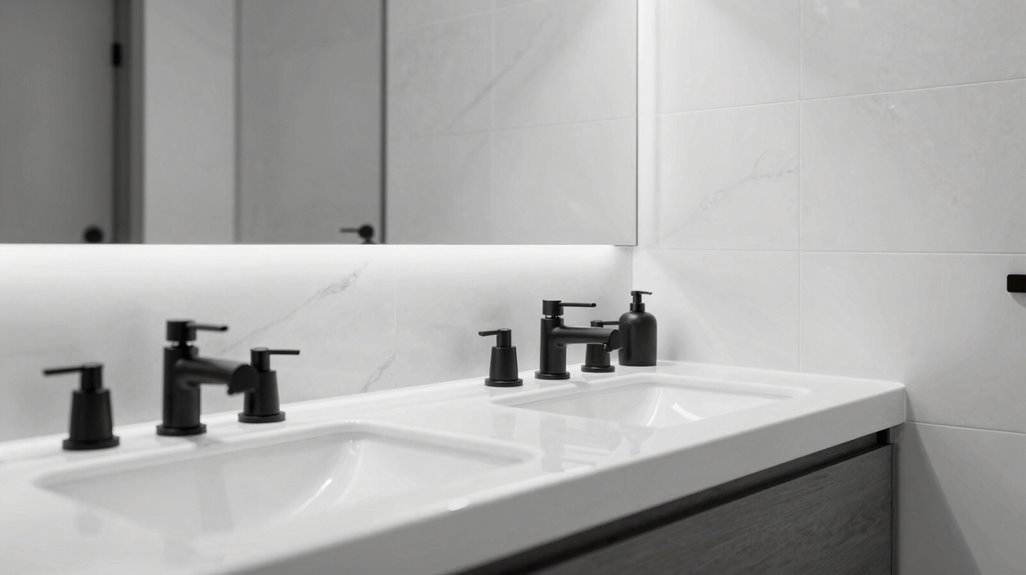
Marble veining softens stark contrasts, but texture and restraint complete the spa transformation.
Texture and restraint transform stark contrast into sanctuary.
- Establish your foundation with white walls and matte surfaces that absorb light rather than reflect it, creating immediate visual quiet.
- Introduce black through honed marble countertops or matte fixtures, limiting accents to 15-20% of visible surfaces to maintain calm finishes.
- Select minimalist hardware in brushed brass or matte black, making certain every element serves function without competing for attention.
- Install integrated storage eliminating countertop clutter, because uncluttered surfaces directly correlate with perceived serenity.
- Layer lighting: combine 3000K ambient fixtures with task lighting at mirrors, plus maximize natural light through sheer treatments.
Your black and white palette becomes a true spa sanctuary when you prioritize material quality over quantity, texture over pattern, and absolute simplicity in every choice.
Go Bold: Floor-to-Ceiling Tile That Commands Attention
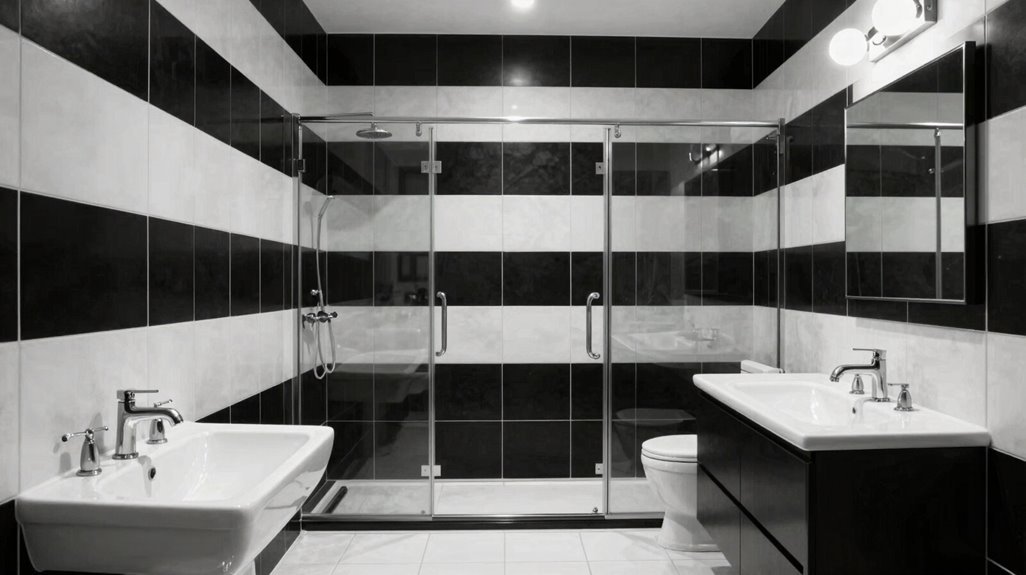
You’ll maximize visual impact when you extend bold tile patterns from floor to ceiling, creating uninterrupted sightlines that amplify spatial perception. Strategic lighting placement turns geometric tile arrangements into dynamic shadow plays, delivering measurable drama without structural modifications.
Coordinate fixture metals and grout widths to your tile’s tonal values, making certain each element reinforces the cohesive, commanding presence you’re building.
Tile Pattern Impact
Why settle for half-measures when you can command the entire vertical plane? You change your monochrome bathroom by extending black and white tiles from floor to ceiling, creating a seamless, expansive canvas that amplifies natural light and delivers showroom-ready sophistication.
Strategic tile patterns anchor your design. You select herringbone tiles for dynamic movement, or deploy geometric tile design for architectural precision. High-contrast decor demands intentional pairing: black herringbone floors against crisp white walls establish bold geometry, while brass fixtures introduce warmth and cohesion.
You maintain balance through restraint; neutral vanities, frameless mirrors, and minimal textiles allow your statement surface to dominate without visual competition.
- Feel the expansive calm of uninterrupted vertical surfaces surrounding you
- Experience the quiet confidence of deliberate, measured contrast
- Claim your place among discerning designers who understand proportional impact
- Savor the daily ritual within a space that reflects your exacting standards
- Join the community who recognizes that true luxury lives in disciplined editing
Visual Drama Techniques
How do you turn a functional shower into a commanding architectural statement? You install floor-to-ceiling tile across every surface, creating a gallery-like focal point that commands immediate attention. This technique maximizes visual drama through high-contrast black and white tiles arranged in precise, repetitive patterns.
| Element | Function |
|---|---|
| Floor-to-ceiling tile | Expands perceived height, unifies surfaces |
| Long windows | Amplify natural light, reduce shadow depth |
| Polished nickel fixtures | Unify monochrome palette, add reflective warmth |
You achieve transitional balance by pairing bold tile work with minimal vanities and calculated negative space. The monochrome palette requires disciplined coordination: select fixtures that echo tile tones exactly.
Natural light becomes your essential tool, turning geometric patterns into dynamic, shifting compositions throughout daylight hours.
Light It Right and Sneak In Color, Art, and Quirky Moments

Where exactly does a black-and-white bathroom risk falling flat? You’ll lose dimension without proper lighting, color accents, art, and texture working together. Layer your lighting: task, ambient, and accent, with dimmers to shift from bright morning routines to spa-like evenings. Add color accents through a vanity in deep green, bold red, or navy, or use brass fixtures for instant glam. Hang art that complements your black and white scheme, extending pieces onto walls for immersion. Incorporate texture with fluted furniture, brass taps, or matte black hardware. These elements create belonging through personalized, high-end spaces without full renovation.
A black-and-white bathroom risks falling flat without layered lighting, bold color accents, curated art, and tactile textures that create dimension and belonging.
- Illuminate your sanctuary with purpose, turning daily rituals into moments of intentional calm
- Forge connection through curated brass and color that whispers your unique story
- Discover belonging in textures that invite touch and quiet recognition
- Anchor your identity with art that mirrors your inner landscape
- Claim space as yours through layered light that adapts to your emotional rhythms