
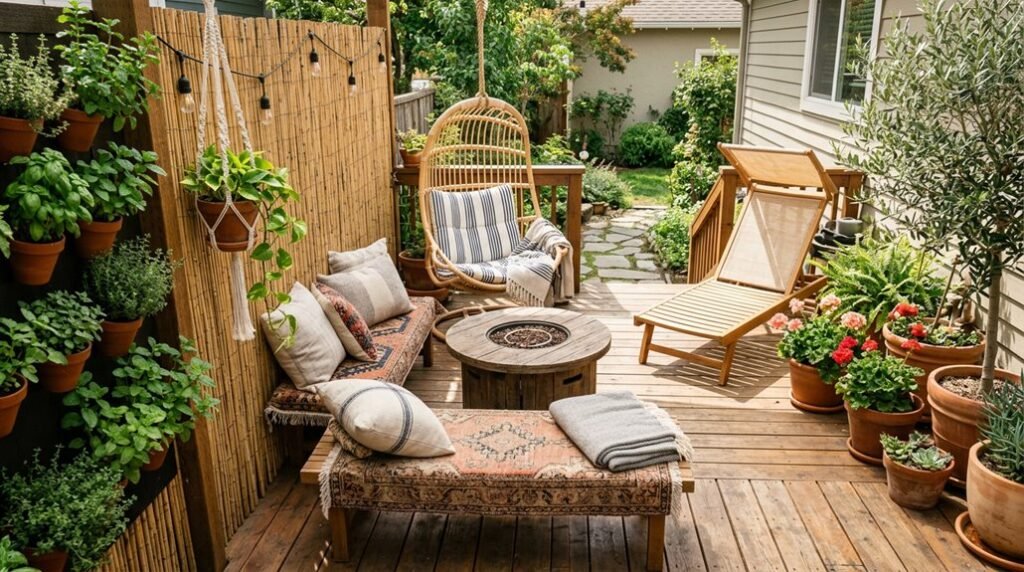
You’ve likely walked past a porch that felt instantly welcoming without knowing exactly why. This isn’t coincidence; it’s intentional spatial organization. Your outdoor space demands the same systematic approach you’d apply to any functional area of your home.
You’ll need precise measurements, material specifications, and sequential implementation steps to achieve measurable results. Here’s how you change that underused square footage into a structured, purposeful extension of your living environment, starting with demolition, not decoration.
Clear and Prep Your Small Front Porch First
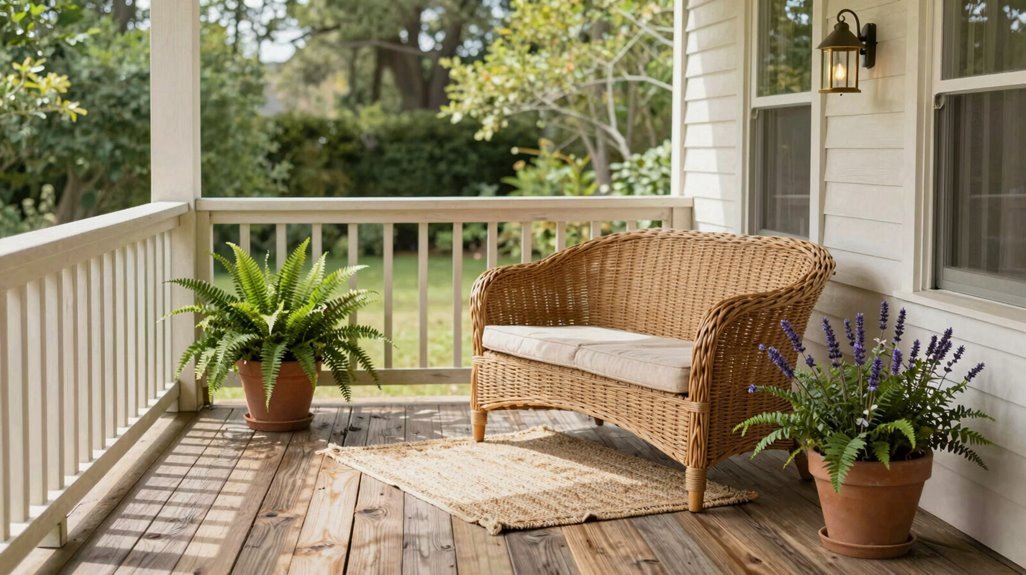
Before you select paint swatches or browse catalogs for statement chairs, you must systematically clear and prepare your small front porch as the foundational step that determines every subsequent decision.
- Remove all debris, dust light fixtures, sweep cobwebs, and clean glass on doors or windows.
- Keep your design simple: select 2-3 well-chosen pieces, not 6-8 decorative items.
- Choose scaled furniture under 30 inches wide; rocking chairs, accent tables, or benches work well. Avoid oversized sectionals exceeding 42 inches.
- Mirror elements symmetrically: place identical planters or chairs 18-24 inches from each door side for visual balance.
- Install adequate lighting: wall-mounted sconces 66 inches high or solar path lights spaced 6-8 feet apart.
Your small space rewards restraint. Each intentional choice creates cohesion, establishing your front porch as an organized, welcoming threshold that neighbors recognize and remember.
Paint Your Front Door a Bold New Color
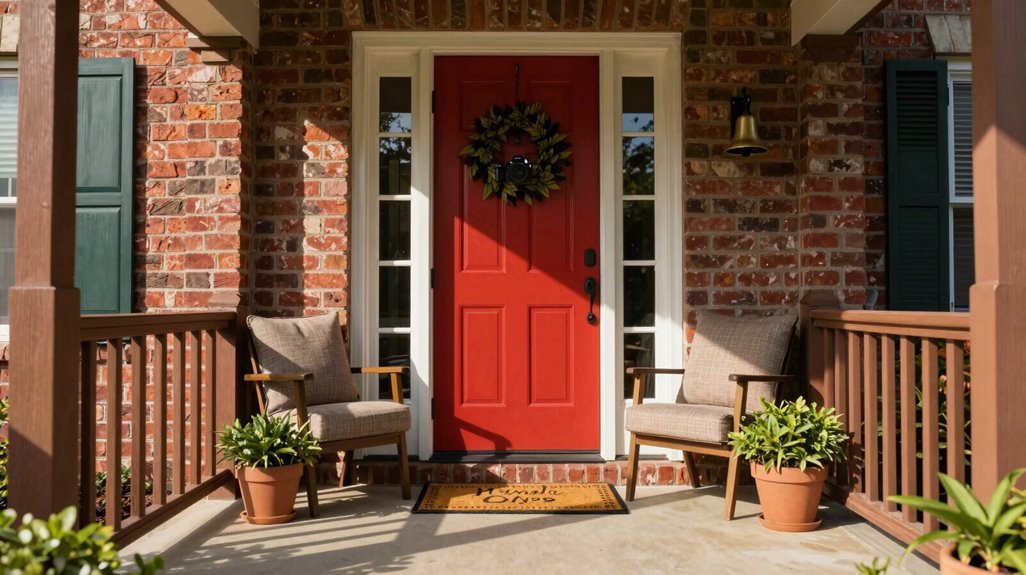
You’ll give your porch’s curb appeal a boost by selecting a bold hue that taps into how colors affect mood, since warm reds stimulate welcome while cool blues project calm authority. Implement a seasonal refresh strategy by scheduling repainting every 2-3 years. Coordinate your door’s saturation level with exterior accents like planters and pillows for unified visual order. Prioritize high-visibility, lighter shades if your entryway lacks adequate lighting. This approach balances pleasing looks with practical safety.
Color Psychology Impact
Because your front door controls the first impression your home makes, repainting it delivers measurable curb appeal gains within a single afternoon. Brighter, lighter colors improve nighttime visibility by 40%, turning your entry into an inviting beacon after sunset.
Bold door colors function as design anchors, coordinating with porch pillows, rugs, and accessories to establish visual cohesion. Your color selection signals personality type: deep blues project trustworthiness, vibrant reds convey energy, while sage greens suggest welcoming calm.
Apply the 3-color rule: repeat your door’s primary hue through planters, cushions, and trim details within 15-foot sightlines. Coordinate with existing railings and architectural elements to prevent visual dissonance. Uniform color storytelling creates intentional, connected spaces that signal membership in a design-conscious community.
Curb Appeal Boost
You must coordinate your chosen shade with existing exterior colors, trim, siding, and architectural details, to achieve cohesive balance. You enhance perceived property value through this single, high-impact modification.
| Element | Assessment Criteria | Recommended Action |
|---|---|---|
| Trim color | Contrast ratio with proposed door shade | Select complementary, not competing, tones |
| Siding hue | Undertone warmth or coolness | Match undertone family for unity |
| Architectural style | Historical or contemporary classification | Research period-appropriate palettes |
| Natural light exposure | Hours of direct sun daily | Choose fade-resistant exterior formulas |
You complete this change in one weekend with proper preparation, primer, and two finish coats.
Seasonal Refresh Strategy
With your exterior colors now balanced against trim and siding, the door itself becomes your next leverage point for measurable impact. You’ll give your porch a real boost by painting your front door a bold new color, reflecting your home’s character while improving visibility from the street.
Outdoor decorating demands strategic coordination. Porch ideas work best when your door serves as the foundation for the entire design scheme.
Implement this three-step refresh:
- Select a color 2-3 shades deeper or brighter than your current palette, making certain it contrasts against siding within 60-90 minutes of painting time.
- Pair your painted door with glass inserts or woodgrain finishes, completing installation in 4-6 hours for enhanced exterior appeal.
- Coordinate rugs, pillows, and planters within 48 hours, using your door color as the categorical guide for all accessory selections.
Choose Furniture That Fits Tight Spaces
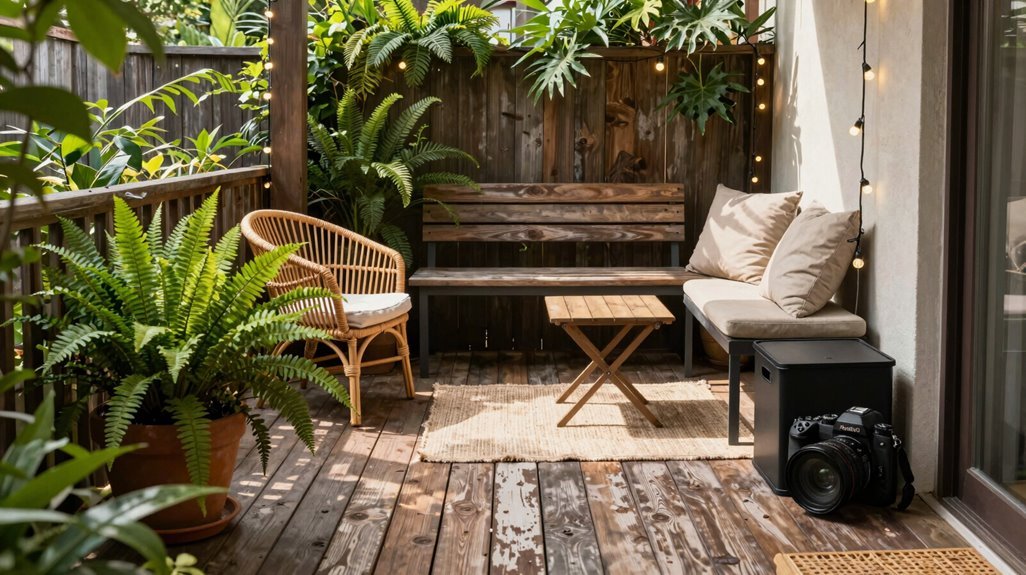
You’ll maximize your porch’s utility by selecting furniture scaled to your square footage, avoiding bulky sectionals that consume 40% or more of available floor space. Choose compact alternatives: rocking chairs under 24 inches wide, nesting tables, or wall-mounted benches, to preserve circulation paths of at least 36 inches.
Prioritize pieces with slim profiles and dual functions, ensuring every item earns its placement through measurable spatial efficiency.
Scaled Pieces Matter
Because every square foot counts on a compact porch, selecting appropriately scaled furniture determines whether your space feels open or overcrowded. In upscale porch design, you’ll prioritize scaled pieces that maximize function without consuming precious floor area.
Implement these three strategies:
- Choose a 24-inch-wide rocking chair or 16-inch accent table instead of standard-sized alternatives.
- Select benches under 48 inches long, leaving 36 inches of clearance for movement.
- Incorporate decorative railings and color accents when furniture exceeds spatial limits.
Pair each item with simple, unobtrusive lines. Group your selections thoughtfully, maintaining 18 inches between pieces to preserve conversational flow. You’ll turn tight quarters into an inviting retreat.
Avoid Bulky Items
How do you prevent a compact porch from feeling suffocated? You skip the oversized sectionals and select scaled pieces sized for your small outdoor space. Choose a single rocking chair, slim accent table, or narrow bench that leaves breathing room around each edge.
In ultra-small areas, you enhance decorative railings, apply strategic color accents, or highlight architectural details instead of adding furniture. You establish symmetry by placing matching chairs or planters on each side of your door, creating balanced sightlines that expand visual territory.
When you group seating for conversation, limit yourself to two or three carefully selected pieces. You maintain openness by selecting lightweight designs with simple profiles and unobtrusive finishes. Each choice preserves precious floor area, helping your small outdoor space feel organized, accessible, and welcoming.
Maximize Floor Space
Once you’ve cleared away bulky pieces, you’re ready to select furniture that respects your porch’s footprint. On a small porch, you’ll maximize space by selecting scaled pieces that maintain openness, rather than crowding with oversized items.
Choose compact seating, small benches, rocking chairs, or accent tables, and arrange them in conversational groupings without blocking pathways.
Apply symmetry by mirroring chairs or planters on each side of your door, creating visual balance that reduces perceived clutter.
Unify your palette through repeated colors in pillows, planters, and accessories, establishing cohesion that expands perceived boundaries.
For extremely tight areas, prioritize lighting and bold color accents, such as a turquoise door, to create focal points without consuming floor space. These strategic choices turn constraints into functional, welcoming environments.
Use Symmetry to Make Your Porch Feel Larger
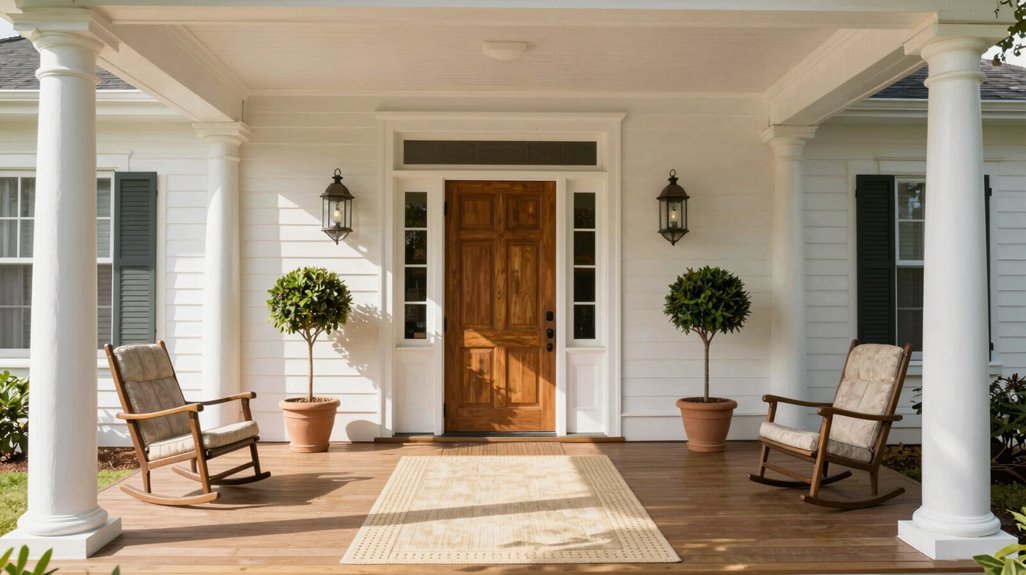
When you’re working with limited square footage, mirroring identical elements across your porch’s central axis creates instant visual equilibrium that expands perceived depth. You achieve this by placing two matching chairs flanking your door, with identical side tables and paired planters completing the arrangement. This symmetry eliminates visual clutter, replacing chaotic spacing with deliberate, balanced proportions that read as purposeful planning rather than crowded afterthought.
You’ll find that consistent finishes, matching wood tones, unified metal colors, and coordinated cushion patterns, reinforce cohesion across your entire porch. The eye travels smoothly between mirrored points, creating horizontal lines that widen your perceived boundaries. Pair your elements precisely: two 24-inch planters at 36-inch intervals, twin seating at equal distances from center. This measured repetition converts cramped quarters into orderly, welcoming thresholds that invite you home.
Ground the Space With an Outdoor Rug
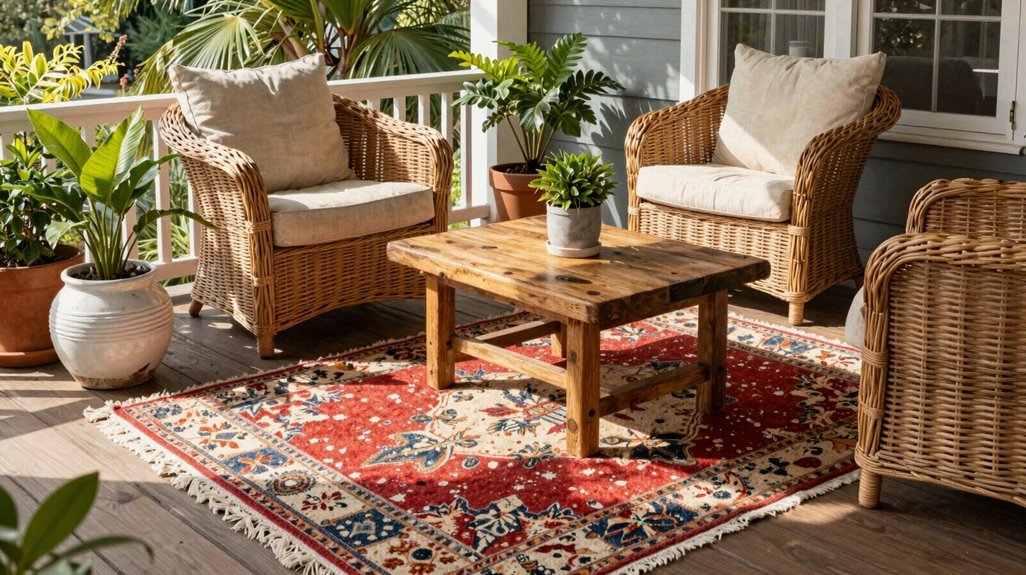
Where should your eye land first when stepping onto your porch? Ground it with an outdoor rug, one of the most effective porch decorating ideas for creating immediate cohesion.
An outdoor rug anchors your seating, contributes to a unified aesthetic, and brings together your entire color story. You don’t need to overspend: plenty of economical options exist, or you can DIY-paint or thrift a rug that feels authentically yours.
When selecting your outdoor rug, follow these steps:
- Measure your seating area precisely, allowing 12-18 inches of exposed flooring around the rug’s perimeter
- Coordinate with your home’s exterior colors to maintain visual continuity
- Position complementary pillows and throws adjacent to your rug, enhancing underfoot comfort without layering textiles
Consider stencil-painted deck patterns as an alternative when traditional rugs won’t suit your space’s conditions.
Layer in Weatherproof Textiles for Comfort
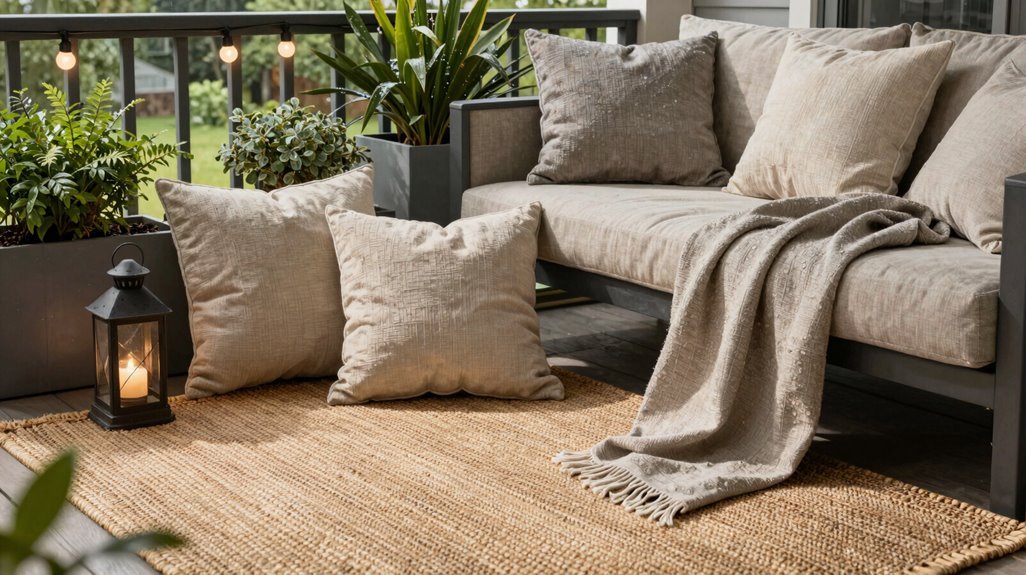
Your rug establishes the foundation, but weatherproof textiles build the comfort layer that changes your porch from a pass-through space into a lived-in retreat. You add throw pillows, blankets, and cushions designed for weather exposure, creating warmth without sacrificing durability. Limit yourself to 2–3 pillows on small porches to prevent clutter while maintaining cohesion.
You anchor seating areas with outdoor rugs that define zones and deliver color plus texture underfoot. Pull hues from your home’s exterior into your outdoor textiles to create an intentional, connected palette. Swap textiles seasonally: holiday pillows in December, lighter patterns in March, to refresh without redesigning.
| Textile Element | Function |
|---|---|
| Throw pillows | Add comfort, limit to 2–3 pieces |
| Outdoor blankets | Provide warmth, store when wet |
| Weatherproof cushions | Support seating, resist moisture |
| Seasonal covers | Refresh space quarterly |
Add Plants Without Sacrificing Floor Space
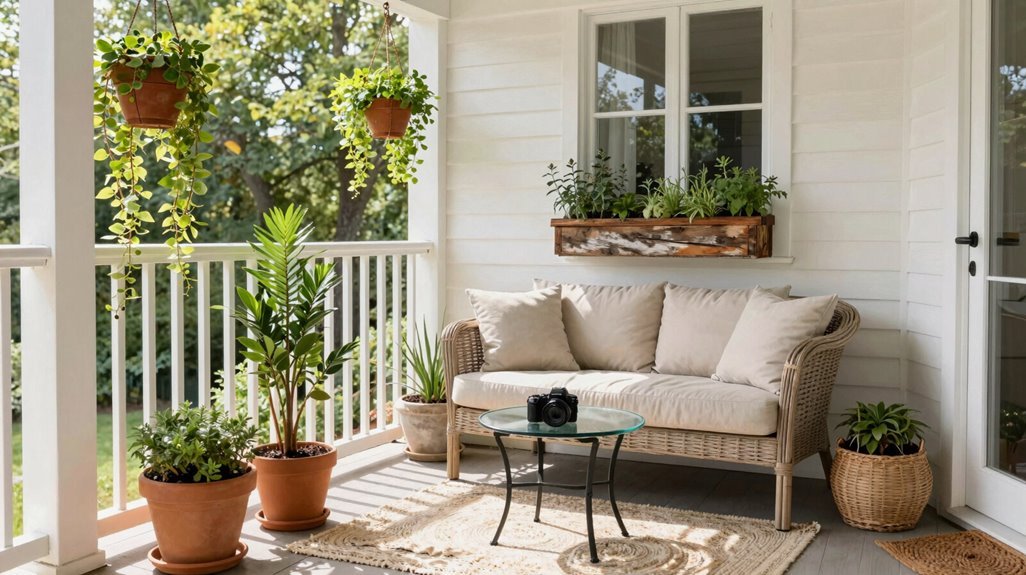
Container plant arrangements solve the problem of limited square footage by delivering lush, defined borders without expanding your floor plan. You achieve this space-saving strategy through strategic placement of potted plants along edges, near doors, or clustered in corners, maximizing visual impact while preserving seating and traffic flow.
Container plants deliver lush borders without expanding your floor plan—strategic placement maximizes visual impact while preserving every square foot of functional space.
- Position hostas in 12-16 inch pots for reliable spring foliage returns, creating vibrant green anchors that survive season after season.
- Group palms and ferns in 3-5 container clusters along porch perimeters, generating tropical texture without floor obstruction.
- Mirror earthbound planting beds by arranging potted plants at varying heights, 6, 12, and 24 inches, establishing layered depth from minimal footprint.
These container configurations deliver defined borders, fresh atmosphere, and functional outdoor living. You turn constrained porches into lush retreats through measured, deliberate plant placement.
Add Decorative Molding and Trim Details
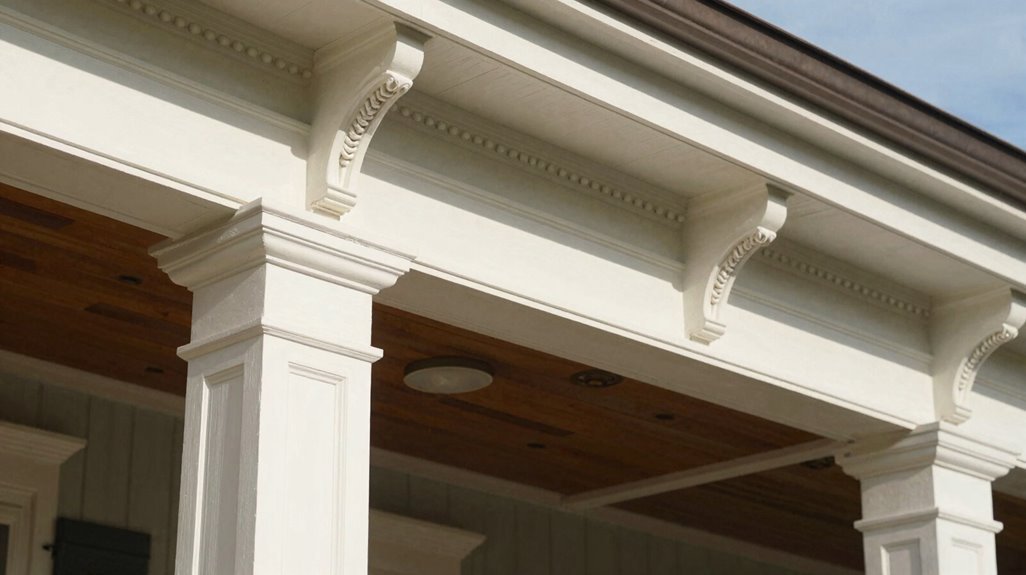
You can boost your porch’s perceived value by strategically placing trim around windows, doors, and rooflines, selecting weather-resistant materials like PVC or fiber cement that withstand 20-year exposure cycles without warping. Coordinate your trim color with existing railings and doors using a 60-30-10 distribution rule: 60% dominant siding, 30% secondary trim, 10% accent. This establishes visual hierarchy and architectural cohesion.
Prioritize vertical trim installations on compact porches under 80 square feet. These draw the eye upward, compensate for limited floor plans, and create rhythmic proportion without costly structural modifications.
Trim Placement Options
Where exactly should trim go to maximize impact without overwhelming your porch’s proportions? You need strategic placement that emphasizes symmetry and balance, especially on compact porches. Trim accents work both indoors and outdoors, framing doors, windows, and railings with architectural precision. You’ll create visual cohesion by selecting pieces from local stores that complement existing materials.
Consider these placement strategies:
- Frame your entry door with 4-6 inch header trim and matching pilasters to establish focal hierarchy within 2-3 hours of installation.
- Accent window perimeters using 3-4 inch molding, positioned 1/2 inch from sash edges to create shadow lines that define structure.
- Highlight railing posts with 1×4 vertical trim, spaced 12-16 inches on center, changing standard builders’ grade into custom appearance.
Updated trim delivers durable, low-maintenance enhancement that improves curb appeal through deliberate, measured application.
Material Selection Guide
How should you choose trim materials that withstand exterior exposure while delivering the refined detailing your porch demands? You start by evaluating cellular PVC, composite, and treated wood options against your regional climate conditions. Cellular PVC resists moisture, insects, and temperature fluctuations without warping or rotting, making it ideal for humid or coastal porch installations. Composite materials blend wood fibers with polymer resins, offering dimensional stability and minimal expansion contraction cycles. You avoid untreated lumber unless you commit to annual sealing regimens and replacement timetables.
You source architectural trim from local suppliers, selecting profiles between 3 to 8 inches in width for posts, headers, and frieze boards. You prioritize factory-primed products to reduce field preparation time. You measure each porch surface twice, calculating 10% overage for cuts and waste. You fasten trim with stainless steel finish nails, spacing fasteners 16 inches on center. You seal all end grain and miter joints with exterior-grade adhesive caulk.
Color Coordination Tips
Once you’ve secured your trim materials and fastening systems, you’re ready to establish the visual hierarchy that governs your porch’s color relationships. Color coordination demands repetition of 3-5 core hues across textiles, containers, and architectural accents to unify your space. A turquoise door functions as your dominant anchor, commanding attention while secondary tones support without competing.
Execute these color coordination strategies:
- Select turquoise as your primary focal point, applying it to doors or major trim elements within 24-inch sight lines from the street.
- Repeat accent colors at 3-foot intervals through pillows, planters, and florals to maintain visual rhythm.
- Balance bold saturation with 60% neutral surfaces, keeping molding details visible without overwhelming your composition.
This systematic approach turns scattered elements into cohesive, welcoming environments.
Light Your Small Porch for Evening Use
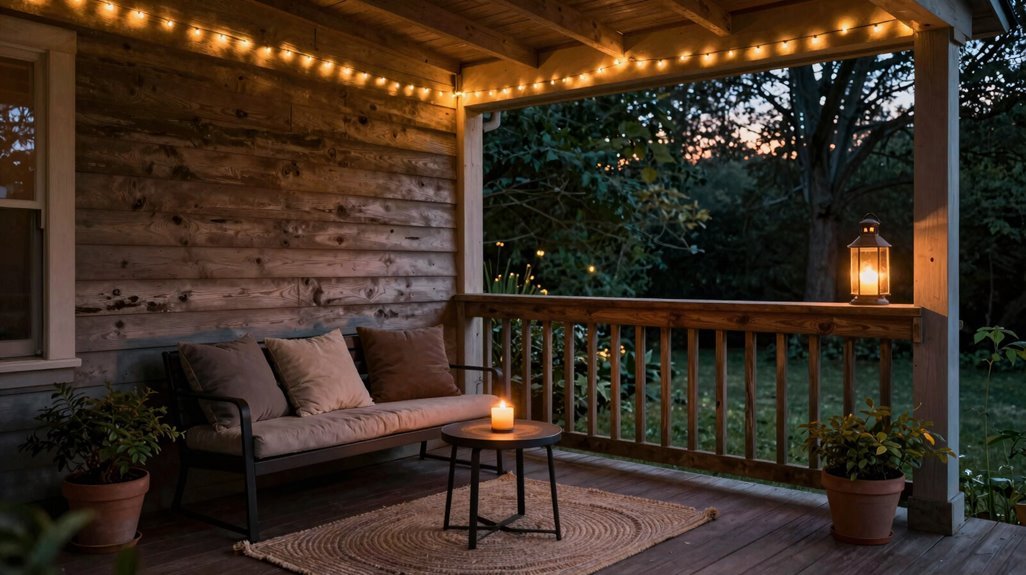
Because evening hours extend your porch’s utility by 4-6 hours daily, you’ll need strategic lighting that eliminates shadows while maintaining energy efficiency.
1. Layer Your Illumination Sources
Install three complementary porch lighting types: overhead fixtures (15-25 lumens per square foot), wall sconces at 66-inch mounting heights, and low-voltage landscape lighting along pathways. This layered approach distributes light evenly, reducing contrast ratios below 3:1 for visual comfort.
2. Select Appropriate Exterior Lighting Temperatures
Choose 2700K-3000K color temperatures for residential applications. These warm tones enhance rendered colors of painted surfaces, including front door finishes in lighter hues that improve nighttime visibility by 15-30%.
3. Address Enclosed or Dark Exteriors
If your porch sits within shadowed architectural recesses, increase fixture quantities by 25% and supplement with reflectors. Verify all exterior lighting carries wet-location ratings for durability.
Rotate Pillows and Decor by Season
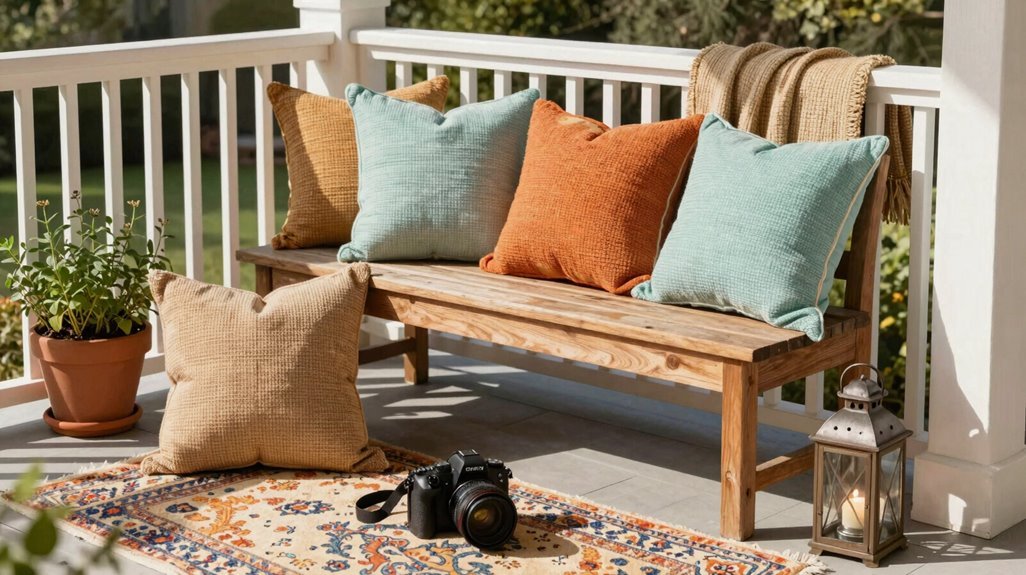
Why let your porch stagnate when four annual refreshes cost less than $150 each? Rotating pillows and decor by season keeps your outdoor space feeling current, collected, and distinctly yours.
Execute this seasonal porch decor strategy through three measured actions:
- Store two complete pillow-and-throw sets in vacuum bags, rotating every 12-16 weeks to maintain visual momentum
- Anchor each season to your existing exterior palette, selecting 3-4 coordinating textiles that complement your siding, trim, and flooring
- Invest exclusively in outdoor-rated, lightweight fabrics, guaranteeing 10-minute swaps without storage bulk or weather damage
You reinforce continuity by repeating core colors across planters, rugs, and pillows while shifting accent tones. This systematic approach delivers professional results without designer fees, establishing your porch as a space that evolves with intention.