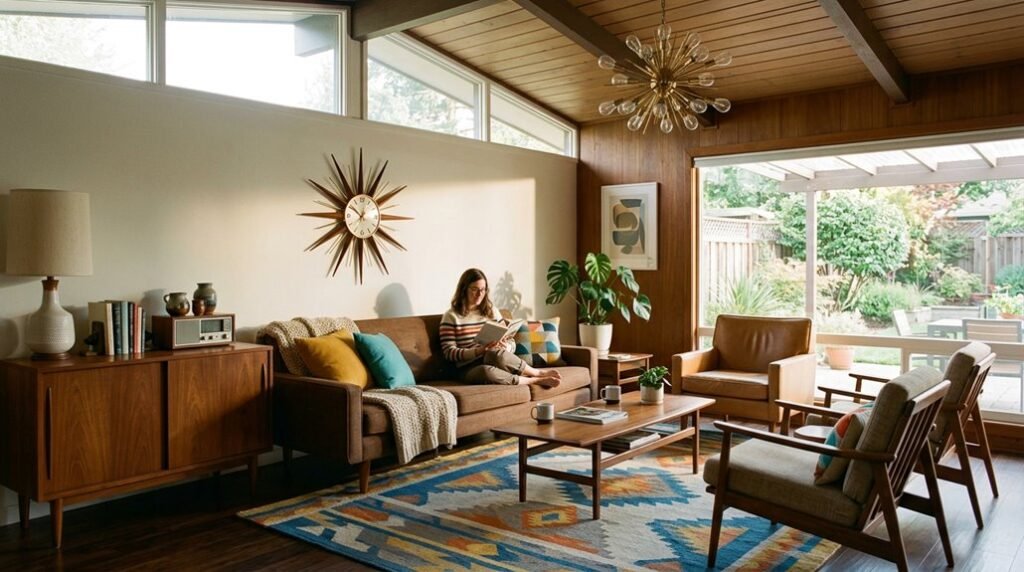
You need a living room that functions, not just looks good. These five strategies solve common layout failures, material mismatches, and spatial inefficiencies that plague mid-century attempts. Each tip includes precise measurements, material specifications, and placement rules you can execute today.
The first mistake most people make? They’ll never fix it without understanding visual hierarchy.
Choose a Mid-Century Rug That Grounds the Room
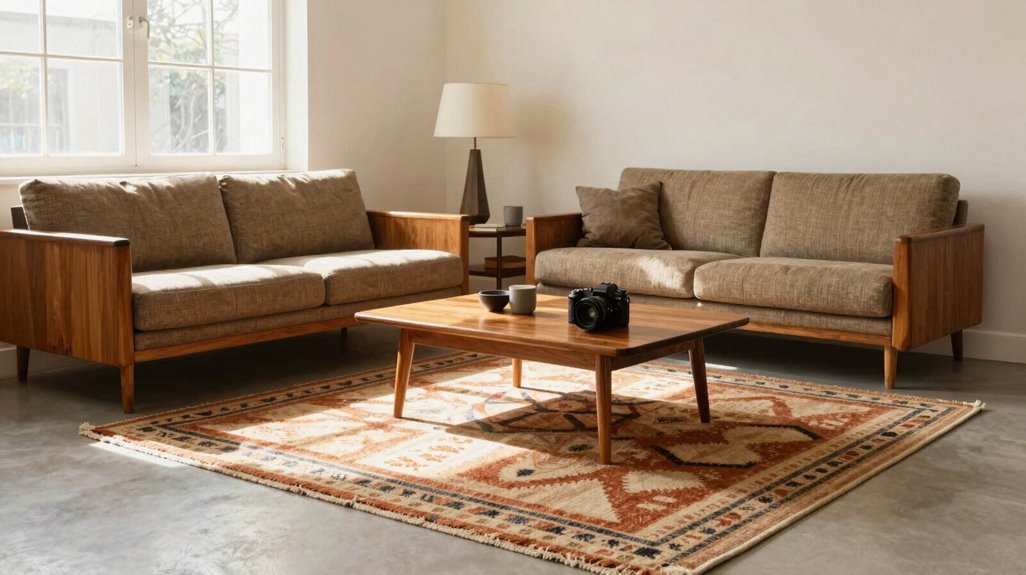
You’ll anchor your mid-century living room by selecting one prominent rug that establishes visual hierarchy before introducing any secondary layers. A well-chosen mid-century rug creates the foundation for grounding room design, directing traffic flow and defining zones within your open-plan layout.
Anchor your mid-century living room with one prominent rug that establishes visual hierarchy before adding any secondary layers.
Select patterns that complement warm wood tones and neutral base furniture, letting accent pops from chairs or pillows command attention. Your cohesive design depends on rug placement that keeps 18-inch walkways unobstructed.
- Measure your seating area, then choose a rug extending 6-12 inches beyond furniture edges
- Prioritize texture balance through strategic rug layering: place your larger base rug first, then add one smaller, complementary piece for depth
This methodical approach delivers practical results without visual clutter, creating spaces where you’ll feel at home.
Anchor With Warm Wood Foundations
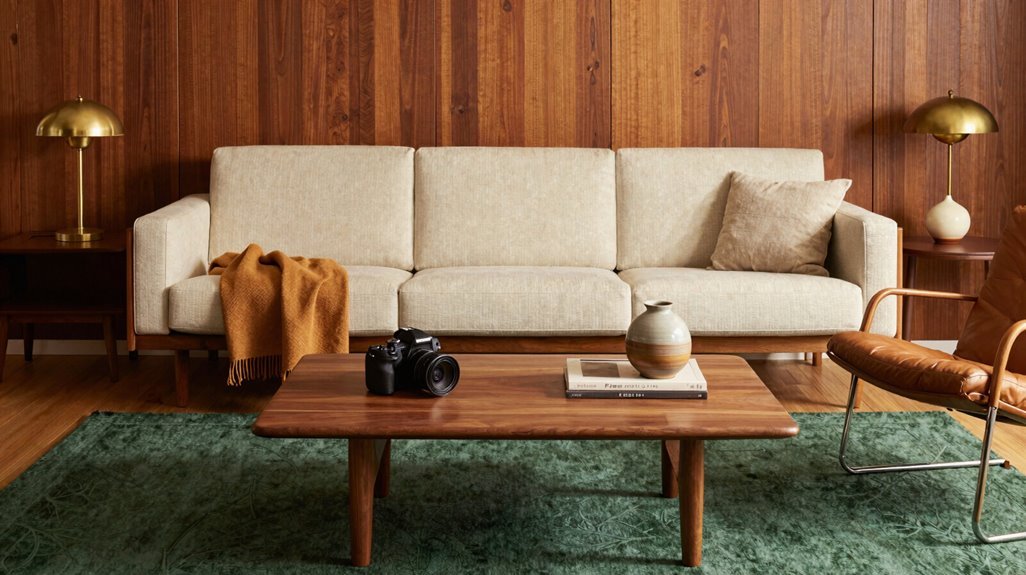
With your rug positioned to establish spatial boundaries, turn your attention to the structural core of mid-century design: warm wood foundations. You’ll anchor your entire space by selecting wood-based furniture—teak credenzas, walnut side tables, oak shelving—that unifies separate zones into one cohesive design. These natural materials create your neutral base, versatile enough for future color accents while maintaining visual calm.
You must balance with contrasting materials, pairing organic wood curves against metal legs, glass tops, or crisp upholstery to achieve authentic mid-century depth without heaviness.
Picture your foundation through these elements:
- A teak floating credenza spanning 72 inches, its warm grain drawing every vintage piece together
- Tapered walnut legs on your sofa, lifting the frame 7 inches from a neutral base rug
- A 1960s oak room divider, its slatted construction filtering light through natural materials
- One saffron ceramic lamp sitting atop your wooden surface, your single bold retro accent waiting to activate the scheme
Activate Neutrals With One Retro Color Pop
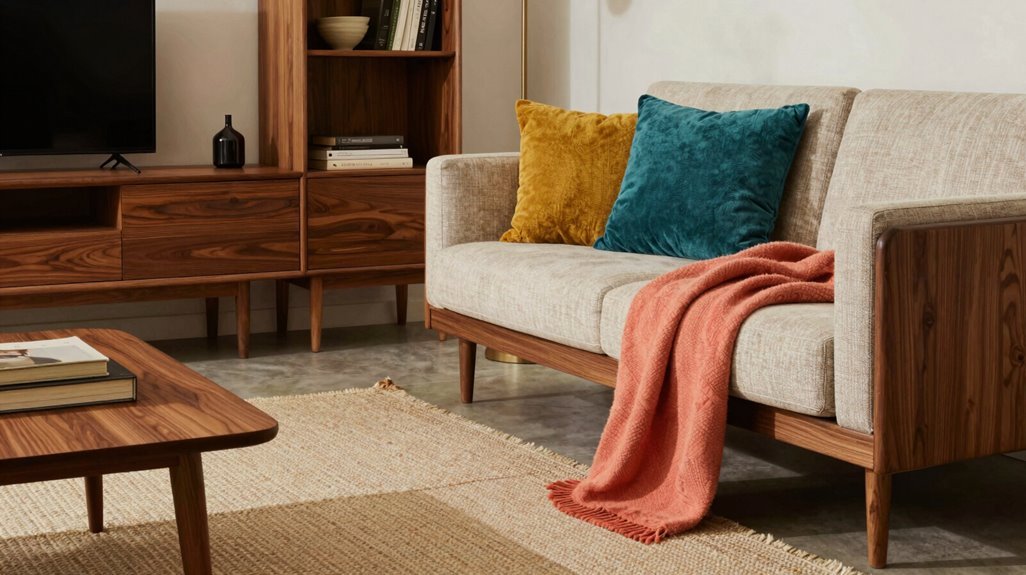
Your neutral foundation demands activation through strategic color intervention. You’ve built your mid-century living room on warm wood and a neutral base, and now you’ll inject energy through one deliberate color pop.
Select a single retro color; mustard or burnt orange work exceptionally well, and deploy it across one or two anchor pieces. You’ll place a mustard chair against your neutral backdrop, or layer burnt-orange cushions onto a streamlined sofa with clean lines and simplified forms.
This approach prevents visual chaos while establishing clear focal points. You’ll maintain balance by keeping bold accents sparse against your muted neutrals, preserving that timeless mid-century modern aesthetic.
Echo your chosen retro color through small accessories; throws, pillows, or framed art, to weave cohesive decor throughout the space. You’re not decorating randomly; you’re solving an organizational challenge with precision, creating harmony between restraint and expression.
Arrange Pieces at Varied Heights and Shapes
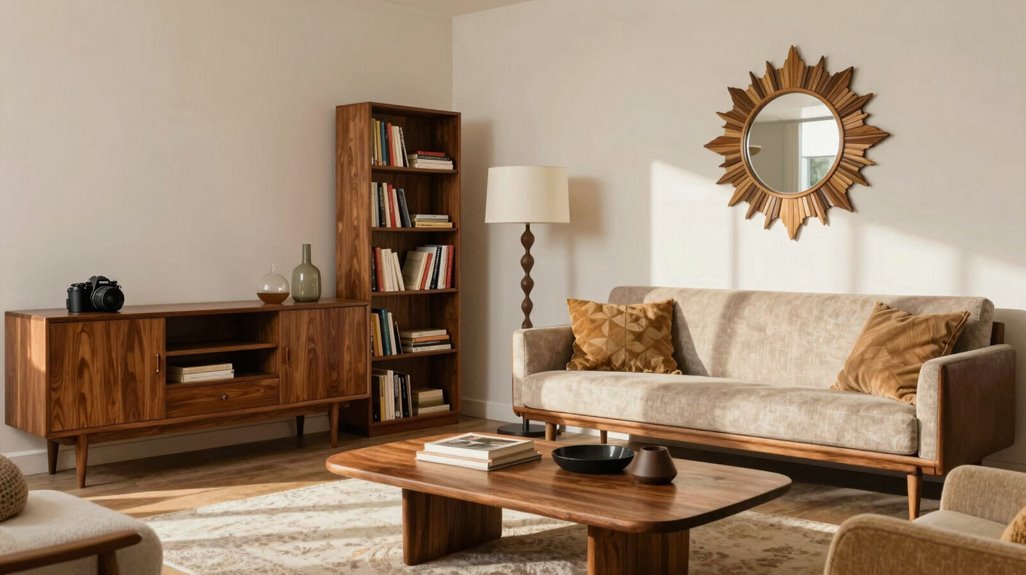
Now that you’ve established color discipline through your single retro accent, you’re ready to solve the spatial composition puzzle. You’ll create visual rhythm by arranging mid-century modern pieces at varied heights, preventing flat, uniform arrangements. Layered seating establishes dynamic elevation changes, while a floor lamp arcs overhead to anchor vertical space.
Position a sculptural furniture piece, like an egg chair, beside geometric pieces such as boxy cabinets. Pair curved forms, including kidney-shaped tables, with straight-lined credenzas for balanced tension.
Stagger console-height storage, mid-height coffee tables, and standard seating across three distinct elevations. Maintain open sightlines through an uncluttered layout that staggers media consoles and seating for easy flow.
This systematic approach delivers sophisticated spatial organization without sacrificing accessibility.
Let Mid-Century Forms Breathe in Open Space
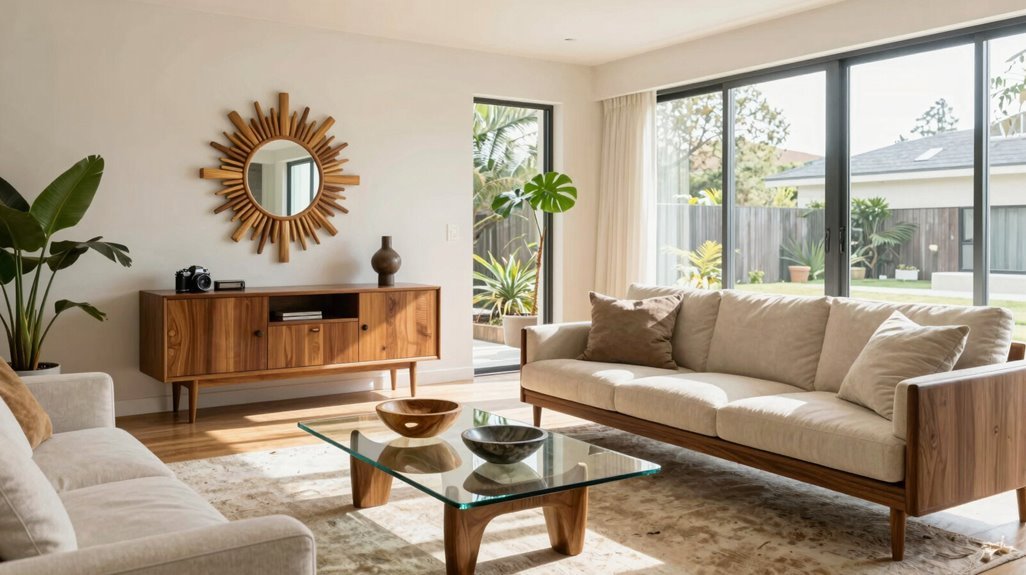
Once you’ve solved the spatial composition puzzle through varied heights, you’ll tackle the breathing room challenge that defines authentic mid-century modern environments. Mid-Century Modern design demands open space, so you’ll prioritize open-plan layouts with clear sightlines and minimal visual obstruction.
You’ll anchor your uncluttered room with natural materials, specifically warm wood tones in teak or walnut, allowing bold furniture to command attention without competition. Your clean lines and sculptural silhouettes need physical space to register fully, so you’ll maintain 36-48 inches between seating pieces.
You’ll balance organic curves against straight lines, pairing one statement piece with two understated companions. This measured approach prevents crowding while preserving flow.
Your checklist:
- Keep surfaces 70% clear
- Position seating for conversation, not screen-viewing
- Limit accent colors to two per zone