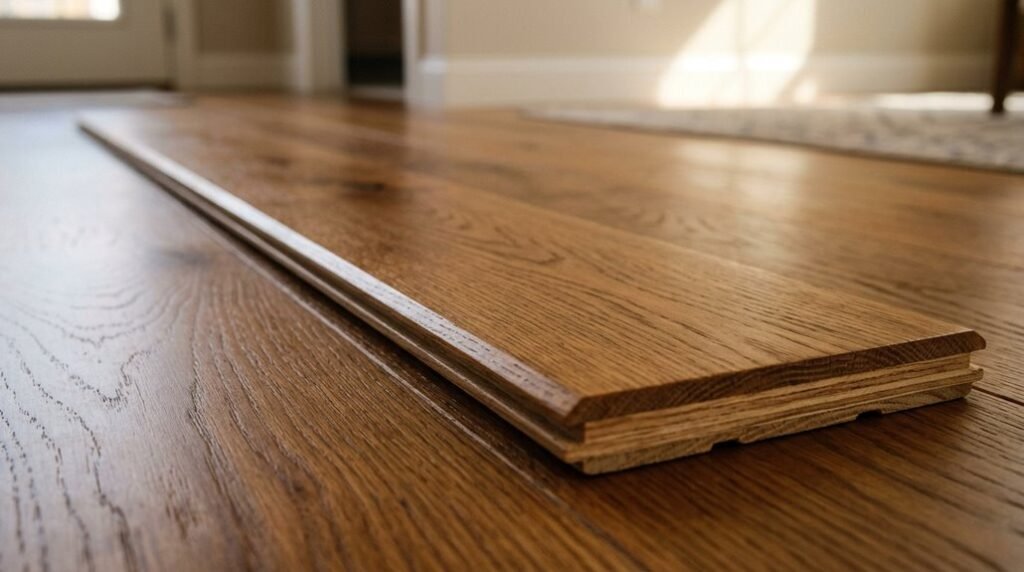
You run your hand across a floor that looks like solid oak, but you’re standing on layers of plywood fused beneath a 2-to-6-millimeter hardwood veneer. That cross-banded core locks out moisture, letting you install planks where solid wood would warp.
You’ll need to know exactly how these layers determine where you can place them, how long they last, and what you’ll pay before you make your choice.
How Engineered Hardwood Is Built: Core, Veneer, and Stability
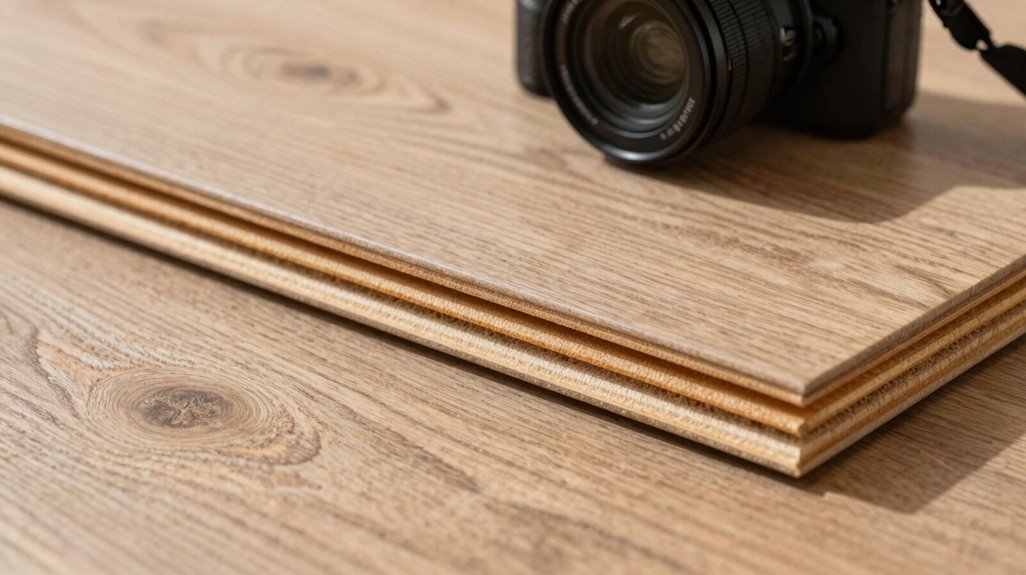
Why does engineered hardwood resist warping when solid boards fail? You’ll find the answer in its layered construction. Engineered hardwood pairs a real hardwood veneer with a plywood core, creating dimensional stability that solid wood can’t match.
- The Veneer: Your real hardwood veneer, typically 0.6–5 mm thick, delivers authentic grain and color. A thin wear layer lets you refinish once or twice.
- The Core: Your plywood core uses 7–9 cross-layered plies. This structure counters expansion and contraction from humidity and temperature shifts.
- Overall Build: Your planks measure 3/8 to 9/16 inches thick, with beveled edges for seamless installation.
| Component | Specification |
|---|---|
| Veneer thickness | 0.6–5 mm |
| Core plies | 7–9 |
| Total thickness | 3/8″–9/16″ |
Install via nail-down, glue-down, or floating methods. You’ll gain stability for basements, concrete, and radiant heat applications.
Choosing Your Floor: Core Types, Wood Species, and Surface Finishes
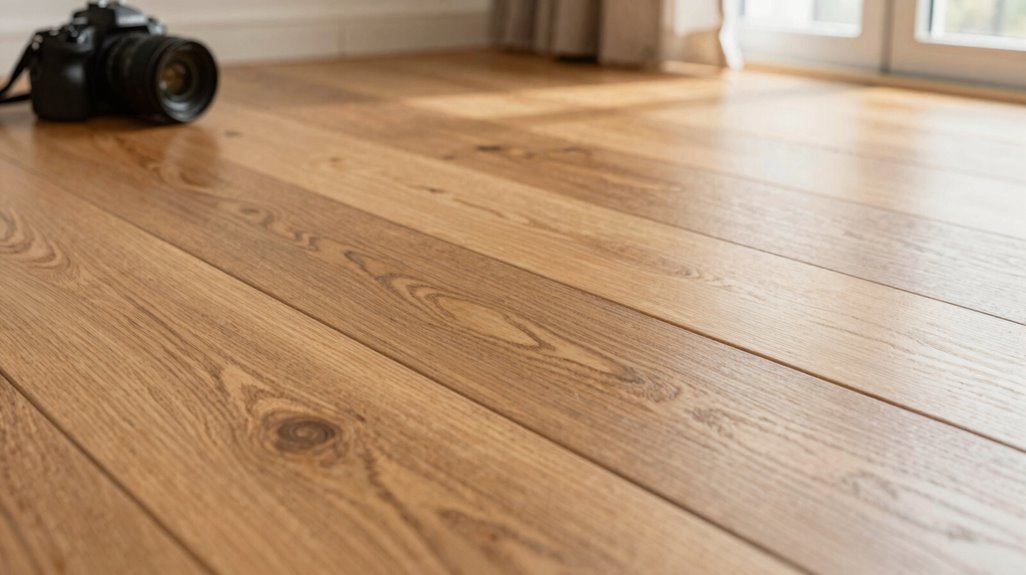
Now that you understand how engineered hardwood is built, you’re ready to select the right floor for your space. Your engineered hardwood core determines stability and moisture resistance, so choose wisely. A plywood core, built from 7–9 plies bonded cross-directionally, resists expansion and contraction better than MDF alternatives.
Your wear layer thickness directly impacts refinishing life; select 5 mm or thicker if you want multiple sanding cycles. Your wood species selection, whether White Oak, Hickory, Maple, or exotic Acacia, defines your floor’s color, grain, and hardness. Your surface finish options range from matte wire-brushed textures to smooth high-gloss, often with beveled edges for visual dimension. Match your core type, species, and finish to your room’s humidity levels, traffic patterns, and maintenance capacity.
Engineered vs. Solid Hardwood: Five Deciding Factors

You’ll weigh construction and composition first, since engineered hardwood’s real veneer over layered core delivers moisture resistance you won’t find in 3/4-inch solid planks. Next, assess installation flexibility: engineered floors bond to concrete slabs, basements, and radiant heating systems where solid hardwood typically fails.
Finally, balance cost against longevity, noting that engineered options with 5mm wear layers permit multiple refinishes over decades, though solid hardwood’s 4+ refinish potential and premium engineered prices demand careful calculation.
Construction and Composition
The construction of engineered hardwood differs fundamentally from solid planks, and you’ll need to grasp these differences before making a purchase decision. You’ll find that engineered veneer sits atop a layered core, typically 7 to 9 plies of plywood core, creating superior dimensional stability. Your wear layer, or top veneer, matches solid hardwood species, while the engineered structure reduces warping. Overall thickness ranges from 3/8 to 9/16 inches, with premium options offering 5-millimeter top veneers for multiple refinishes.
You’ll gain significant moisture tolerance, making these floors suitable for concrete subfloors and basements where solid hardwood fails.
Engineered construction gives you these advantages:
- Real hardwood surface with engineered stability
- Multiple installation methods unavailable to solid planks
- Consistent performance across variable humidity conditions
Installation Flexibility
Your choice between engineered and solid hardwood hinges on where you’re installing and how you’re installing it. Engineered hardwood gives you installation options that solid wood simply cannot match. You can choose nail-down, glue-down, or floating methods depending on your subfloor compatibility and project needs. This flexibility means you’re never locked out of the hardwood look you want.
| Factor | Engineered Hardwood Advantage |
|---|---|
| Moisture tolerance | Basements, concrete subfloors |
| Installation methods | Nail-down, glue-down, floating |
| Wide-plank feasibility | Up to 12″ wide, 16′ long |
Your moisture tolerance expands dramatically with engineered hardwood’s layered core, letting you install where solid wood fails. You achieve wide-plank feasibility without sacrificing stability. Match your method to your space, and you’re done.
Cost and Longevity
How much should you pay, and how long will your floors actually last? Engineered hardwood typically runs $2.50 to $10 per square foot, with most options falling between $4 and $7 per square foot.
Your refinishing lifespan depends directly on wear layer thickness; a 5 mm layer accommodates four to six refinishes, delivering 60 to 120 years of service. Core plywood layers grant engineered hardwood superior moisture tolerance over solid alternatives, expanding your installation options to basements and concrete subfloors where solid wood risks damage.
- Engineered hardwood matches or exceeds solid wood durability in challenging environments
- You gain authentic hardwood aesthetics at reduced cost per square foot
- Strategic wear layer selection maximizes long-term value through multiple refinishing cycles
Where Engineered Hardwood Can (and Can’t) Be Installed
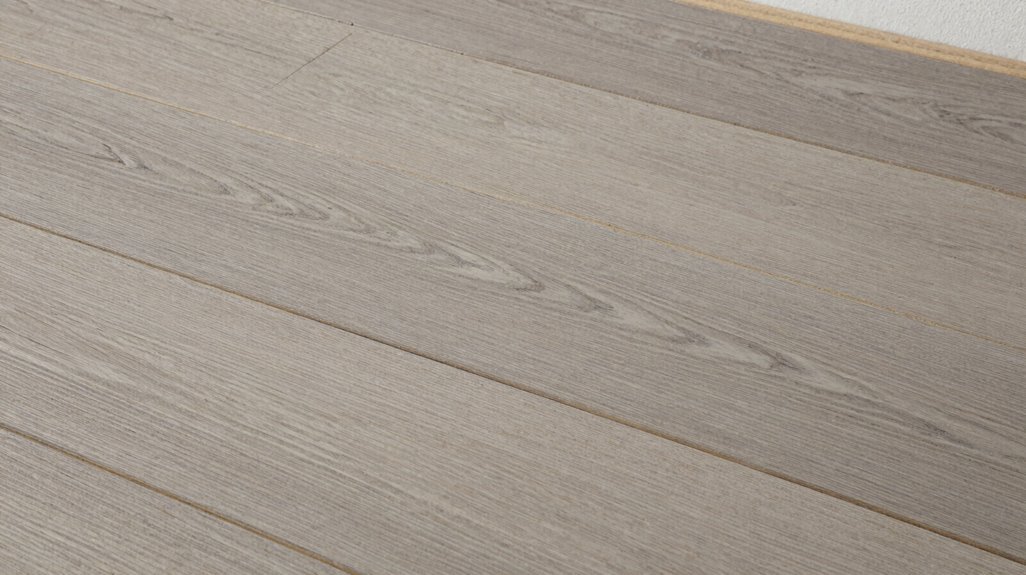
One of engineered hardwood’s primary advantages lies in its installation versatility, allowing you to place it where solid wood cannot survive. You gain access to three proven installation methods: nail-down for wood subfloors, glue-down for concrete slabs, and floating systems that adapt to nearly any surface. This flexibility means you install engineered hardwood directly over radiant heat systems without warping, a critical limitation with solid wood.
Your subfloor options expand dramatically. You secure engineered planks to concrete slabs in basements, where moisture destroys traditional hardwood. You float floors over existing tile or vinyl without demolition. You glue directly to radiant-heated concrete for efficient warmth distribution.
However, you must check water-resistance ratings before installing in kitchens or bathrooms. Not all engineered products withstand standing water, so you select appropriate specifications for wet areas.
Engineered Hardwood Costs: Budget to Premium Price Ranges
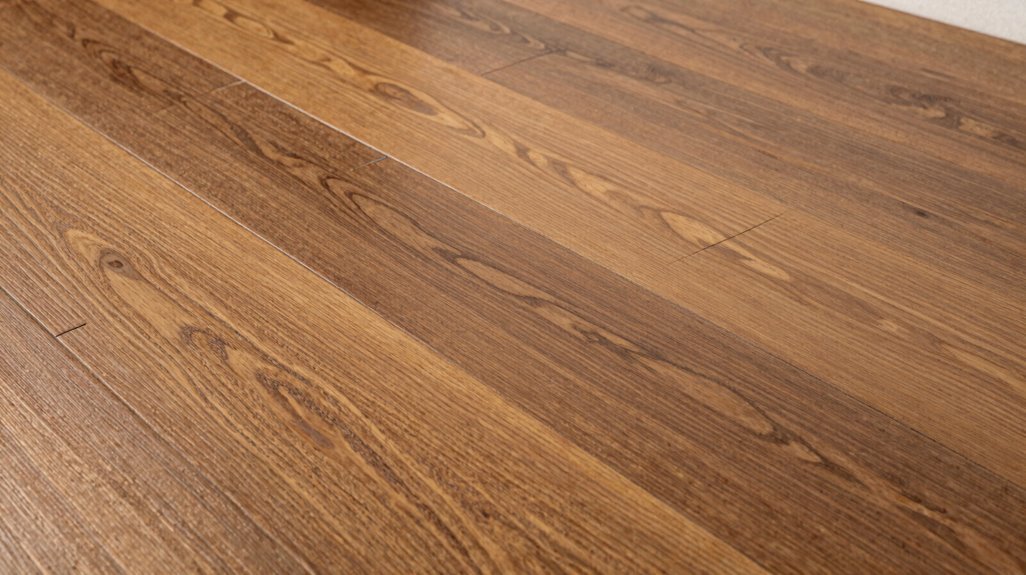
What determines whether engineered hardwood fits your budget? You’ll find engineered hardwood costs span wide price ranges, typically $2.50–$10 per square foot, with most falling between $4–$7. Budget options start near $1.99 per square foot, while premium engineered floors reach $9.39–$10.99. Your investment depends on construction quality and materials.
Wear layer thickness directly impacts durability and cost, with 5 mm layers commanding premium prices. Multi-ply cores provide superior stability, justifying higher tiers in product lineups. Finish-ready and prefinished selections add $2–$6 per square foot over unfinished engineered bases.
Vermont Plank demonstrates how these elements combine, using substantial wear layers and robust cores. Unfinished engineered options in specialty markets run $12–$28 per square foot before finishing costs. You’ll match your project to appropriate engineered hardwood costs by evaluating these measurable specifications against your requirements.
Engineered Hardwood Lifespan: Durability and Refinishing Timeline
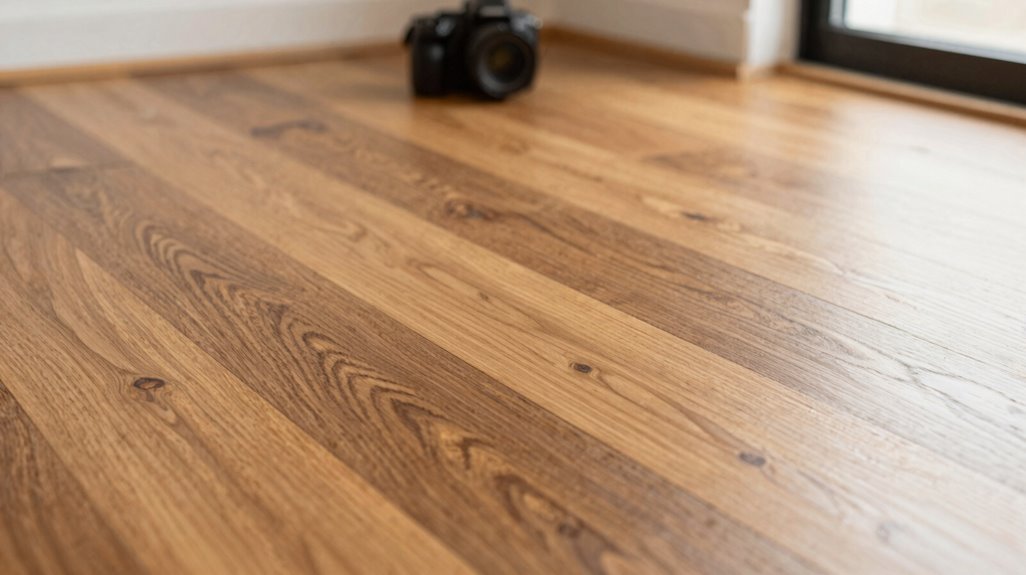
You can expect engineered hardwood to last 60 to 120 years when you select products with substantial wear layers, such as Vermont Plank’s 5 mm veneer that permits 4 to 6 sandings. Your refinishing schedule will typically run 15 to 20 years per cycle, though thinner lamellas limit this potential and shorten overall service life.
Prioritize premium construction with precise manufacturing standards, because material quality directly determines whether your floor reaches or exceeds century-long durability.
Typical Lifespan Expectancy
How long can you realistically expect engineered hardwood to last? With proper care, you’re looking at 60 to 120 years, sometimes exceeding a century in ideal conditions. Your floor’s longevity hinges on critical construction elements, starting with a robust plywood core that delivers stability against expansion and contraction.
Your wear layer thickness determines refinishing potential. A 5 mm wear layer supports 4 to 6 refinishing cycles, spaced approximately 15–20 years apart. This renewable surface changes durability from a fixed trait into an extendable asset. Your controlled environment matters intensely; maintaining 40–60% relative humidity preserves dimensional integrity and prevents structural stress.
To maximize your investment, prioritize these specifications:
- Select thick wear layers (5 mm minimum) for maximum renewal cycles
- Verify cross-banded plywood cores with 11+ layers for superior stability
- Maintain strict humidity control year-round
Refinishing Possibilities
When exactly should you plan your engineered hardwood’s refinishing cycles? You space them every 15–20 years, with proper care extending these intervals considerably. Your engineered hardwood flooring rewards attention to detail, especially when you maintain indoor humidity between 40–55% RH per NWFA guidance.
Your hardwood veneer bonded to a stable core determines refinishing success. A 5 mm wear layer delivers four to six refinishes, while thicker wear layer options multiply your opportunities. Core stability matters equally; eleven-ply construction, like Vermont Plank’s engineered core, prevents rapid wear-through during sanding.
You control your floor’s century-plus lifespan through predictable maintenance. Thinner wear layers limit you; strategic selection preserves options. Monitor conditions, schedule refinishing proactively, and your investment endures across generations.
Maintaining Engineered Hardwood: Daily Cleaning and Long-Term Protection
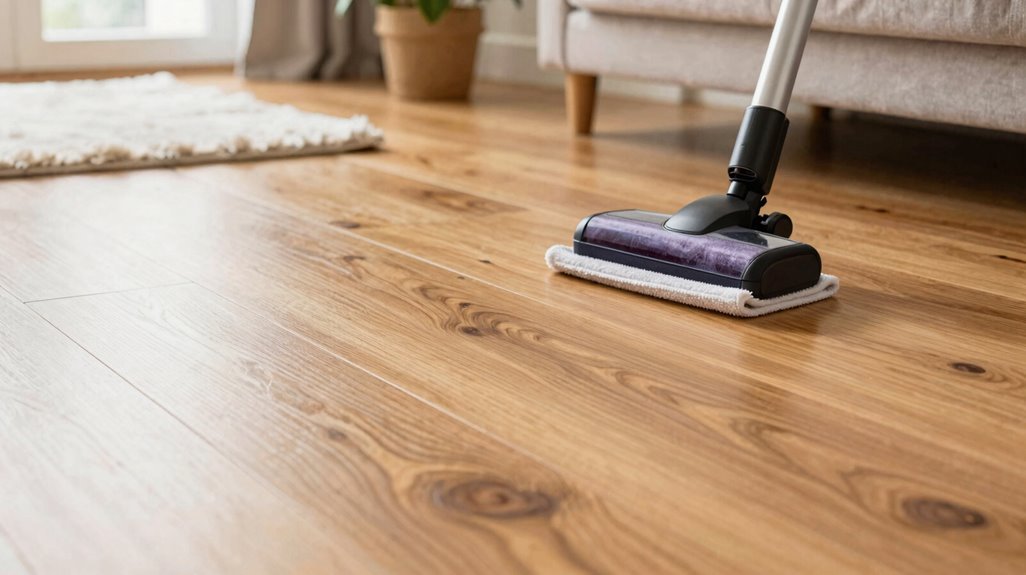
Where does engineered hardwood’s durability truly come from? It comes from you. Your daily cleaning habits, your vigilance with spills and spills management, and your commitment to humidity control determine whether your floor lasts 20 years or 40.
Sweep daily, damp-mop weekly with a hardwood-safe cleaner, and never pool water. Wipe spills immediately; moisture tolerance helps, but water damages the wear layer. Maintain 30%–55% relative humidity year-round to prevent checking.
Your engineered hardwood can handle 4–6 refinishings if you protect that 5 mm wear layer. Use humidifiers in dry climates. Skip the superhero effort; just follow the system. Your floor joins you in this space. Treat it like a teammate, not a trophy, and it’ll perform.