Your ceiling commands more visual real estate than every wall combined, yet you have probably ignored it completely. You will fix this oversight with five measurable, repeatable strategies that solve height limitations, structural constraints, and lighting deficiencies. Each solution includes specific dimensions, material specifications, and installation sequences you can execute immediately.
The first method determines everything else.
Match Your Ceiling Design to Room Height and Scale
How do you make sure your ceiling complements rather than competes with your room’s proportions? You start by measuring your ceiling height, then select ceiling ideas that match your scale precisely.
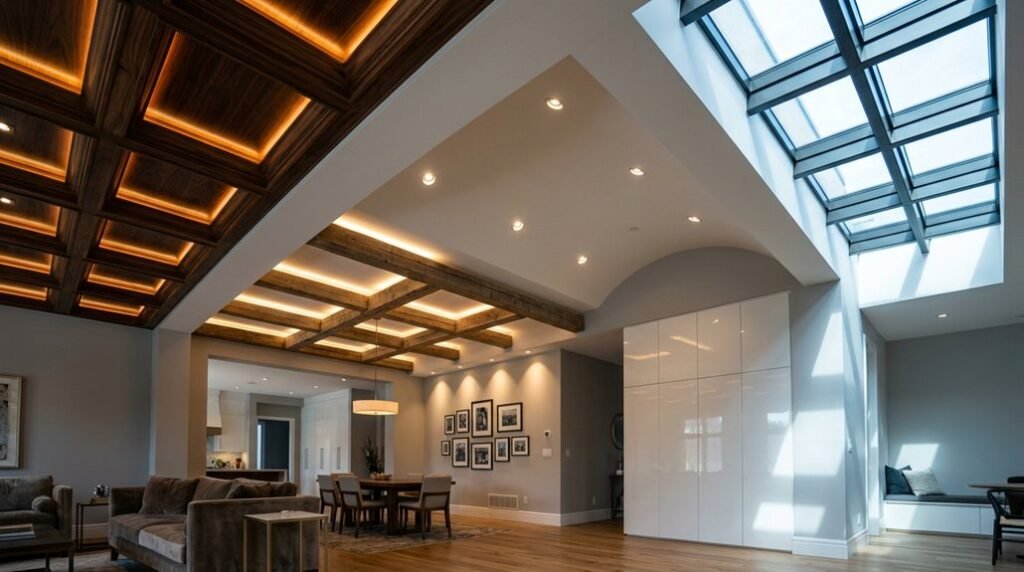
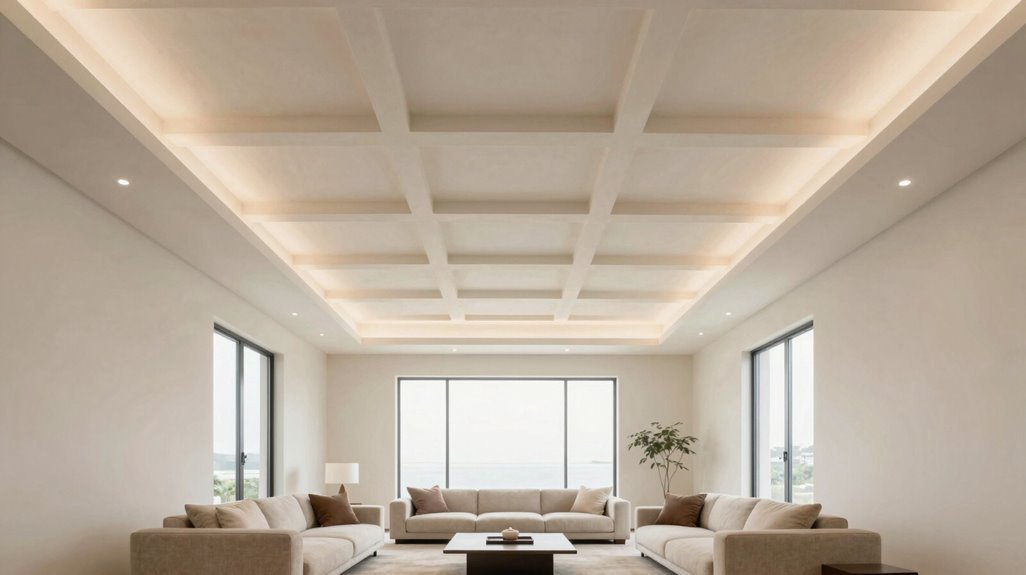
For ceilings above 9 feet, you install coffered ceilings with bold, deep beams that fill vertical space and create architectural rhythm. You add ambient lighting within coffers to maintain an open feel while drawing eyes upward. You choose lighter finishes and bright lighting to visually expand the room height further.
For ceilings below 8 feet, you select simpler designs that preserve headspace. You apply light colors, avoid heavy textures, and use recessed lighting to maximize your vertical space without visual weight.
You treat vaulted or cathedral ceilings differently: you emphasize steep slopes with light, airy paint and statement lighting that reinforces grandeur. You balance room height with proportional details, making certain every element serves your space’s scale.
Create Height and Drama Without Structural Changes
Where can you find extra vertical space when structural modifications aren’t an option? You manipulate perception through strategic ceiling color and lighting integration.
Where can you find extra vertical space when structural modifications aren’t an option? You manipulate perception through strategic ceiling color and lighting integration.
1. Employ Optical Expansion Techniques
Select lighter ceiling color palettes, particularly for vaulted configurations, to amplify perceived ceiling height by 15-20%. Install recessed lighting in uniform grid system patterns to eliminate shadows that compress spatial volume.
2. Implement Architectural Illusions
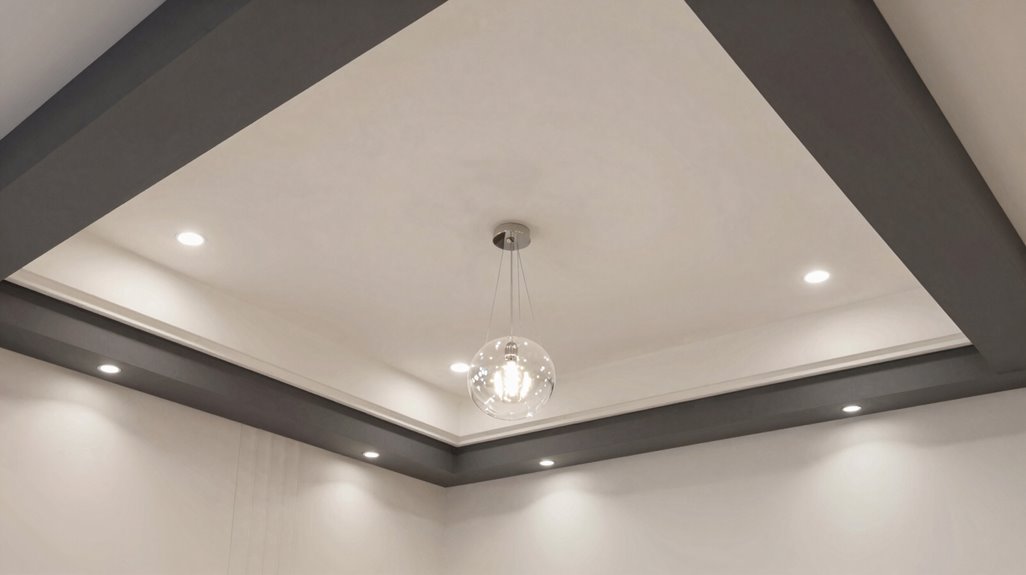
Construct tray ceiling or coffered ceiling designs with perimeter borders, maintaining minimum 8-foot clearances in occupied zones. These three-dimensional elements create vertical hierarchy without structural intervention.
3. Integrate Textural Directionality
Apply wood beams or varied ceiling texture treatments to establish upward visual flow. Position lighting integration within beam channels or coffer recesses to reinforce dimensional depth through controlled illumination gradients.
Choose Ceiling Materials for Your Room’s Function and Location
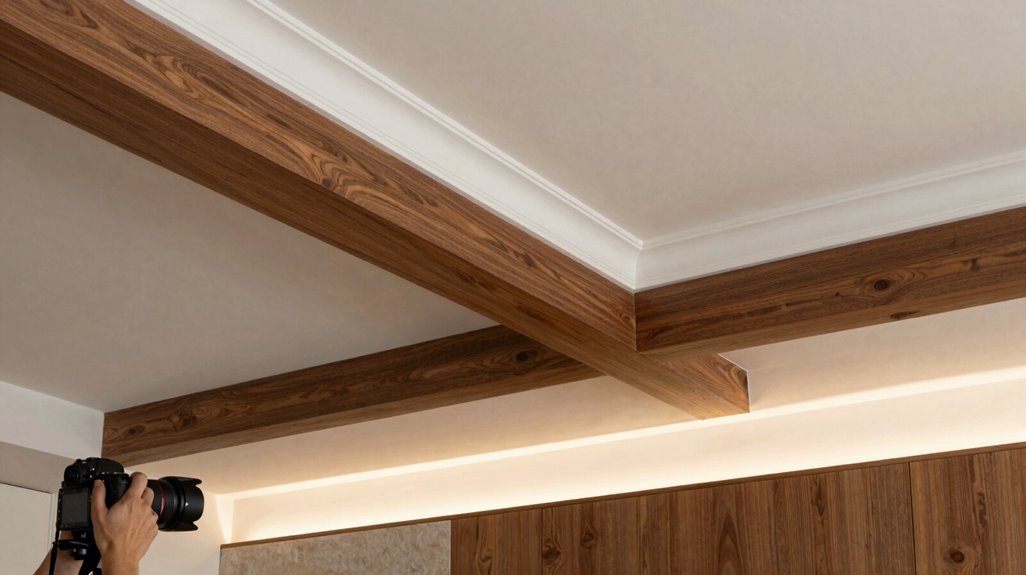
Why risk material failure when selecting ceiling components without accounting for environmental demands? You match ceiling materials to your room’s demands first, then layer in style.
1. Address Basement Conditions
Basements need moisture resistance and acoustic performance. You install a suspended grid system with integrated panels that block humidity and dampen sound. This gives you access to plumbing or wiring without demolition.
2. Select Panel-Based Treatments
You choose panel-based treatments, like single raised panels in white, that satisfy functional requirements while blending with your décor. These fit standard grid dimensions, typically 2×2 or 2×4 feet.
3. Balance Practicality with Design
You incorporate decorative panels or a coffered ceiling within the grid system to boost aesthetics. Recessed lighting drops into designated slots, merging functionality and aesthetics without compromise.
You solve structural problems through material selection, joining homeowners who prioritize intelligent design over guesswork.
Add Trim, Molding, and Layered Details for a Custom Look
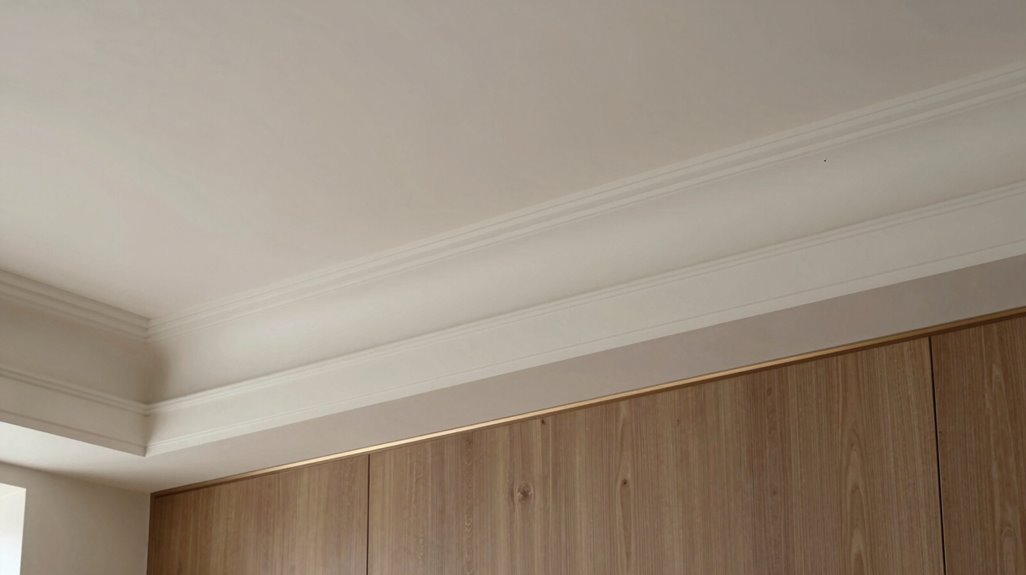
What separates a basic ceiling from a refined architectural statement? You achieve distinction through deliberate trim detailing and strategic layering. Install crown molding where walls meet ceiling to establish immediate visual authority. Build a layered ceiling using a central tray ceiling with recessed panels, integrating ambient lighting within 4-6 inch recesses.
Add perimeter ceiling borders using 3-inch decorative borders to frame the composition. Incorporate a coffered ceiling with grid-patterned architectural accents, painting recessed panels two shades deeper than field color. Complete the change with medallions and carved trim detailing that frames fixtures.
| Layer Component | Installation Zone | Function |
|---|---|---|
| Crown molding | Perimeter wall-ceiling joint | Defines boundary, adds height |
| Recessed panels | Field grid intersections | Creates shadow depth |
| Ambient lighting | Tray recess perimeter | Delivers dimensional drama |
Apply contrasting paint to deepen visual separation between elements.
Coffered Ceilings and Architectural Styles That Maximize Impact
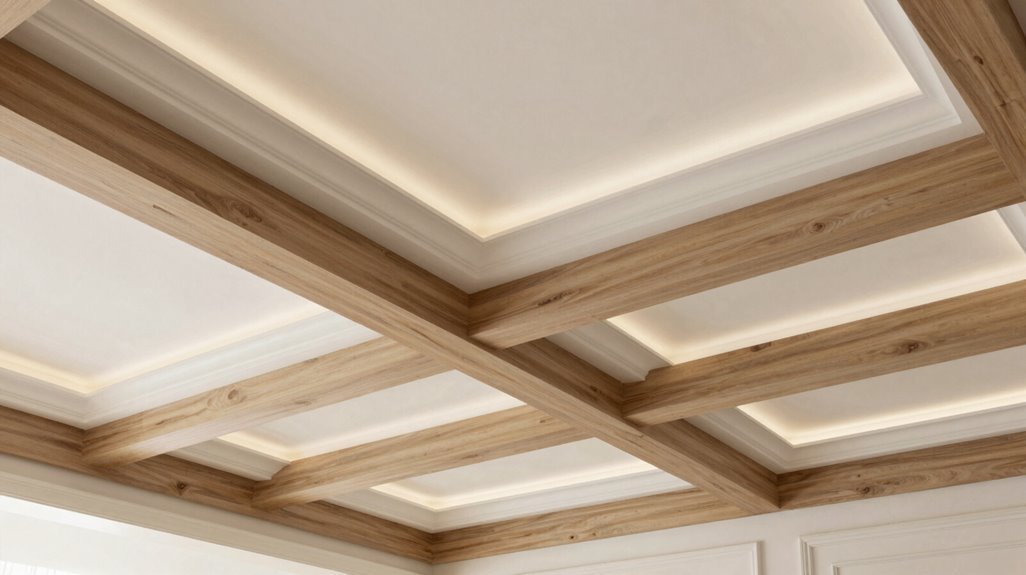
How do you convert a flat ceiling into a commanding architectural feature? You install coffered ceilings, creating a grid of recessed panels that deliver immediate depth and dimension. This ceiling design establishes symmetry through geometric precision, letting you maximize visual impact in your living room renovation.
Your architectural styles options span classical and contemporary applications. Paint recessed panels in contrasting shades to emphasize the grid pattern, or maintain monochromatic schemes for subtle sophistication. Lighting integration is essential: position ambient lighting within coffers or along perimeter borders to amplify perceived height and eliminate shadows.
You’ll achieve measurable results through strategic planning. Coffered ceilings adapt across room dimensions, pairing with furnishings from traditional to modern. The three-dimensional structure creates shadow lines that shift throughout daylight hours, delivering dynamic visual interest without additional ornamentation.