
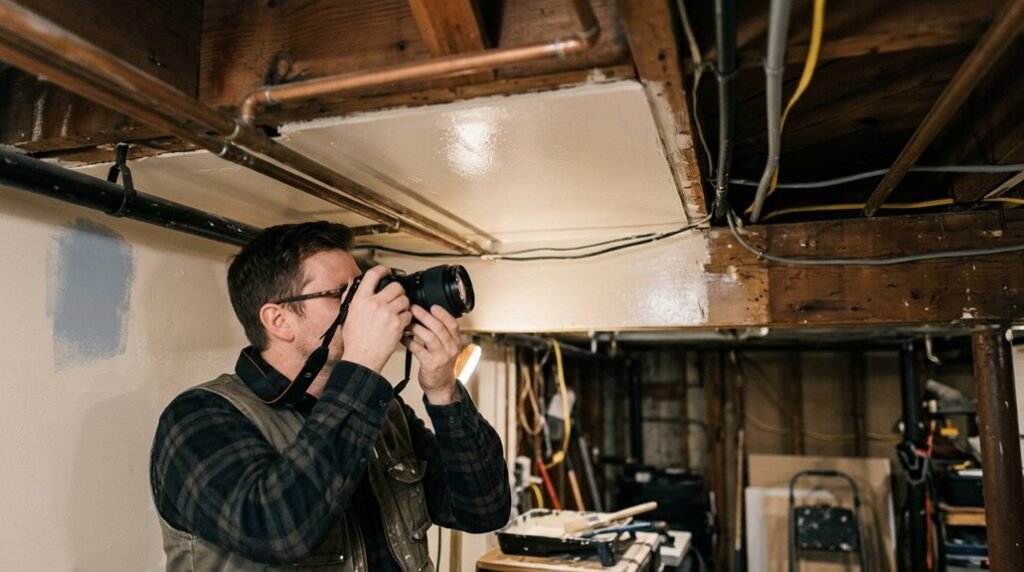
You’re facing a basement ceiling under 7.5 feet, and every inch matters. Paint it wrong, and you’ll feel the walls closing in. Paint it right, and you’ll gain perceived height without touching a beam. Three tested methods, unified light color, strategic uplighting, and calculated dark tones, deliver measurable results when you follow precise application rules. Here’s how to execute each without costly mistakes.
Paint Low Basement Ceilings and Walls One Light Color to Maximize Height

How do you make a 7-foot basement ceiling feel less oppressive? You paint your basement walls and ceiling one light color, creating seamless visual expansion that tricks your eye into perceiving greater ceiling height.
In low-height spaces, harsh edges between surfaces trap your gaze and shrink your space perception. You eliminate these boundaries by coating every surface: ceiling, walls, trim, with identical light paint. Choose soft whites, pale grays, or warm creams in matte or low-sheen formulas for glare reduction and surface imperfection concealment.
Pair your single palette with cool, reflective finishes on floors and fixtures to amplify light distribution. Install recessed lighting with 4-inch trims, spaced 6-8 feet apart, for even illumination without shadow bands. You’ll turn cramped quarters into an open, unified environment where you actually want to spend time.
Test Black Ceilings in Low Basements With Temporary Fabric Before Committing
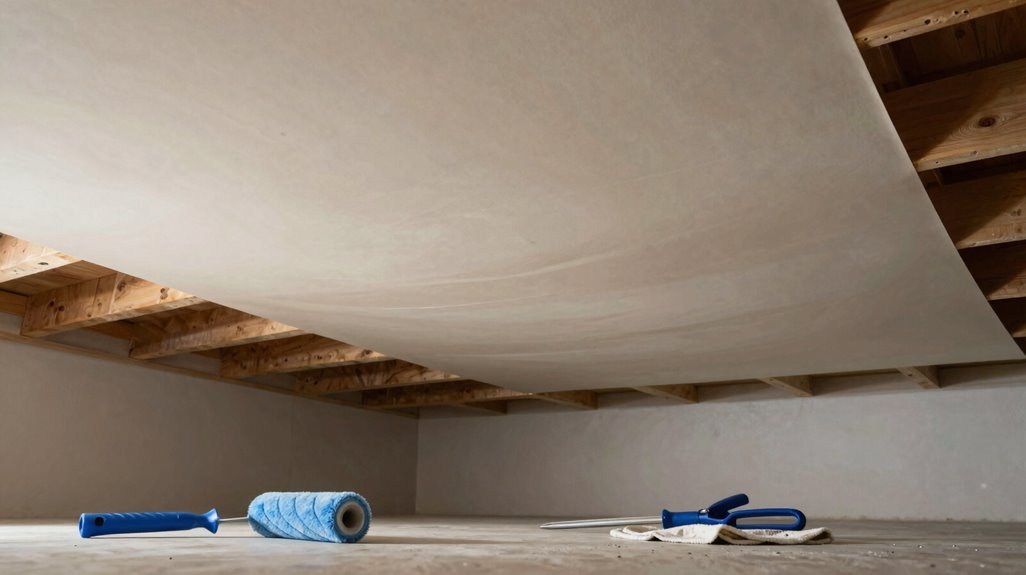
Where do you turn when you’re tempted by a black ceiling but fear it’ll crush your already tight 7-foot basement? You test first, using temporary fabric as your safety net.
- Select your material. Choose cheap black sheets or lightweight cloth; any breathable cover works. Avoid plastic; you need airflow to prevent moisture damage.
- Install the removable material. Staple or tape temporary fabric across a 6×6 foot section of your basement ceiling, ensuring edges stay loose for ventilation.
- Run your test period. Observe for 2–4 weeks during different times of day. Track lighting reflections, noting how fixtures create reflections and shadows you didn’t anticipate.
- Evaluate the mood effect. If low height spaces feel heavier, adjust. Swap for lighter fabric, or proceed confidently knowing your black ceiling won’t backfire.
Add Uplighting and Vertical Lines to Stretch a Low Basement Ceiling
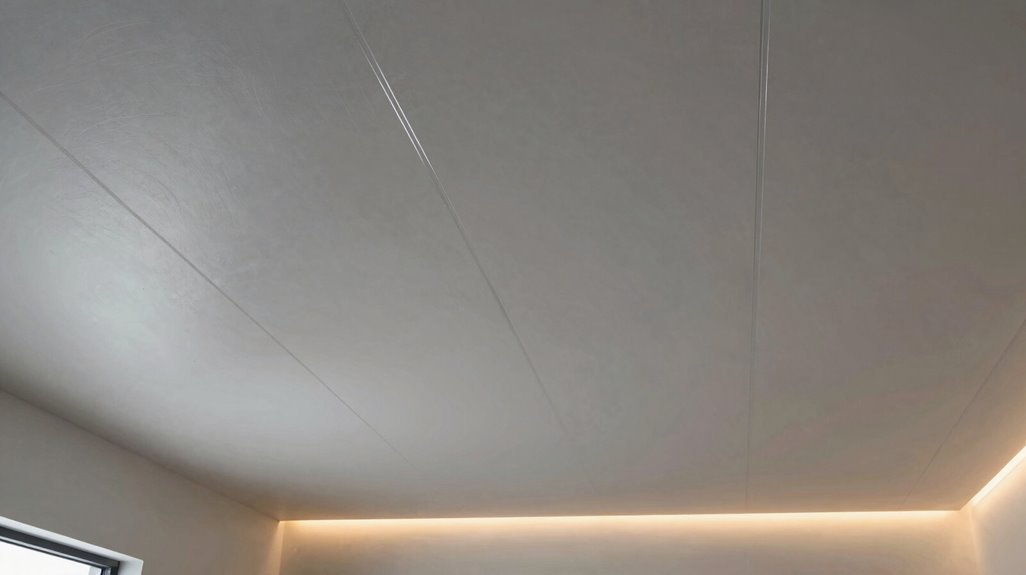
Once you’ve settled on your ceiling paint color, whether it’s black, white, or something between, you’ll face the next challenge: making that 7-foot height feel less oppressive.
Install uplighting; concealed perimeter LEDs or wall-washed fixtures; at 8-12 inch intervals along wall-ceiling junctions. Position these fixtures to direct light upward, maximizing light reflection and making your basement ceiling visually taller. Select cool-neutral light color temperature (3,500-4,000K) to maintain vertical lift without harsh shadows.
Uplighting transforms oppressive 7-foot ceilings into visually expansive spaces through strategic fixture placement and cool-neutral color temperatures.
Create wall-to-ceiling continuity by extending ceiling paint color 6-12 inches down adjacent walls, softening harsh edges where planes meet. Integrate vertical lines through floor-to-ceiling curtains, tall shelving units, or vertically striped wallpaper with 4-6 inch stripes; these vertical accents draw the eye upward, amplifying perceived height through deliberate spatial manipulation.
Place narrow, high art displays and tall built-ins deliberately to reinforce vertical rhythm throughout the space.