
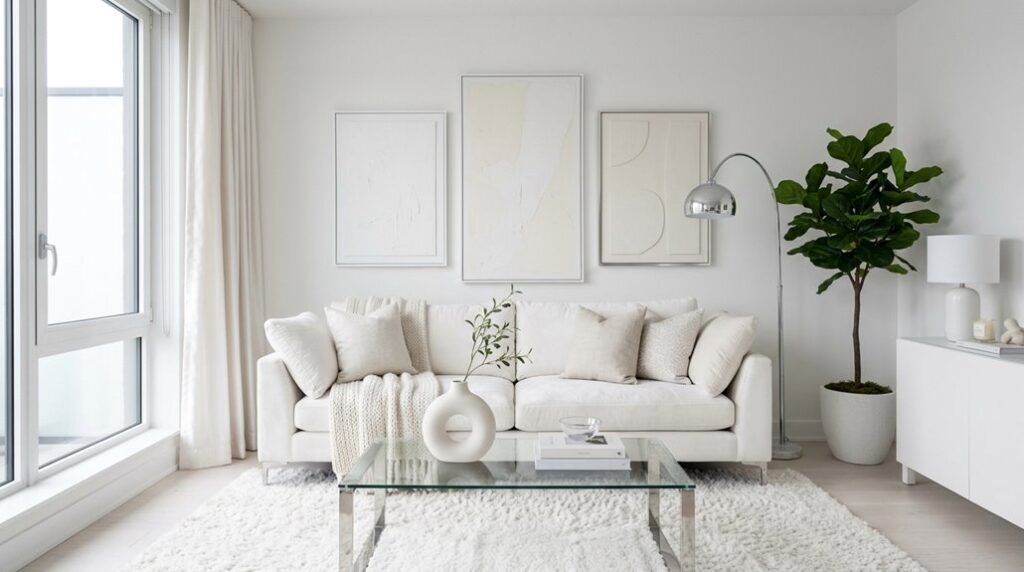
You want a white living room that works, not one that feels cold, flat, or impossible to maintain. You need systems that account for light temperature, material durability, and spatial flow. You require measurable standards, swatch sizes, Kelvin ranges, finish counts, to eliminate guesswork.
The following fifteen approaches provide exact specifications, organized by decision sequence, with tables for quick reference. You will build a functional, layered space without common failures: yellowing paint, washed-out textures, or furniture that shows every stain. Your parameters await documentation.
Is a White Living Room Right for You?
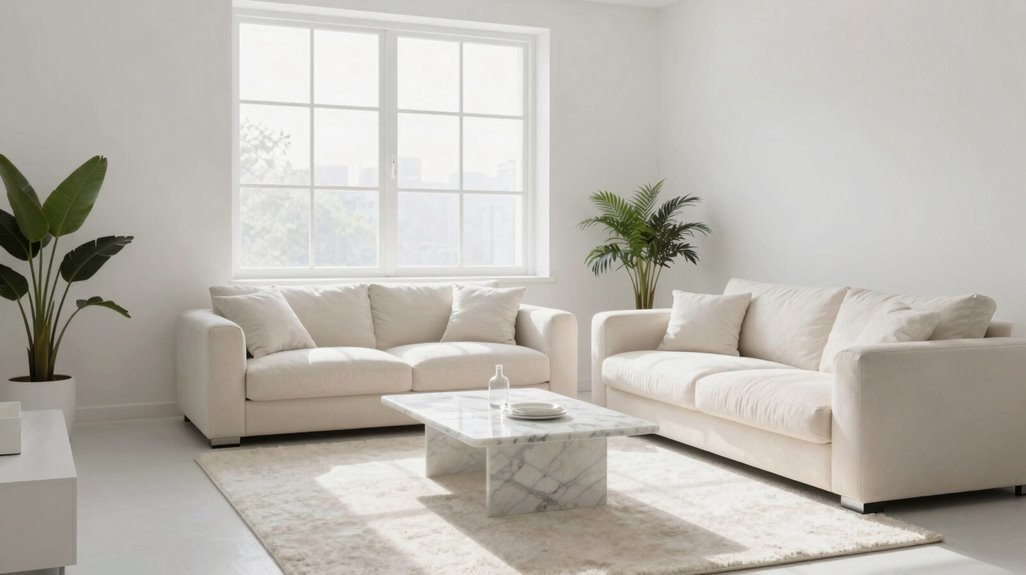
Why consider an all-white living room? White living rooms deliver enduring sophistication, adaptable foundations, and spatial expansion, particularly in compact areas under 400 square feet.
Assess your priorities against these criteria:
- Lifestyle compatibility: You entertain frequently, prefer serene environments, or seek easy refresh cycles through accessory swaps.
- Maintenance capacity: You accept quarterly deep-cleaning schedules, invest in stain-resistant fabrics (performance ratings above 30,000 double rubs), and utilize protective slipcovers.
- Textural execution: You commit to layering three-plus finishes; matte walls, glossy ceramics, woven textiles, to prevent visual flatness.
White living rooms accommodate modern minimalism, coastal schemes, or Boho styling without structural changes. The neutral canvas integrates personal artifacts, seasonal color shifts, and evolving preferences.
Evaluate your tolerance for upkeep, your need for spatial perception enhancement, and your willingness to deploy varied materials. If these align, proceed with implementation.
Find Your Design Style First
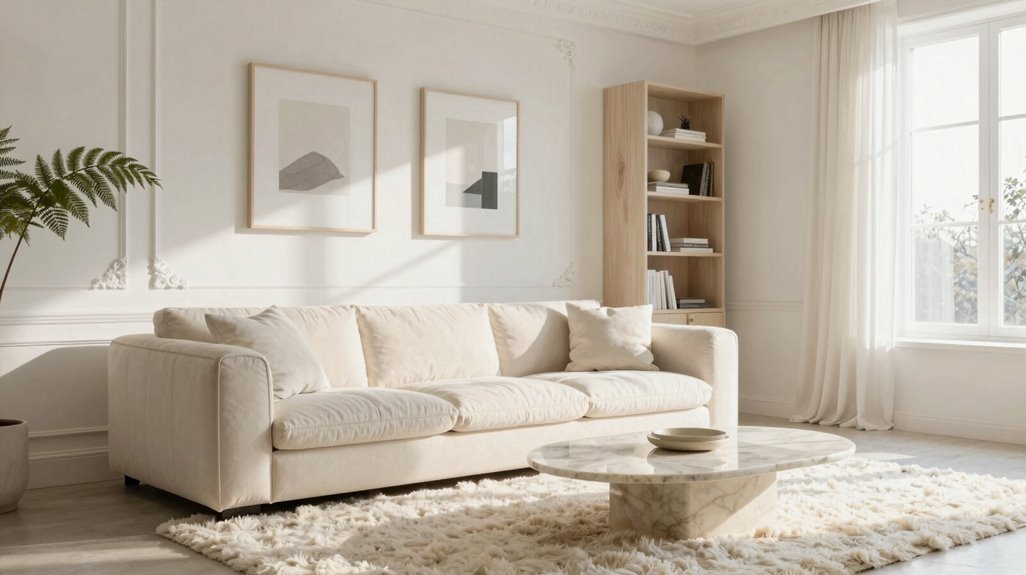
How do you guarantee your white living room doesn’t clash with your existing preferences? You’ll solve this by identifying your design style before selecting any paint, furniture, or accessories. This foundational step prevents costly mismatches and establishes a coherent framework for every subsequent decision.
Take these four actions to define your style:
Four decisive steps transform vague taste into concrete design rules: assess, apply, document, reassess.
- Complete a free, 10-minute interior design quiz to categorize your aesthetic tendencies precisely
- Apply your results to select White-compatible furniture and decor that reinforce cohesion
- Document your style parameters to govern color schemes, textures, and spatial themes
- Reassess your choices quarterly as you gather new inspirations, adjusting selections methodically
Your identified style will direct layout configurations, lighting specifications, and accessory procurement. This systematic approach turns abstract preferences into executable design parameters, making certain your white living room functions as an integrated personal environment.
Choose Warm or Cool White Based on Natural Light
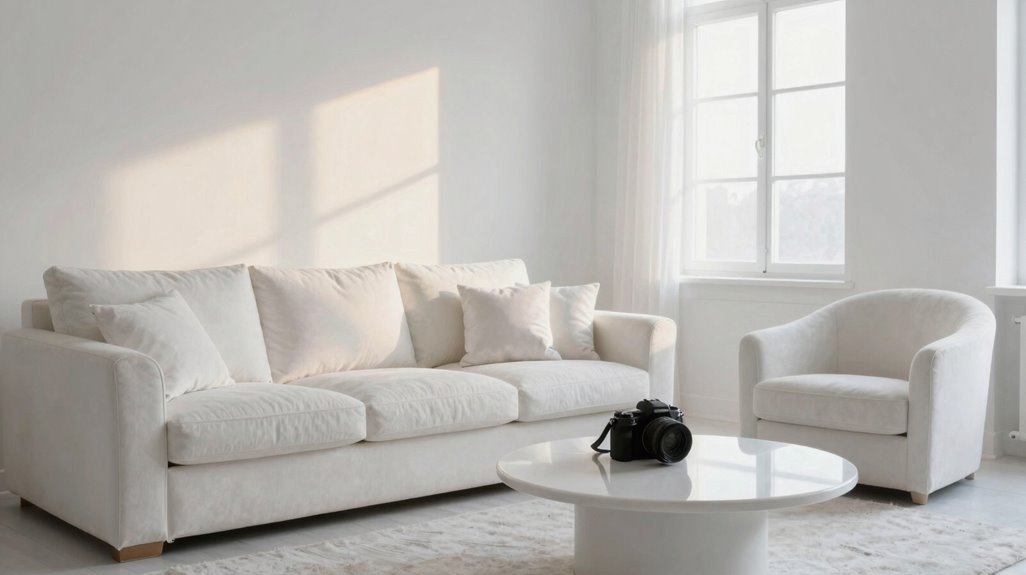
Assess your room’s natural light by observing its intensity and direction across morning, midday, and afternoon hours, noting that south-facing windows deliver 6-8 hours of direct sun while north-facing spaces receive cooler, indirect illumination. Select your white tone based on these measurements: choose cool whites (3500-4100K) for sun-drenched rooms exceeding 4 hours of direct light, or warm whites (2700-3000K) for dimmer spaces receiving under 2 hours, to prevent visual flatness.
Test 12″ x 12″ paint swatches on multiple walls, evaluating them at 9:00 AM, 3:00 PM, and under evening lamps to confirm your selection maintains its intended character across all lighting conditions.
Assessing Natural Light
Where you position your white palette depends heavily on the light entering your space, so you’ll need to evaluate your windows before opening a single paint can. White living room ideas succeed when you match your white tone to your daylight conditions.
- Measure your window exposure. Count hours of direct sunlight, noting north-facing rooms receive cooler, consistent light while south-facing spaces get warmer, intense beams.
- Identify your light quality. Morning light casts yellow tones; afternoon light shifts blue-gray.
- Apply paint samples. Brush 12-inch squares on north, south, east, and west walls, observing at 8 AM, noon, and 6 PM.
- Coordinate with existing elements. Compare samples against wood floors and upholstery to check tonal harmony.
Selecting White Tone
Whether you’re chasing modern crispness or enveloping warmth, your white choice hinges on what your windows deliver. South-facing rooms amplify warm white tones, shifting them creamier by midday, while north-facing spaces preserve cool white tones with subtle blue undertones.
You’ll match your selection to your desired atmosphere: warm whites generate coziness, cool whites establish contemporary edge. Test paint chips at 9 AM, noon, and 4 PM to verify stability across changing light. Pair warm whites with amber bulbs, cool whites with 4000K LEDs. Examine adjacent materials: oak, brass, and linen favor warmth; chrome, glass, and ash complement cool palettes.
| White Tone | Best Orientation | Supporting Lighting |
|---|---|---|
| Warm | South, West | 2700K amber LEDs |
| Cool | North, East | 4000K cool LEDs |
| Neutral | Variable | Dimmable mixed sources |
| Undertone Test | All | Morning, noon, evening |
Modern Minimalist White: Sleek, Not Sterile
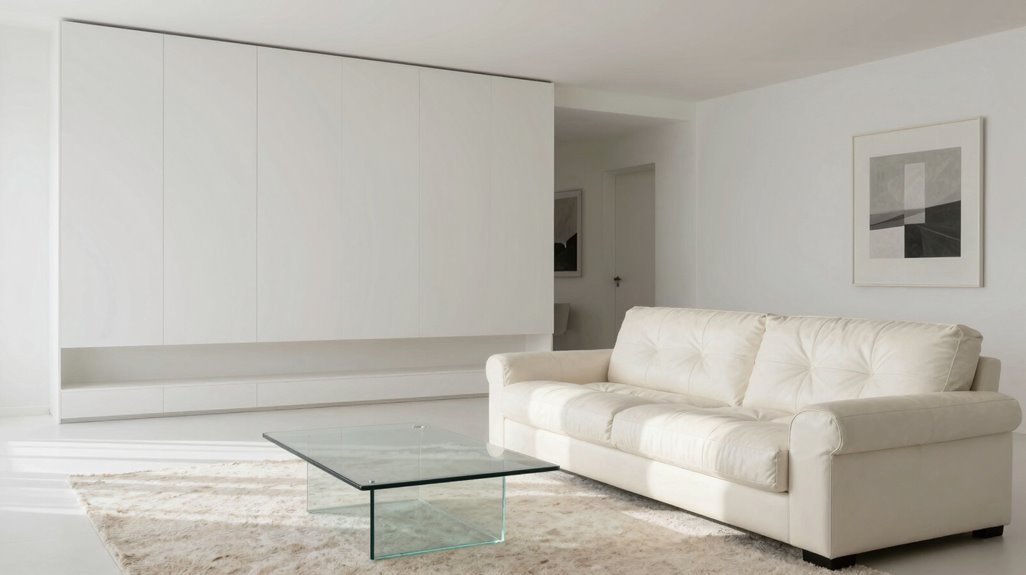
Why does a white minimalist living room often feel cold when you’ve followed every rule? You’ve paired streamlined furniture with white walls, yet the space lacks soul. In modern White living room design, sterility isn’t inevitable, it’s a fixable error.
To create sleekness with warmth, execute these four strategies:
- Layer three distinct textures minimum, combine metal, glass, and wood with soft textiles like rugs and cushions.
- Install one bold piece, select geometric coffee tables or abstract art to inject personality.
- Apply metallic accents sparingly, add silver or gold elements for glamour without visual clutter.
- Stack texture vertically, layer rugs, velvet cushions, and woven throws to eliminate clinical flatness.
Execute these steps, and you’ll build a minimalist sanctuary that welcomes rather than rejects.
Cozy White Living Room: Soft Layers and Warm Light
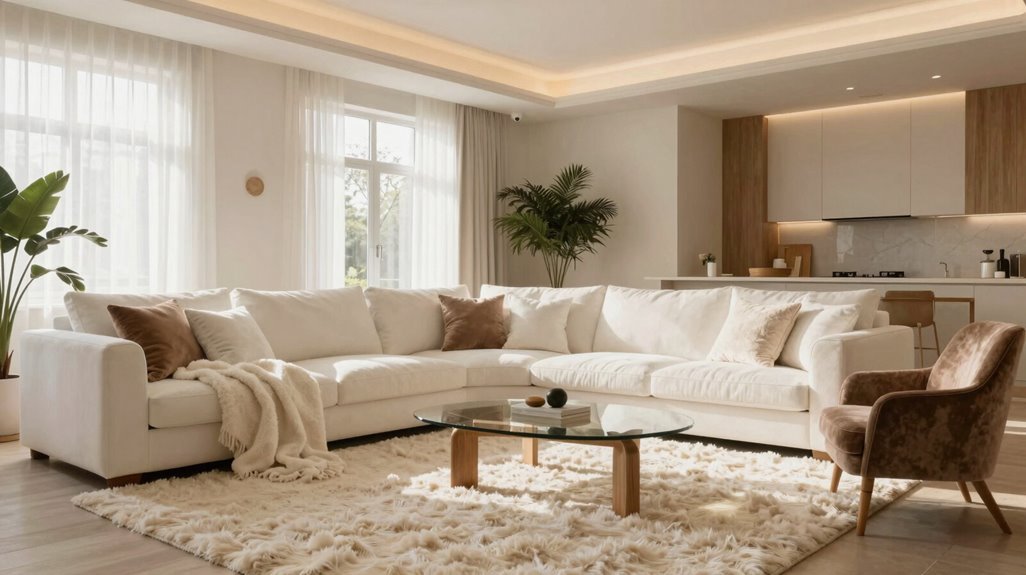
You need layered textures and warm lighting to change a white room from cold to comfortable. Start by stacking three distinct fabric weights: base rug, mid-weight throw, accent pillow, across each seating zone, then position 2700K bulbs within 6 feet of primary gathering areas. This systematic layering creates measurable warmth without compromising the room’s bright, expansive foundation.
Layered Textures
How do you change a stark white room into a space that invites touch and relaxation? You layer textures deliberately, combining materials that create depth without clutter. Start with a foundation: place a thick, woven rug measuring at least 8×10 feet to anchor your seating area. Then, build upward with soft elements that contrast against your white walls.
Follow these four steps to execute this strategy:
- Drape wool throws over armrests, choosing pieces 50×60 inches minimum.
- Stack velvet cushions in odd numbers; three or five per sofa section.
- Mix linen curtains with heavier velvet upholstery for material contrast.
- Position tactile objects within arm’s reach of primary seating positions.
Balance these textures with 40% negative space to prevent visual chaos. You’re constructing a multi-sensory environment where every surface offers invitation.
Warm Lighting
Where does a white room fall flat? Under harsh, cool lighting that exposes every imperfection and chases comfort away.
You fix this by layering three distinct light sources: ambient overhead fixtures, task lamps for reading, and accent sconces for depth. Select bulbs rated 2700K–3000K, the warm color temperature that casts a gentle yellow glow across your white surfaces, eliminating starkness without muddying the palette.
Install dimmer switches immediately; you need granular control from 100% brightness for tasks down to 20% for evening intimacy. Position warm-toned sconces or a working fireplace as deliberate points of interest, anchoring the eye while your velvet cushions and wool throws absorb and scatter that light.
Test placements at dusk, adjust angles within 15-degree increments, and measure coverage in foot-candles until shadows soften uniformly across the room.
Scandinavian White: Clean Lines, Natural Materials
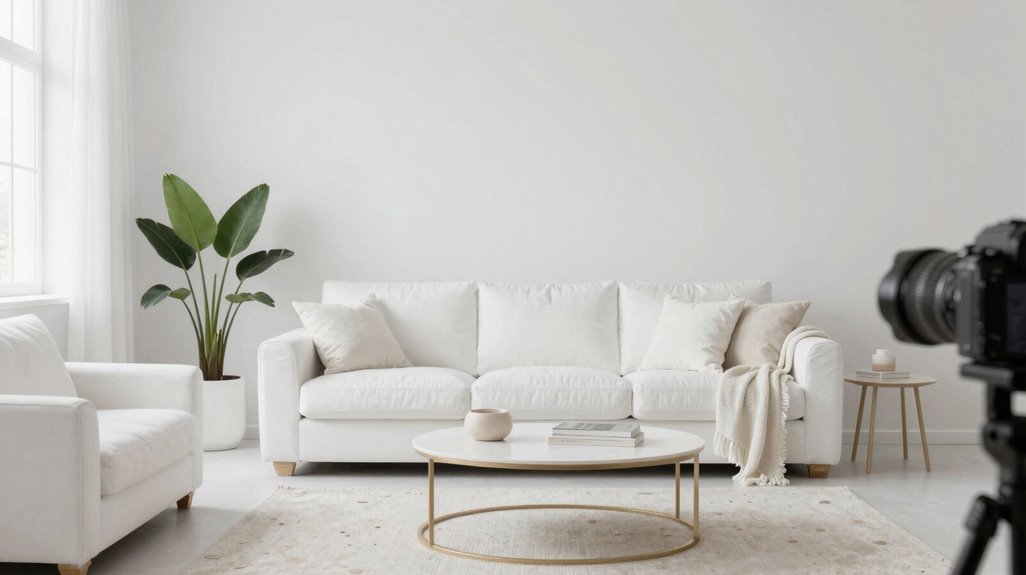
Why settle for visual noise when streamlined function delivers superior results? These Scandinavian principles prioritize purposeful design over excess.
Your white palette establishes the foundation, but natural materials deliver the essential warmth. Light oak flooring, whitewashed birch furniture, and untreated linen textiles prevent sterile atmospheres while maintaining visual coherence.
Execute this systematic approach:
- Install pale wood flooring or refinish existing surfaces with white-wash treatments, covering 80-90% of visible floor area.
- Position 3-5 indoor plants; specifically snake plants, pothos, or fiddle-leaf figs; within 6 feet of natural light sources.
- Select multifunctional furniture: storage ottomans (minimum 18-inch diameter), convertible sofas (75-84 inch lengths), or nesting tables.
- Restrict decorative objects to 5-8 curated pieces per 100 square feet.
You’ll achieve belonging through intentional restraint, not accumulation.
Boho White Living Room: Patterns, Texture, Collected Pieces
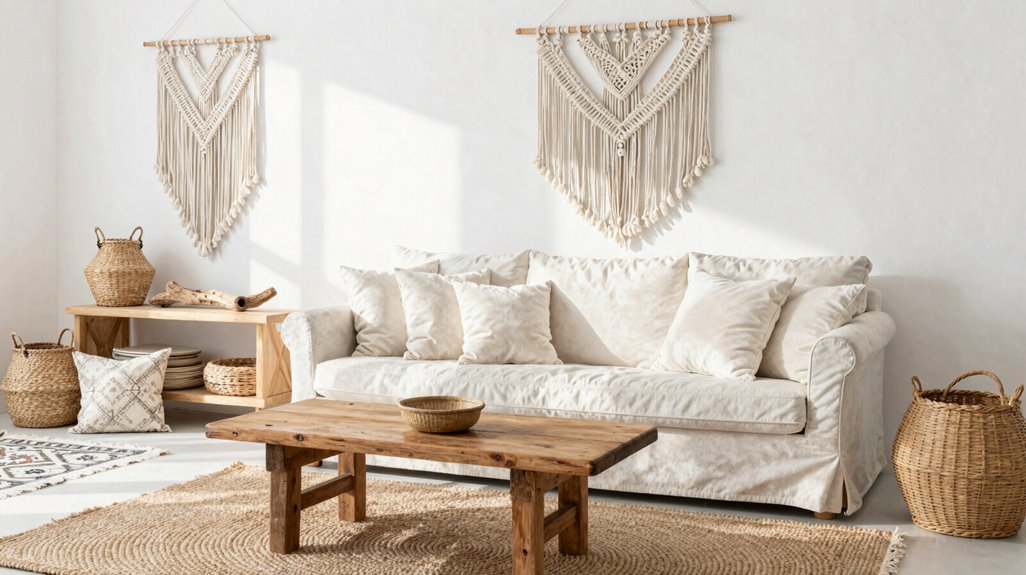
Scandinavian restraint serves its purpose, but you’re ready for a more expressive framework. A Boho white living room delivers exactly that, blending white backdrops with eclectic, global-inspired elements.
1. Layer Textiles Strategically
Add woven rugs, macramé wall hangings, and 4-6 mix-and-match cushions. These patterns build depth without overwhelming your white base.
Layered textiles transform stark white into a warm, lived-in sanctuary rich with tactile character.
2. Integrate Natural Materials
Incorporate wood, rattan, jute, and wicker furniture pieces. These materials provide organic warmth, creating essential contrast against white surfaces.
3. Curate Collected Pieces
Source vintage baskets, handmade throws, and global textiles. Aim for 8-12 distinctive items that suggest traveled experiences and personal history.
4. Maintain Visual Balance
Reserve 40% of wall and floor space as negative space. Introduce neutral beige or cream tones every third element to prevent visual chaos.
Your Boho white living room becomes a collected sanctuary, not a cluttered space.
All-White Living Room: Texture Variations That Prevent Flatness
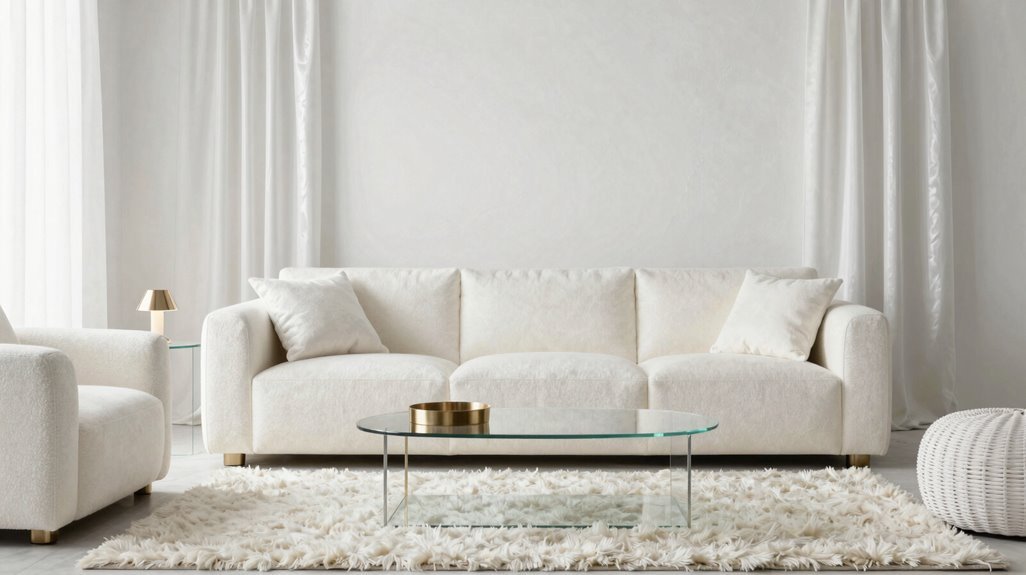
How do you keep an all-white living room from feeling like a sterile showroom? You layer textures deliberately, building tactile complexity that invites touch and anchors your space in warmth.
- Combine natural materials: Integrate linen, wool, and wood finishes at a 3:2:1 ratio to create visual rhythm without breaking your white palette.
- Alternate surface finishes: Pair matte walls with glossy ceramics and textured ceramics across three to five surfaces per room.
- Layer textile weaves: Stack knit, fur, and boucle throws and cushions, maintaining 4-6 distinct weaves within your sightline.
- Balance negative space: Position one sculptural white piece per 100 square feet, keeping 40% open wall area.
These textures change clinical white into an environment where you, and others, want to gather.
Luxury White Living Room: Marble, Velvet, and Gold Accents
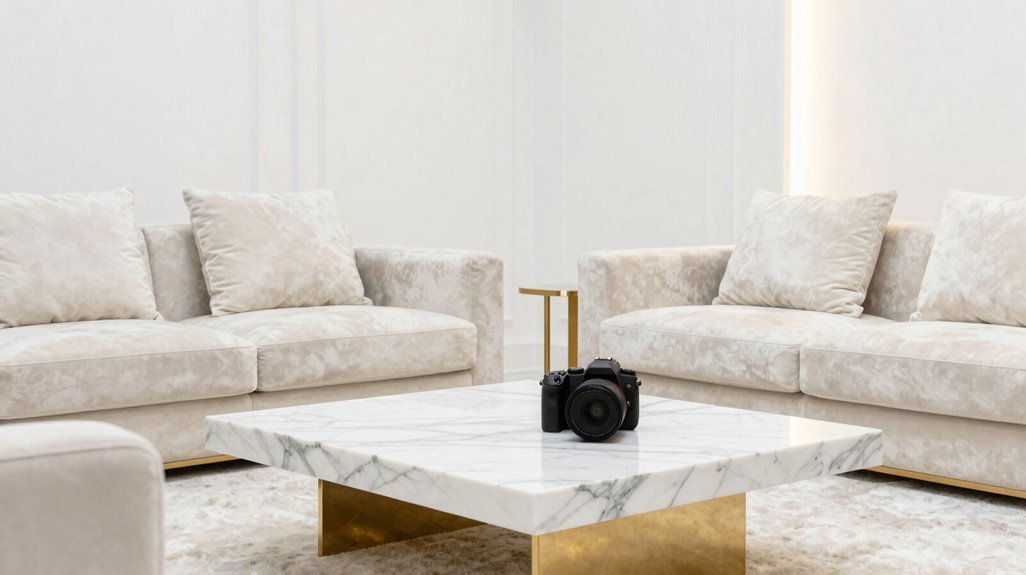
Trade predictable whites for three definitive materials, and you’ll establish luxury without ambiguity.
1. Select Quality Materials
Choose marble for 40-60% of surfaces: countertops, flooring, or accent tables. Incorporate velvet upholstery on one statement piece, sofa or armchairs, in cream or ivory tones. Add gold accents through lighting fixtures, mirror frames, or hardware.
2. Install Statement Lighting
Hang one crystal chandelier (24-36 inch diameter) or place a designer floor lamp in corners. These create focal points without competing elements.
3. Apply Proportional Decor
Use one oversized artwork (minimum 48 inches wide) or sculptural piece per wall. Position gold-framed mirrors opposite windows to amplify natural light.
Material Breakdown:
| Element | Percentage | Placement |
|---|---|---|
| Marble | 40-60% | Surfaces |
| Velvet | 10-15% | Seating |
| Gold | 5-10% | Accents |
You’ll achieve unmistakable luxury through deliberate material selection.
Warm Up Your White Living Room With Natural Wood
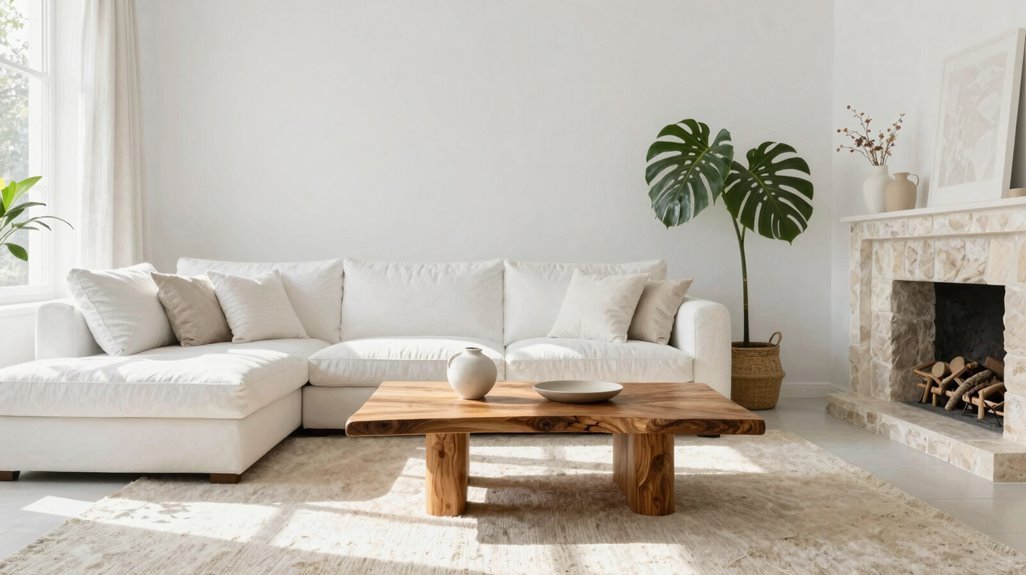
You’ll select wood tones strategically, pairing light oak or whitewashed finishes for Scandinavian airiness with darker walnut accents for dimensional contrast. Layer these natural elements with tactile textiles, specifically velvet throws and linen upholstery, to build systematic depth without disrupting your neutral foundation. Apply this two-tier approach, combining three or more wood species with complementary fabrics. You’ll engineer a white living room that functions as a warm, precisely organized environment.
Wood Tone Selection
Where exactly does a white living room fall flat? It happens when surfaces lack tonal variation, creating visual monotony that distances rather than welcomes. You solve this through deliberate wood tone selection, mixing white with natural wood tones that add warmth and earthy contrast.
Anchor your space with wooden coffee tables or reclaimed shelves to introduce organic texture and depth. Integrate wood accents in lighting fixtures or picture frames to establish cohesive layout connections.
Combine white surfaces with different wood finishes to prevent flat, uniform appearances throughout the room. Layer varying wood species, such as oak, walnut, or pine, for multidimensional visual interest.
You’ll find belonging in spaces that balance precision with organic imperfection. Select finishes within two to three tone ranges, maintaining 60% white dominance, 30% primary wood, and 10% secondary species for optimal spatial harmony.
Layered Textures
How do you prevent a white living room from feeling sterile and inhospitable? You layer textures deliberately, combining velvet, linen, and wool to build tactile depth against your white backdrop.
Natural wood becomes your essential warming agent. You install light oak flooring or select whitewashed furniture pieces that integrate seamlessly without visual disruption. You combine multiple wood species—oak, walnut, pine—to establish dimensional interest rather than flat uniformity.
You incorporate functional wooden elements: storage ottomans measuring 18″x18″, reclaimed shelving units spanning 48-60″ widths. These pieces maintain clean lines while radiating organic warmth.
You avoid monotony by varying wood grain patterns and surface treatments. You balance smooth planed finishes with hand-hewn textures, ensuring each element contributes distinct visual weight. Your resulting space achieves cohesion through calculated material contrast, turning stark white into an inviting, multi-layered environment where you actually belong.
Mix Textures to Add Depth to White Walls
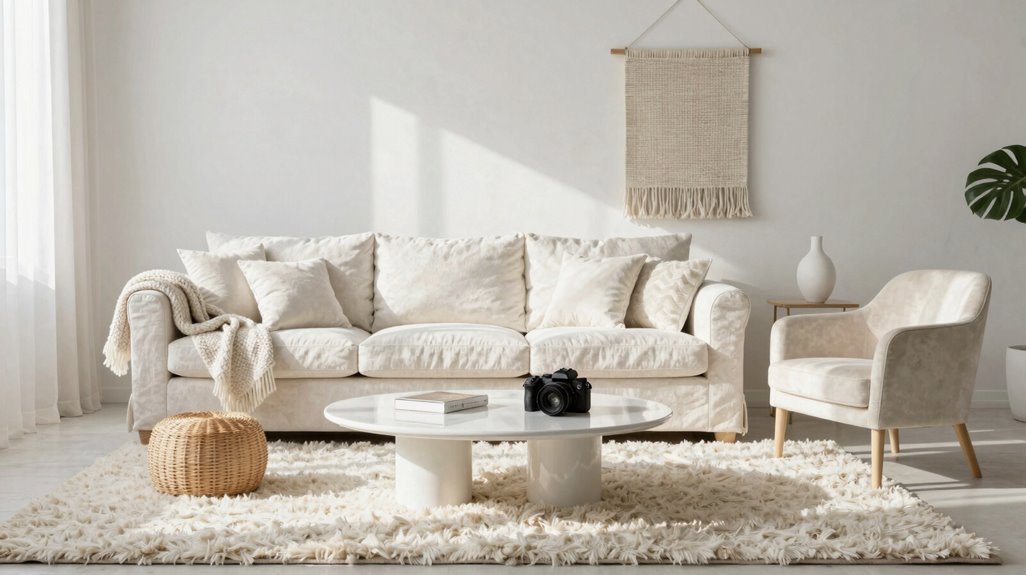
Why does a white living room sometimes feel unfinished, even when you’ve invested in quality pieces? You’ve likely neglected texture, the critical element that turns flat white walls into dimensional, welcoming spaces.
Texture creates belonging by inviting touch, establishing comfort through visual complexity. Without varied surfaces, your room risks sterility regardless of furniture cost.
Implement these texture strategies:
- Layer textiles; combine velvet cushions, linen throws, and wool rugs within arm’s reach
- Integrate natural materials; wood, hemp, and woven baskets add organic warmth
- Vary finishes; apply matte paint beside glossy ceramics and textured plaster
- Balance distribution; assign distinct textures to each zone, making sure of cohesive flow across furniture, walls, and accessories
You’ll achieve depth when textures interact deliberately, not randomly.
Ground White Rooms With Black Accents
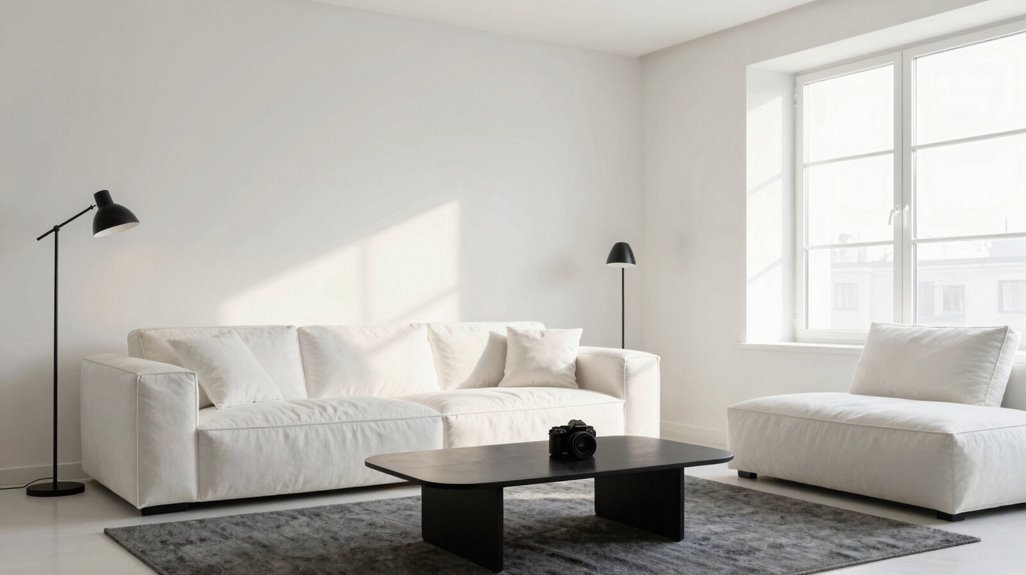
You will create bold contrast choices by grounding your white room with strategic black accents that anchor the space without overwhelming it. Position one to three dominant black elements: a 48-inch coffee table, 24-by-36-inch framed artwork, or pendant fixtures under 18 inches in diameter, to establish deliberate focal points.
Keep 70 to 80 percent of surfaces white, with black details making up no more than 20 to 30 percent of the visual field. This maintains balanced visual weight throughout the space.
Bold Contrast Choices
Where might you ground an airy white room without dimming its natural brightness? You’ll find your answer in strategic black accents that secure the space while preserving luminosity. Strong contrast choices rethink sterile white expanses into sophisticated environments through calculated visual tension.
To execute this approach effectively, follow these four implementation steps:
- Select one dominant black furniture piece, such as a coffee table or armchair, positioned centrally within 8-10 feet of natural light sources
- Layer three distinct textures minimum, combining velvet upholstery, matte metal frames, and raw wood grain to prevent flatness
- Install black window trims on 60-70% of visible frames, creating architectural definition without enclosure
- Distribute five to seven smaller black accessories, such as ceramics, frames, or lighting, across 200-300 square foot zones for rhythmic balance
Your monochrome scheme succeeds when texture variation exceeds 40% surface differentiation.
Strategic Black Placement
How precisely should you distribute black elements to ground a white room without sacrificing its luminous quality? You’ll anchor white rooms with black accents by deploying 1–3 high-contrast pieces maximum. Position a black coffee table centrally, hang black-framed art at eye level, or install black trim along baseboards and window casings. These black accents create strong visual contrast, highlighting architectural details without overpowering your space.
You’ll prevent oppressive heaviness by respecting this quantity limit. Pair each black element with softer textures; linen throws, oak shelving, brass fixtures, to maintain warmth and layering. Balance your lighting with 3000K bulbs minimum, so white surfaces stay bright while black accents remain crisply defined. You’re solving an organizational puzzle, not pursuing transformation. Measure twice, place once, and trust the system.
Balanced Visual Weight
Why does visual imbalance persist even after placing your black accents? You’ve scattered dark elements yet your white living room still feels lopsided, unfinished, adrift. The problem isn’t quantity: it’s distribution and proportion. You’re missing systematic balance, the calibrated approach that turns contrast into cohesion.
Anchor your space with these four weighted principles:
- Position one dominant black anchor at your room’s visual center, typically a coffee table or media console measuring 40-50% of your seating width
- Distribute secondary accents in triangular patterns, placing three smaller pieces (frames, ceramics, lighting) at unequal distances
- Layer textured matte surfaces against glossy white planes, keeping 60% smooth to 40% textured ratios
- Insert metallic intermediaries; brass, copper, between stark black-white boundaries to soften tonal tension
Apply these measurements precisely, and your white living room achieves equilibrium.
Select White Living Room Furniture That’s Sleek Yet Livable
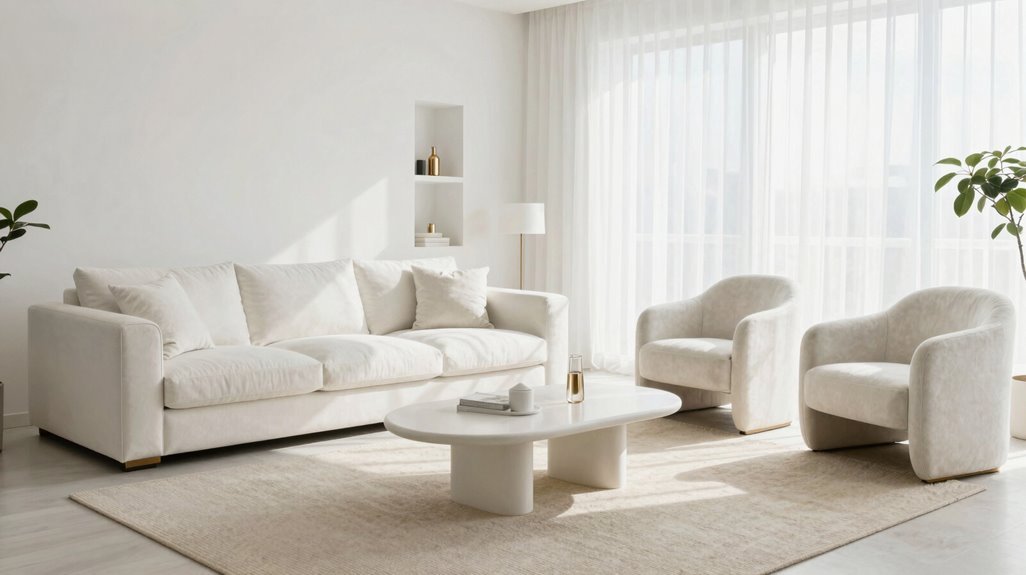
When selecting white living room furniture, you must balance aesthetic refinement with daily practicality, making certain each piece withstands real use while maintaining visual cohesion. You choose white furniture as your foundation; opt for white leather sofas delivering modern luxury, or select distressed white cabinets anchoring coastal themes.
You place importance on easy-to-clean materials and deploy slipcovers protecting upholstery while simplifying maintenance routines. You layer textures strategically: velvet cushions, wool throws, and varied fabrics prevent starkness and inject essential warmth.
You incorporate modular sofas and customizable coffee tables, adapting configurations to your space constraints and lifestyle demands. You balance finishes deliberately, matte, glossy, textured surfaces generate dimension without visual weight. Your white furniture selections create livable elegance, welcoming daily life without sacrificing the polished aesthetic you envision.
Add Seasonal Color to White Backdrops
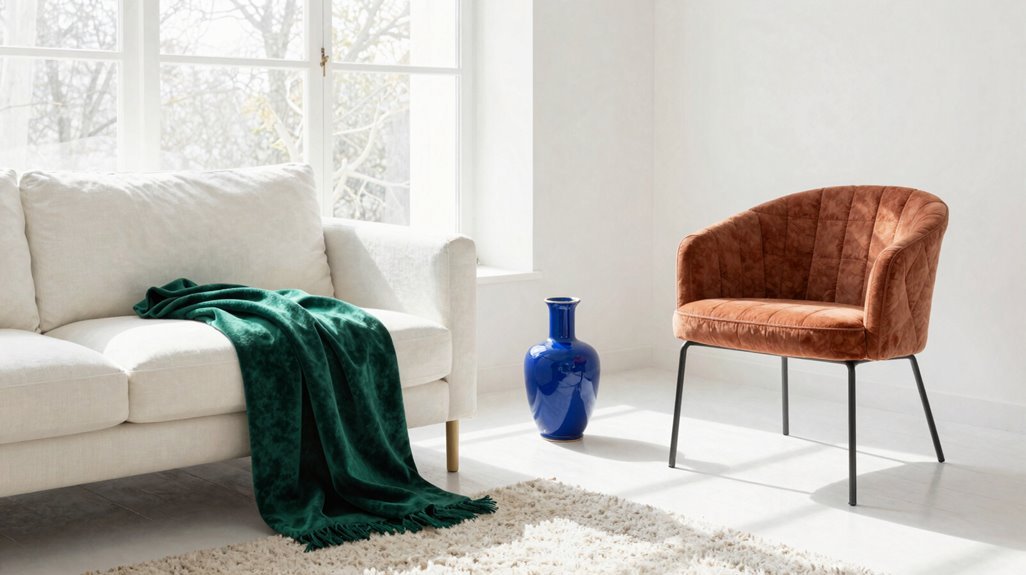
You’ve built your white foundation with durable, livable pieces; now you change color through strategic accessory rotation to maintain visual interest year-round.
- Swap textiles seasonally: replace pillows, throws, and rugs every 3-4 months using a 2-3 color scheme (blues/greens for spring, burnt orange/gold for autumn).
- Rotate artwork and small decor: exchange 3-5 tabletop items rather than furniture to preserve airy openness.
- Adjust lighting temperature: install 2700K bulbs in fall/winter, 3000K in spring/summer, or add 1-2 decorative lamps.
- Balance with texture and space: pair seasonal color with velvet, linen, or wood surfaces, keeping 60% negative space to prevent visual clutter.
White Living Rooms With Pets: Durable, Cleanable Materials
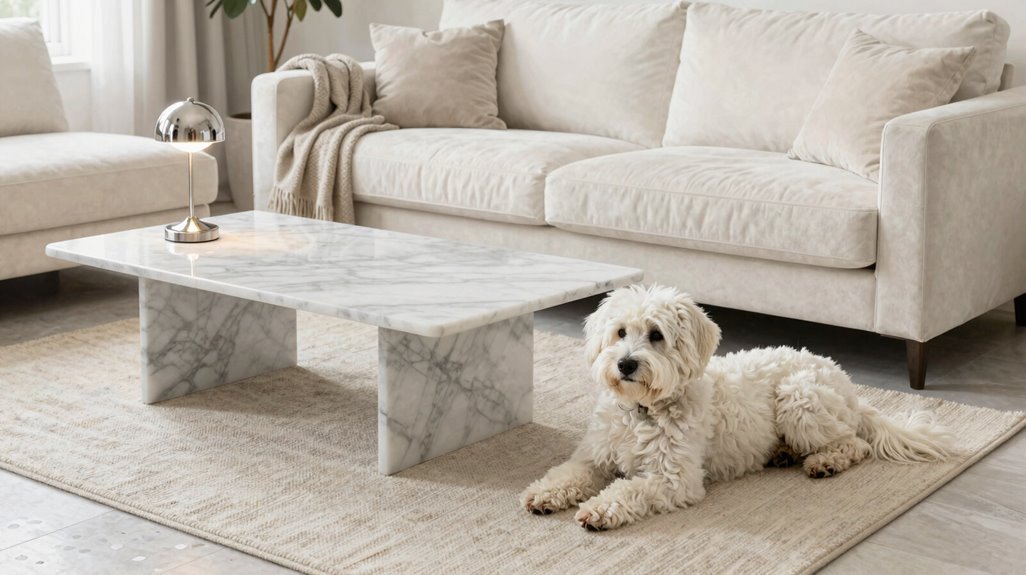
How do you maintain a pristine white living room when pets share your space? You select pet-friendly materials designed for durability and simple maintenance.
- Choose leather furniture. You wipe away fur, mud, and spills within 30 seconds using a damp cloth. Full-grain leather withstands 10,000+ claw contacts without visible damage.
- Specify synthetic fibers. You prioritize microfiber and solution-dyed acrylic with 50,000+ double rub ratings. These fabrics release pet hair during 5-minute vacuum sessions.
- Apply stain-resistant treatments. You apply fluoropolymer finishes every 12-18 months. These create liquid-repellent barriers lasting 15-20 cleanings.
- Install tightly woven textiles. You select fabrics with 200+ thread counts. Tight weaves prevent claw snags and trap 40% less dander than loose weaves.
You preserve your white aesthetic through material selection, not restriction.