
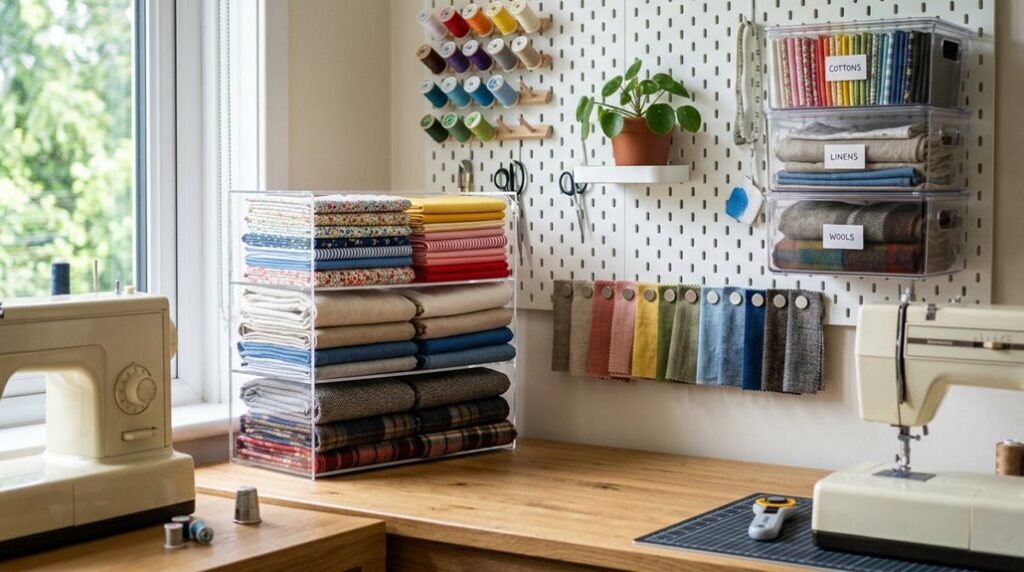
Your small sewing space limits your fabric storage capacity, but three proven systems solve this constraint. You will learn to construct rigid-core mini bolts for vertical stacking, implement color-blocked shelving displays, and deploy clear bin systems for fat quarters.
Each method maximizes cubic footage while maintaining visual inventory. The measurements, material specifications, and implementation timelines follow.
Stand Fabric on Mini Bolts to Save Space
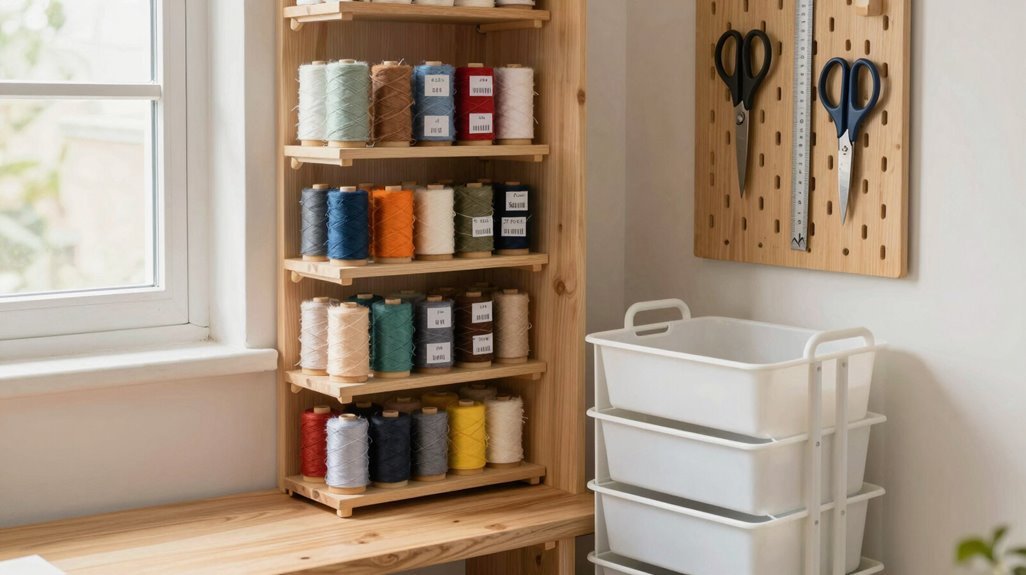
How do you fit 50 yards of fabric into a 12-inch cubby? You master bolt folding with comic book boards, that’s how. You wrap fabric around these rigid cores, creating uniform mini bolts that stack flat and maximize every inch.
Your fabric organization changes when you deploy vertical storage. You stand these color-blocked fabric units on shelving display, turning cramped sewing room storage into boutique-worthy arrangements. You’re not cramming, you’re curating.
Here’s your space-saving protocol:
| Step | Action | Result |
|---|---|---|
| 1 | Remove cardboard bolts | Slimmer profile |
| 2 | Wrap fabric around comic boards | 10″×7″ uniform size |
| 3 | Stack vertically | 3× capacity increase |
You achieve quick fabric access because each bolt faces forward. Fabric visibility means you grab what you need in seconds, not minutes. You belong to a community that values precision, and this system proves it.
File Fat Quarters and Scraps in Clear Bins
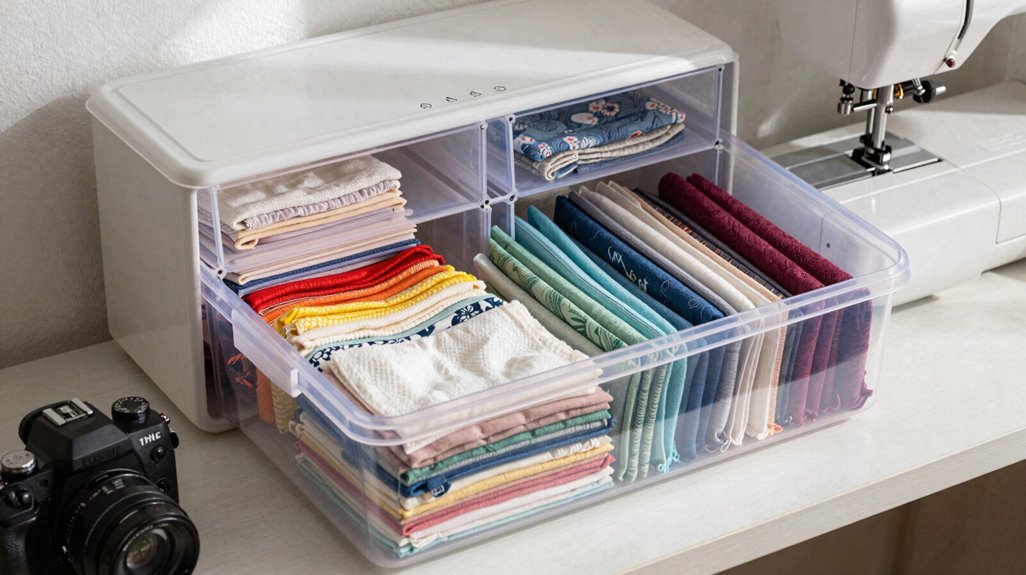
Fat quarters and scraps slip out of sight inside deep drawers, so you stack them on end inside clear bins, each piece facing up for instant recognition. This fabric storage method turns your small sewing space into an efficient workspace where every piece serves a purpose.
Stack fabric on end in clear bins, face-up for instant recognition, transforming cramped sewing spaces into efficient, purposeful workspaces.
- Select clear bins sized precisely for fat quarters, approximately 6.5″ x 9″ x 6″, to prevent overfilling and maintain stack stability.
- Arrange fat quarters by color coordination, grouping warm tones, cool tones, and neutrals into separate storage bins for rapid project assembly.
- Sort smaller scraps by dimension, strips under 2″, squares 2″ to 5″, and irregular pieces, placing each category in designated clear bins.
- Substitute open containers with lidded clear bins when dust protection matters; visibility remains intact while fibers stay pristine.
Your organization system now delivers maximum accessibility with minimal footprint.
Wheel Your Fabric Cart to Any Project
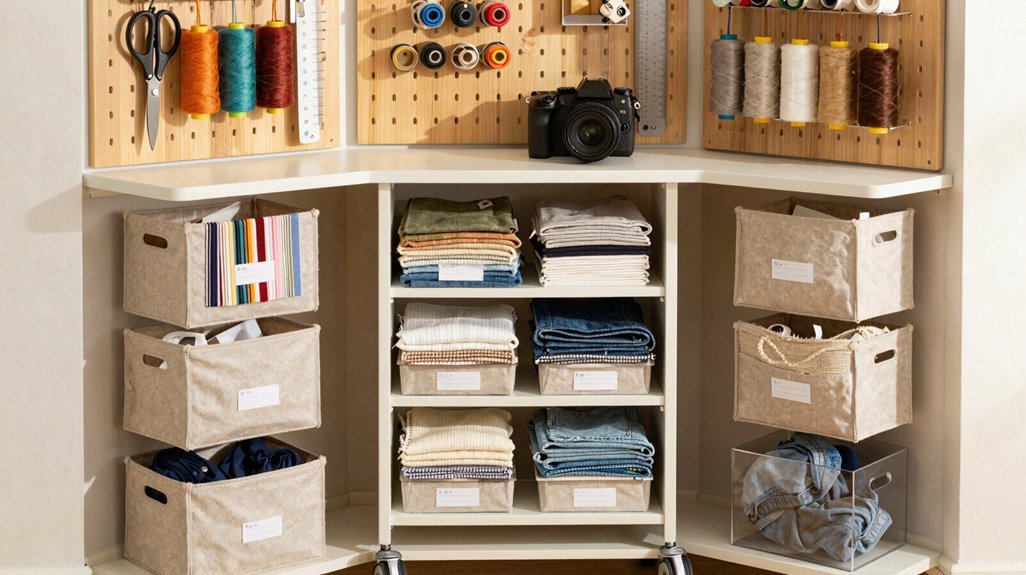
Where should you store fabrics when every every square inch counts? You wheel your fabric cart to any project, reclaiming control over cramped quarters with mobile storage that follows your workflow. This on-wheels solution turns static clutter into dynamic efficiency.
Select a unit with casters, prioritizing locking wheels that stabilize your cutting surface when precision matters. Multiple shelves and bins enable categorical separation: solids, prints, scraps. This delivers quick-access retrieval without rummaging. You’re not merely storing; you’re engineering project organization that anticipates your next seam.
These fabric storage ideas accommodate spatial evolution. As your collection expands, your cart repositions, preserving optimal sightlines and reach. Position frequently used notions within arm’s length, eliminating 15-second retrieval delays that fragment concentration. Your sewing space becomes responsive infrastructure.