
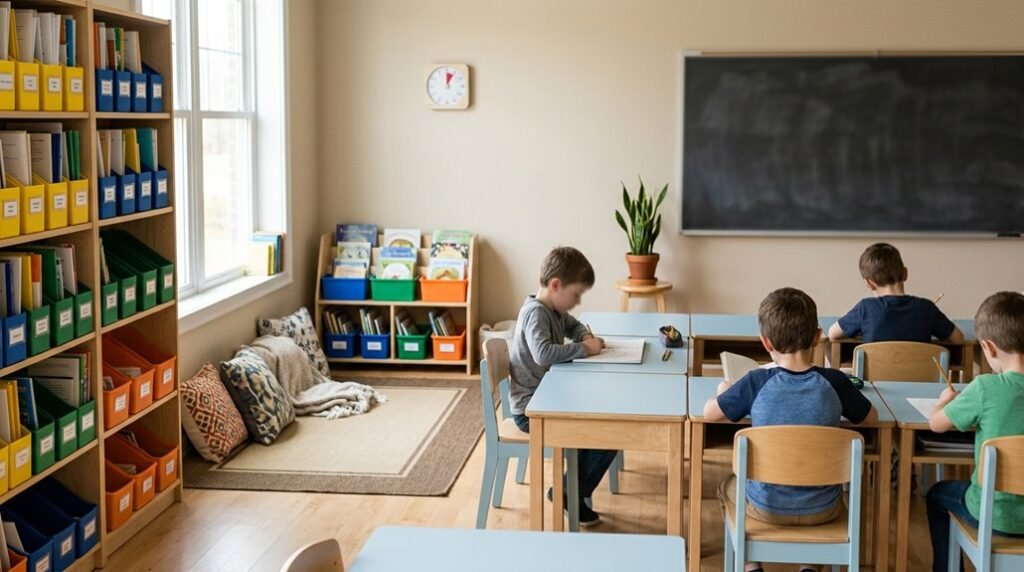
You have climbed this mountain before, yet each August the trail crumbles anew.
Seven operational frameworks will reconstruct your classroom systems with surgical precision, turning chaos into autonomous, student-maintained infrastructure.
You will receive exact specifications for curriculum mapping, emergency preparation protocols, and sustainable material management.
The first system awaits.
Start With an Organized Curriculum Map for Next Year
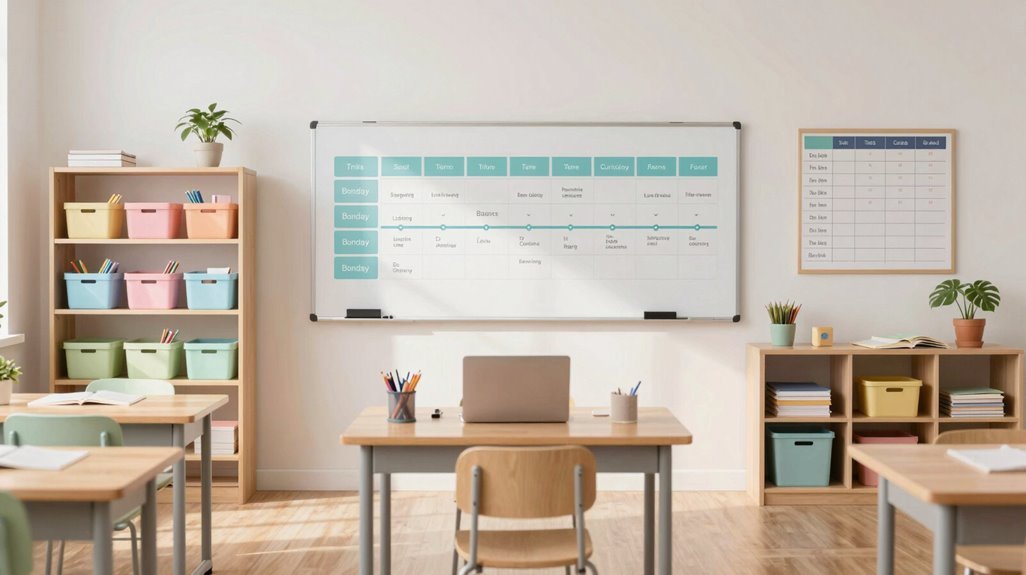
Begin your preparation with a complete curriculum map that structures every month of instruction, because disorganized pacing creates unnecessary stress and gaps in student learning. You need classroom organization that starts with your curriculum map, aligning monthly units by topic, skill progression, and instructional minutes available.
Your planning timeline should span 10-12 months, with each monthly unit containing 3-5 learning objectives, 2-3 assessment windows for diagnostics and formative checks, and 20-30 instructional days mapped precisely.
Back-to-school readiness demands you prepare first-unit materials eight weeks early, including copies, manipulatives, and substitute-ready resources. You must embed student data feedback protocols quarterly, revising units based on performance metrics below 70% proficiency. This systematic approach changes chaotic preparation into predictable execution.
Build “Do Not Open Until” Boxes for Key Moments
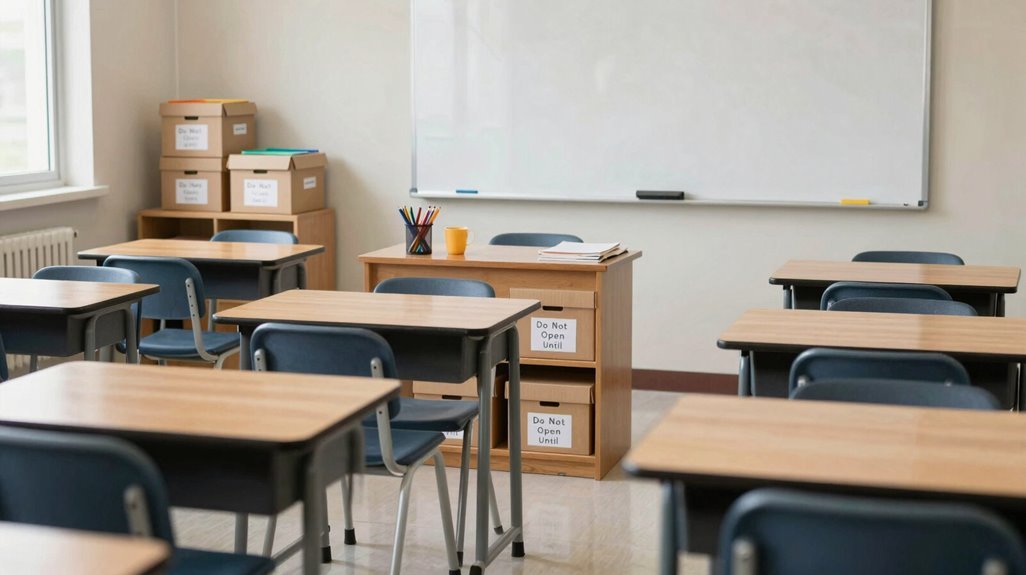
Why scramble through cluttered cabinets when you can pre-stage every critical moment in sealed, labeled containers? You need Do Not Open Until boxes for calm transitions.
Your First Day box holds name tags, welcome activities, syllabus copies, and classroom procedures. Your First Week box contains community-building exercises, behavior expectations, diagnostic assessments, and early-finisher tasks. Your Emergency Sub Plans box stores ready-to-teach lessons, updated rosters, seating charts, and generic backup activities.
Your arrival-ready system starts with a survival kit box: tape, markers, bulbs, chargers, and a printed setup checklist for room configuration verification.
Allocate one 12×15 inch plastic bin per critical timeframe. Label each bin with bold permanent marker: “Do Not Open Until [Specific Date]”. Store all five containers on a single, eye-level shelf near your desk.
You’ve eliminated frantic searching through disorganized storage spaces.
Declutter Your Digital Files Now, Not Later
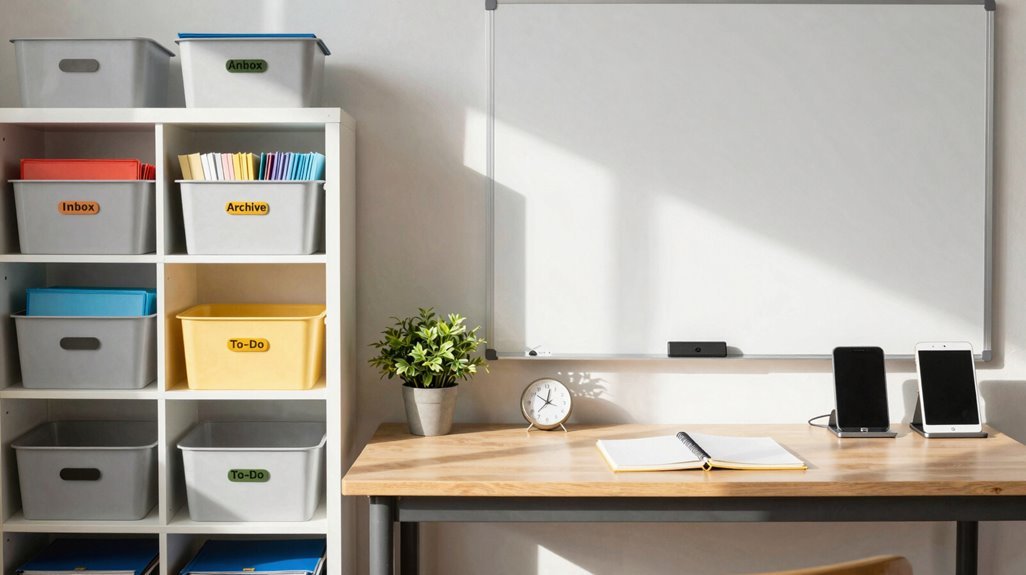
You’ll eliminate redundant files, standardize your naming conventions, and build a hierarchical folder system before the semester accelerates.
Start by purging duplicate documents and outdated resources, then apply consistent, descriptive titles like “Unit 3, Week 2: Photosynthesis Lab.” Establish topical folders for each unit, subcategorizing by lesson or assessment type, so you retrieve materials in under 30 seconds.
Delete Duplicate Files
Digital clutter taxes your cognitive load every time you hunt for files, so confront your duplicate documents before they multiply beyond control. You’re not alone in this struggle; every educator faces the chaos of accumulated materials. Execute a systematic Google Drive cleanup by identifying duplicate files through search commands like “title:copy” or “title:final.” Implement version control by retaining only the most recent iteration of each resource.
Establish organized folders by unit, then complete resource pruning quarterly to eliminate outdated content.
- Scan your Drive weekly for duplicate files consuming storage space
- Archive one backup copy, then delete redundant versions immediately
- Schedule monthly 20-minute sessions for sustained digital declutter
This disciplined approach changes your digital workspace into an efficient, searchable system. You’ll locate materials faster, reduce decision fatigue, and join colleagues who’ve mastered sustainable file management.
Rename With Consistency
How often do you waste precious minutes deciphering cryptic filenames like “Doc_final_FINAL_v3_ACTUAL”? You deserve better systems, and rename consistency delivers immediate relief. Adopt uniform naming patterns such as “Unit 2, Lesson 3: Author’s Purpose” across all digital assets, changing chaotic directories into searchable libraries.
Apply these standards for maximum impact:
- Specify components: Include unit number, lesson sequence, and topic descriptor in every filename
- Maintain spacing rules: Use consistent punctuation; colons separate categories, commas indicate subdivisions
- Date critical revisions: Append version dates (YYYYMMDD format) only when materials undergo substantial changes
This file organization strategy enables quick access during lesson prep, reducing retrieval time by 60-90 seconds per document. Your Google Drive folders become intuitively navigable, supporting clutter reduction through immediate visual recognition. You’ll preserve cognitive energy for instruction rather than digital archaeology.
Create Topic Folders
Once your files carry clear, consistent names, they need proper containers or they’ll scatter across your desktop like loose papers. Build your digital filing system with unit folders that mirror your curriculum sequence. Create labeled folders for each unit, then nest subfolders by week or standard. Establish student work separation immediately; dedicate distinct directories for submissions versus your teaching materials. This structure enables quick retrieval during instruction.
Delete duplicates and outdated files before building folders, reducing clutter by 40-60%.
Name unit folders using this format: “Unit 3_Ecosystems_2024-25” for instant recognition.
Schedule 15-minute monthly reviews to prune obsolete content and maintain alignment.
Your classroom organization depends on this systematic backbone. When every digital asset has a designated, labeled home, you’ll locate resources in under 10 seconds.
Make Reusable Master Copies for the Year
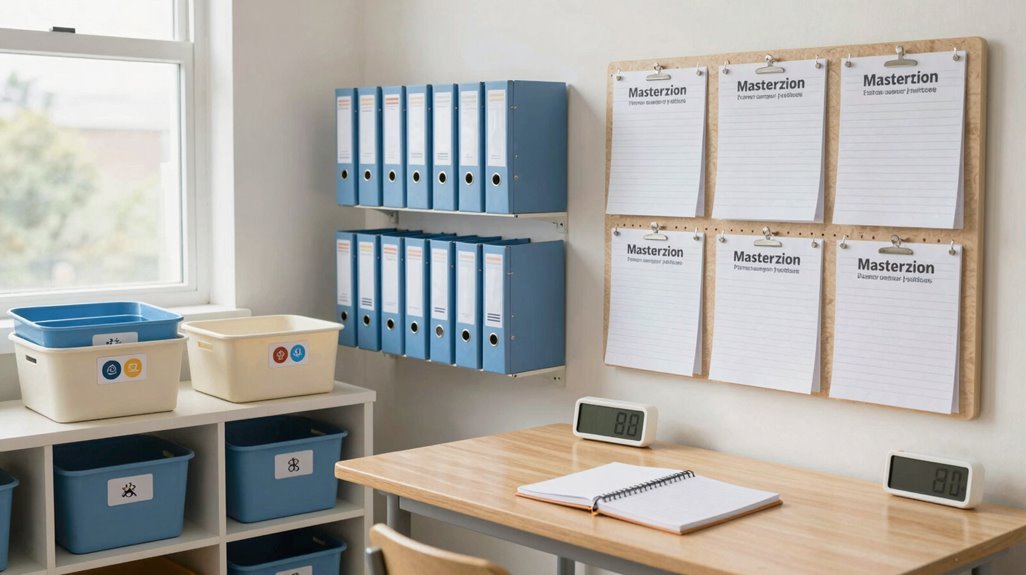
One preventable source of prep-week chaos stems from scattered worksheet versions, where you’ll find three nearly identical files named “final,” “final_FINAL,” and “final_FOR_REAL.” You’re not alone in this frustration; it’s a universal struggle that derails year-long planning.
Establish one master copy per worksheet as your single source of truth. You’ll copy only from this approved file for class sets or revisions, keeping consistency across materials prep. Implement standardized titles following this format: “Unit 2, Lesson 3: Author’s Purpose.” This naming convention streamlines retrieval and turns scattered documents into reusable resources.
Build a unit-by-unit digital folder structure with clearly labeled directories. Store master copies within these folders for instant access next August.
Review and refresh these files after each unit, updating content based on assessment data. This systematic approach to classroom organization eliminates version confusion and preserves your instructional time for teaching, not searching.
Assign Permanent Homes for Classroom Supplies
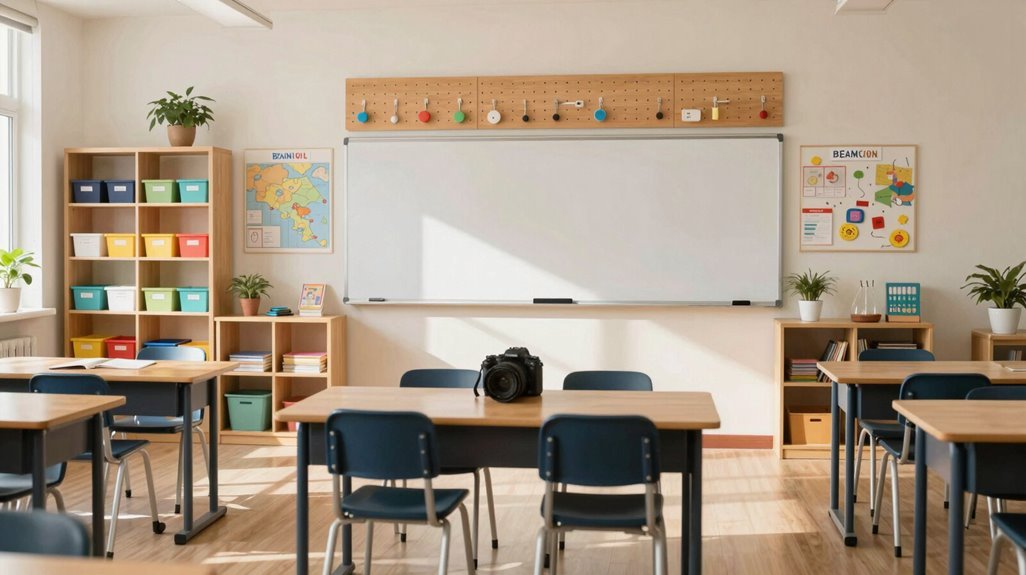
Your digital files now have permanent homes, but your physical supplies likely wander your classroom without assigned destinations. Effective classroom organization demands you designate permanent homes for every item using labeled bins, clear containers with visual icons, and drawers positioned at student eye level to guarantee immediate recognition.
Develop a master storage plan mapping exact locations for copies, next-day materials, and lesson-specific resources. Position a three-tier rolling cart adjacent to your desk for essential teacher copies, daily resource books, and frequently accessed pens.
Group writing utensils in labeled jars and math materials in designated labeled containers by functional category. Maintain closed storage for teacher-only items, guaranteeing consistent student-accessible zones. Implement uniform picture-and-text labels across all permanent homes so students achieve true independence through easy access without constant supervision.
Plan Routines That Run Themselves
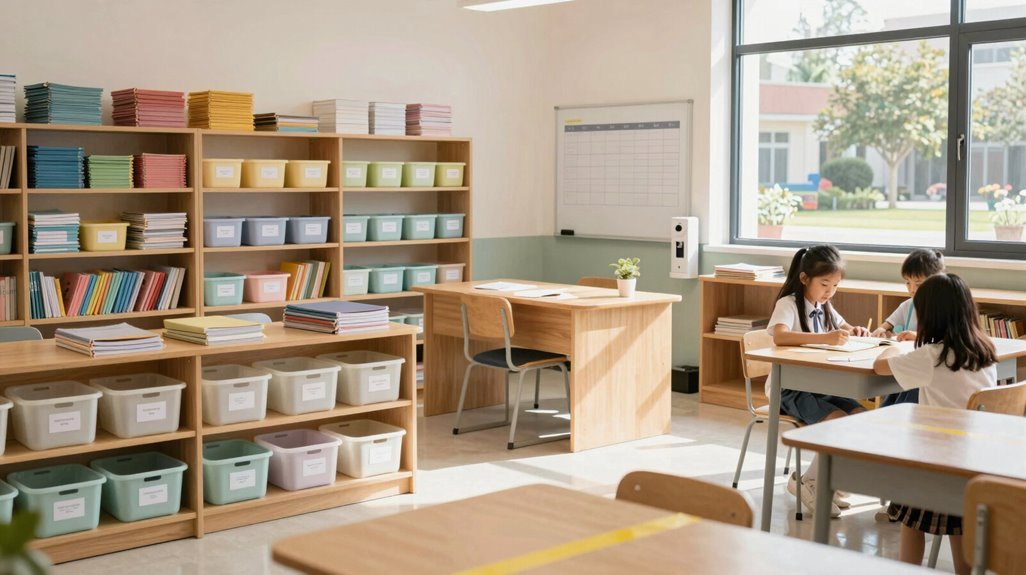
You need to construct self-sustaining operational frameworks that minimize daily decision fatigue. Map daily procedures with granular specificity: arrival protocols, material distribution chains, transition cues. You’ll establish predictable flows that persist without constant oversight. Build student independence through scaffolded responsibility releases. Refine through repetition by cycling corrective feedback loops until behaviors become automatic.
Map Daily Procedures
- Post a 4-foot vertical schedule with color-coded 20-minute blocks
- Designate material flow zones: intake trays left, finished work right, student helpers distribute
- Build substitute management into your “Plan Routines That Run Themselves” folder with scripted directions
Maintain checklists for each transition. Review weekly, revising intervals or steps that lag.
Build Student Independence
How do you eliminate the daily drain of micromanaging student movements? You build classroom routines that operate with minimal intervention, creating systems where students feel capable and included.
Start with a first-week checklist mapping transitions, material access, and behavioral protocols. This document helps you address each procedure sequentially, dedicating 15-20 minutes daily to explicit routines reinforcement until patterns solidify.
Organize your physical space for student autonomy. Position labeled containers at 36-42 inch heights, matching elementary sightlines. Use pictorial cues on 4×6 inch laminated cards indicating quantity limits and return procedures. Students retrieve supplies independently, reducing your oversight by approximately 40 percent within three weeks.
Gradually withdraw prompts. Initially, you verbalize each transition step. By week three, students execute classroom routines using posted sequence charts. You observe, redirect selectively, and update your checklist for subsequent units. Independence emerges through systematic structure.
Refine Through Repetition
Where do routines falter most often? They collapse when you skip the repetition phase, assuming students mastered classroom procedures after one demonstration. You need routines reinforcement built into every day, not treated as a first-week luxury.
Turn your first-week checklist into a repeatable schedule that governs material distribution, transition protocols, and behavioral expectations. This scalable system evolves with your year, letting you adjust details without rebuilding foundations.
Break down explicit practice sessions into 10-15 minutes daily, before introducing new content. Revise existing routine lists rather than starting fresh, promoting consistency across units. Plan monthly reviews using observed flow data and student feedback.
Your classroom routines become automatic when you prioritize repetition over novelty. Students thrive in predictable structures, and you reclaim instructional time for actual teaching.
Train Students to Sustain Organization Before Summer
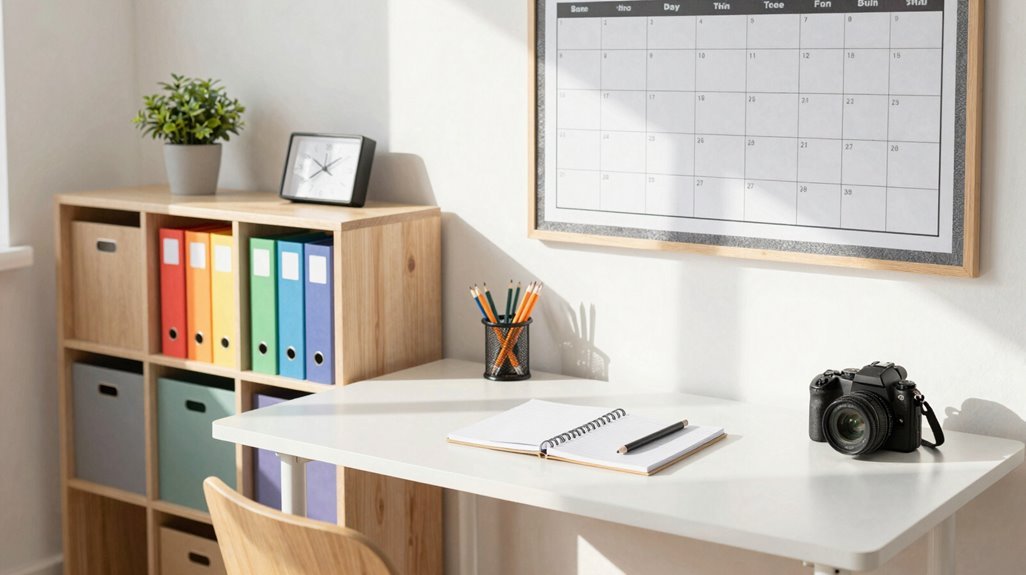
When summer approaches, you’ll need systems that outlast your presence, and that demands student ownership built through deliberate, repeated practice. Your classroom organization succeeds when students internalize routines through structured repetition.
Assign student responsibility using these methods:
- Position labeled, category-based containers at student eye level, 36-42 inches from floor
- Designate one “responsible student” per zone for daily upkeep
- Execute 2-minute daily checks at 2:45 PM each school day
- Conduct 15-minute weekly peer-led organization reviews every Friday
Establish your student filing system with Manila folders per pupil, clear alphabetical labels, and color-coded subject categories. Integrate classroom jobs, materials manager, supply distributor, shelf inspector, into early finisher rotations.
Conclude with an end-of-year reflection: students evaluate storage efficacy, document failures, and propose modifications. This transfers maintenance capacity to your community, making certain order persists without your direct oversight.