
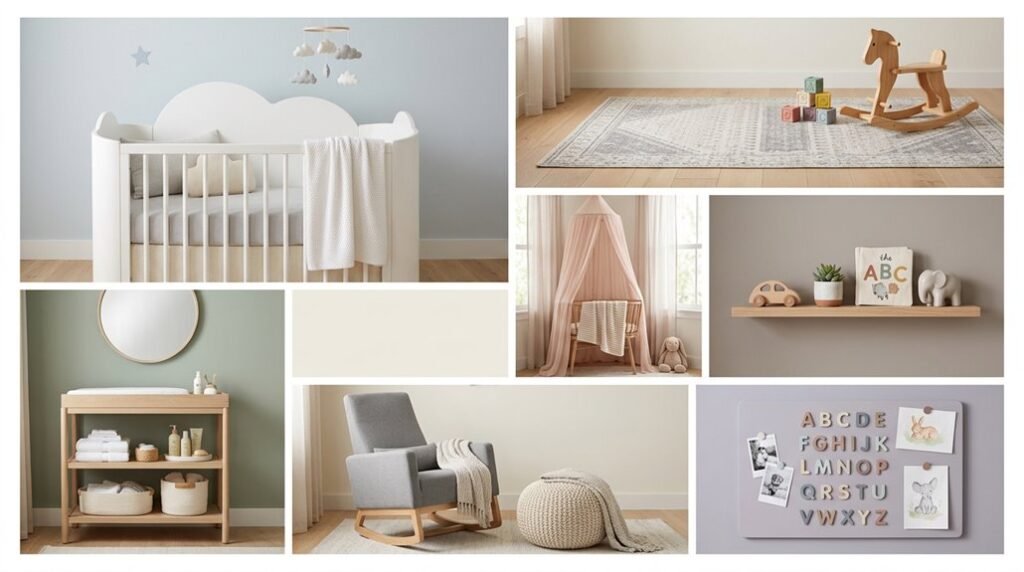
You will spend roughly 2,000 hours in your baby’s nursery during their first year alone, yet most parents approach this space without a systematic plan.
The difference between a functional room and a chaotic one comes down to seven specific decisions you make before the crib arrives.
Pick a Nursery Theme That Grows Beyond Babyhood
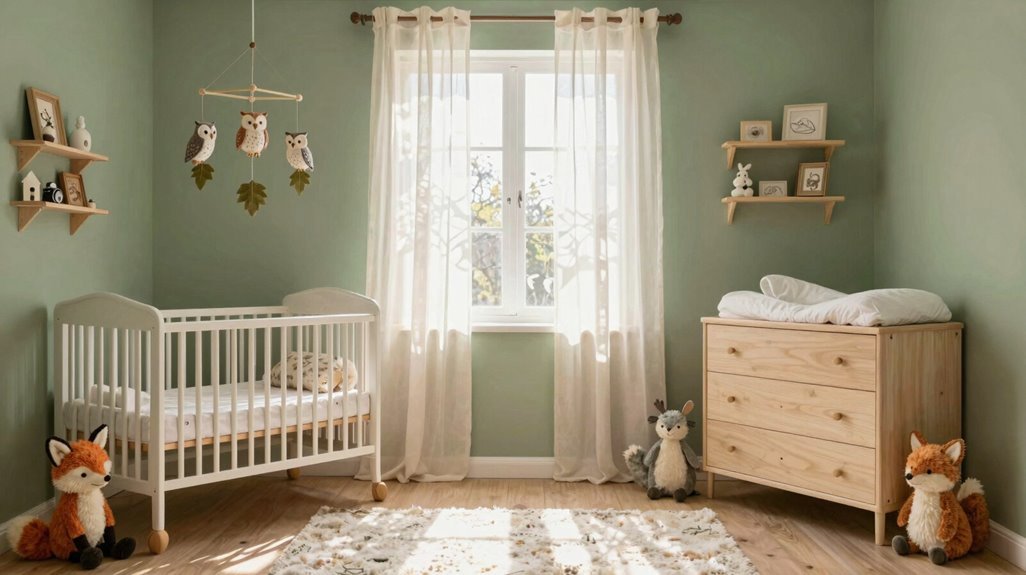
You will often outpace your nursery’s relevance within 24-36 months, so you must select foundational elements that accommodate developmental progressions from infancy through early childhood. Build your neutral nursery around grays, creams, and beiges, layering color through accents and textiles you can swap as preferences shift.
Choose growth-forward cribs with timeless silhouettes and multipurpose furniture like dressers with removable changing toppers, extending usability 5-7 years. Verify all pieces carry GREENGUARD Gold certification for enduring safety standards. Preserve open wall space measuring 40-60% of total surface area for future art, murals, or larger furniture configurations.
These systematic selections create adaptable environments, helping your investment maintain relevance through toddlerhood without requiring complete reconstruction.
Plan Your Layout Around the Crib and Rocker
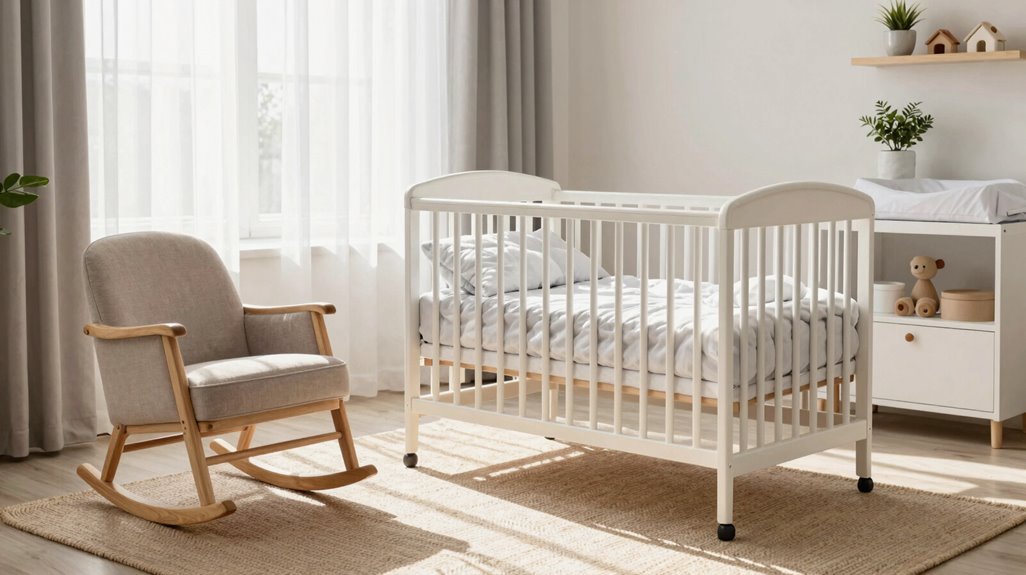
Anchor your nursery layout by positioning the crib as the room’s central focal point, making sure there’s 36 inches of clearance on all sides for safety and accessibility. Place your glider or rocker within 4-6 feet of the crib, angled to face both the baby and a side table stocked with feeding supplies.
This strategic arrangement minimizes your movement during nighttime routines, keeping diapers, wipes, and burp cloths within a single arm’s reach.
Crib Placement Priority
Where should you begin when mapping out your nursery? Start by anchoring your nursery layout with the crib as your central piece, then position rockers placement nearby for seamless access during feeds.
Your crib placement demands strategic attention. Position it away from windows to eliminate glare, and avoid doorways to minimize drafts and noise. You must maintain a 36-inch safe sleeping zone around all crib sides, keeping this perimeter clear of soft furnishings, tall furniture, and potential hazards.
Store near crib essentials within arm’s reach to streamline nighttime routines. Install wall-anchored storage or position a dresser nearby for quick access to diapers, wipes, and clothing without crowding the crib area. This storage near crib configuration reduces disruption, maintains a clutter-free footprint, and supports efficient, sleep-friendly workflows for you and your baby.
Rocker Positioning Strategy
Once you’ve locked in your crib placement, turn your attention to the rocker, the second anchor of your nursery’s functional triangle. Your rocker positioning determines how smoothly nighttime feeds and soothing sessions flow, so prioritize crib and rocker alignment from the start.
Position both pieces to face the same viewing area, keeping the rocker within arm’s reach of the crib for seamless transitions. Place it on a stable, floor-friendly surface, avoiding windows and corners where drafts and hazards lurk. Maintain 3–4 feet of clearance around all sides to establish a safe rocking zone with room for storage access and diaper changes.
Select low-profile upholstery in durable, soft textures that complement your neutral decor. This unified nursery layout eliminates visual clutter, reinforcing the calming space where you and your baby belong.
Choose Colors and Wallpaper That Tell a Story
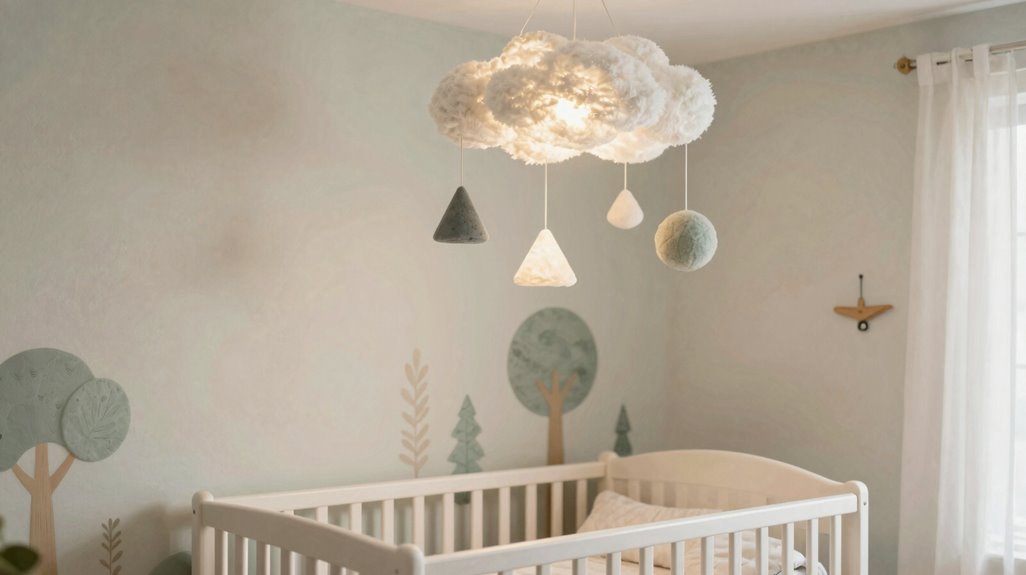
You’ll begin by selecting a bold wallpaper statement, such as a handpainted mural spanning 8-12 feet, to establish your nursery’s central narrative. Next, build a storybook color palette using neutral bases like Sherwin-Williams Agreeable Gray or Benjamin Moore Swiss Coffee, then layer vibrant accents in measured 60-30-10 ratios for visual hierarchy.
Finally, apply pattern mixing by combining large-scale motifs under 6 inches with medium textures 2-4 inches wide, making sure each element coordinates through shared undertones rather than matching shades.
Bold Wallpaper Statements
If you want to establish immediate visual impact, bold wallpaper will function as your nursery’s foundational narrative device, commanding attention through scale, pattern, and controlled chromatic intensity. You’ll position this focal point on a single accent wall, typically 8-10 feet wide, ensuring large-scale patterns dominate without consuming the entire 120-150 square foot room.
Your color mood emerges directly from these wallpaper selections, with 60-70% of the nursery’s chromatic identity deriving from this narrative centerpiece. You’ll balance dramatic installations against neutral furniture; think beige cribs, white dressers, to prevent visual overwhelm.
Practical execution follows three steps: 1) Measure your wall precisely, accounting for 10% pattern waste, 2) Select non-toxic, washable vinyl for 5+ year durability, 3) Layer textures, lighting, and accessible toys around your bold wallpaper to maintain cohesive storytelling throughout the space.
Storybook Color Palettes
Because your nursery functions as a contained narrative environment, you must orchestrate color and pattern as interconnected storytelling devices, weaving visual continuity across walls, textiles, and accessories. Your storybook color palettes establish narrative cohesion through deliberate chromatic relationships.
Anchor your nursery with crib bedding, then derive wall decor and wallpaper selections from those established hues. Commission focal murals or source handpainted wallpapers, positioning these as primary narrative anchors within the spatial composition. Layer story-themed textiles, framed prints, and accessories that reinforce your chosen chromatic system without visual overload.
You will achieve optimal results by mixing neutral bases, warm grays, soft creams, with calculated vibrant accents in 15-20% saturation ratios. This methodology produces the playful, book-like atmosphere you seek while maintaining organizational clarity throughout your infant’s environment.
Pattern Mixing Magic
Pattern mixing turns your nursery from a static space into a dynamic visual narrative, but it demands systematic execution rather than intuitive guesswork. You’ll anchor your nursery decor with a neutral color foundation, applying the 60-30-10 rule: 60% dominant tone, 30% secondary hue, 10% vibrant accent. This creates balance while permitting bold experimentation.
Select one focal pattern, typically wallpaper or an oversized rug, then build outward. You’ll coordinate smaller prints in crib bedding, wall art, and mobiles through unified color families. Layer textiles strategically: velvet pillows, woven baskets, and plush toys introduce contrasting textures without visual chaos.
Self-stick wallpaper offers commitment-free pattern integration. You’re weaving a cohesive storybook environment where every element belongs, guaranteeing your little one’s space feels both stimulating and harmoniously composed.
Buy One Piece of Furniture That Does Three Jobs
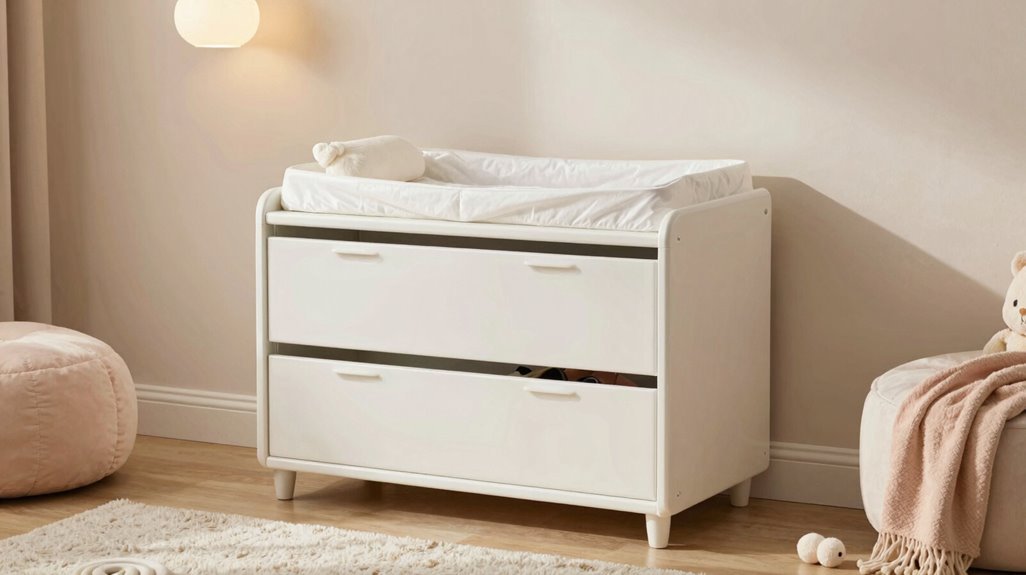
Where exactly does a changing station, sleeping area, and clothing storage fit in a 10-by-12-foot nursery? You solve this with multi-functional furniture that anchors your entire nursery layout.
Anchor a compact nursery with multi-functional furniture that transforms limited square footage into an organized, flowing space for sleep, changing, and storage.
Select one piece that performs three critical functions:
- Crib with storage drawers underneath captures 4-6 cubic feet of hidden capacity
- Changing station dresser combines diaper duty with clothing organization in 30 inches of wall length
- Convertible frame systems deliver longevity/future-proofing through toddler-bed conversion
Prioritize GREENGUARD Gold certification to eliminate volatile organic compound exposure in enclosed spaces. Position your three-in-one unit against the longest wall, leaving 36 inches of clearance on all sides for safe movement and future play zones. Match wood tones to wallpaper and textiles for visual cohesion.
Set Up a Changing Station You Won’t Hate Using
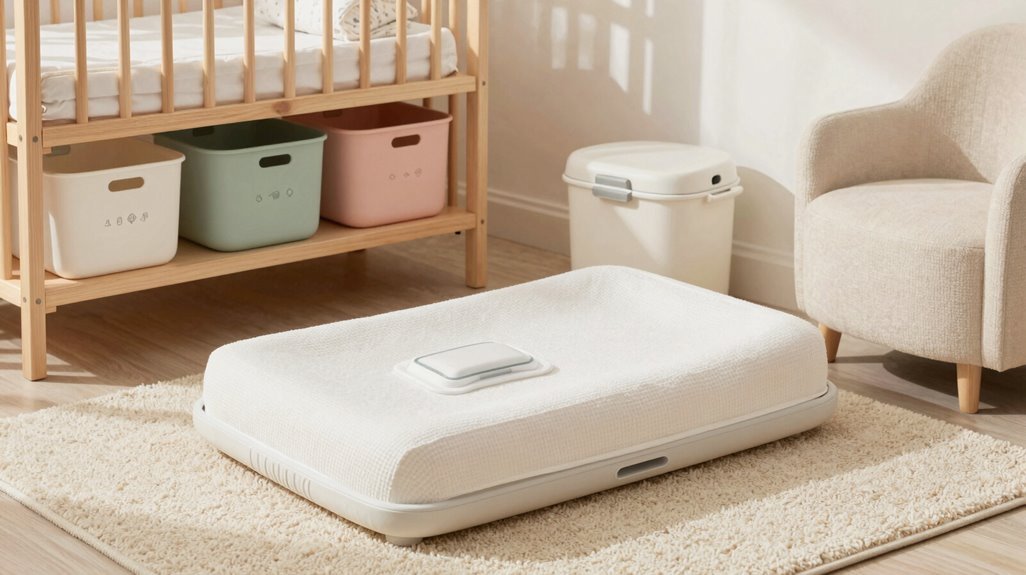
How many times will you stand at a changing station before your child outgrows diapers? You will log roughly 2,700 diaper changes. Make every one efficient.
- Select a modular dresser with built-in storage. Position diapers, wipes, creams within 18 inches of your standing position.
- Check that your changing surface carries GREENGUARD Gold certification. This confirms low chemical emissions for 360+ days of daily contact.
- Install a dresser-to-changing-table conversion unit. Remove the topper at month 24-30 for continued use.
- Cover your pad with wipe-clean fabrics. These withstand 5-7 weekly launderings without degradation.
- Mount wall-anchored shelves at 48-inch height, or add a rolling cart with three tiers. Keep this organization system: top shelf for immediate-use items, middle for backup stock, bottom for soiled-clothes containment.
Create a Feeding Corner Worth the 3 A.M. Wake-Ups
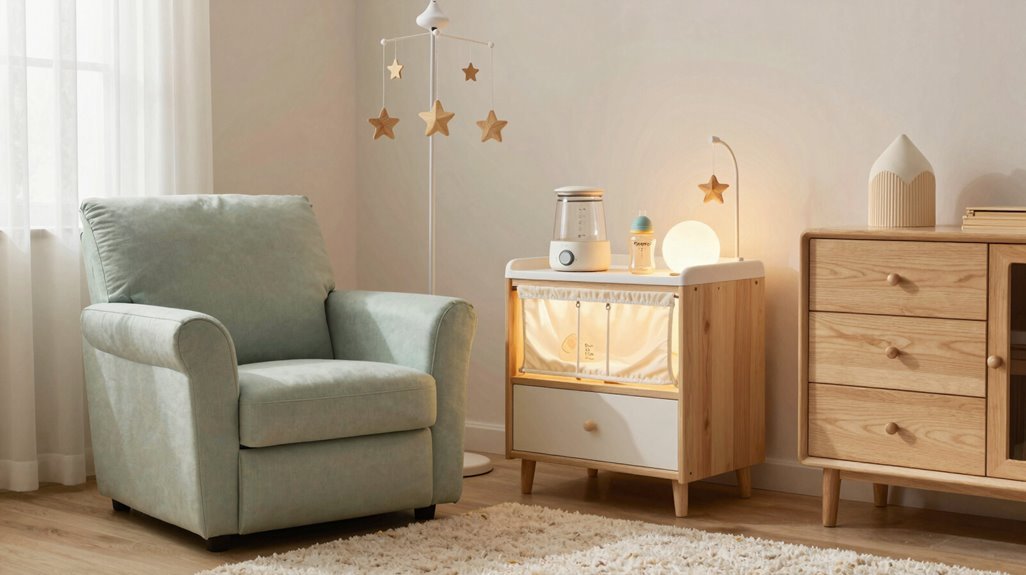
Why settle for a feeding corner that merely functions when you can engineer one that sustains you through 1,460+ annual nighttime sessions? Here’s your blueprint:
- Set the foundation with a premium glider, pairing it with a coordinating ottoman to support 20-45 minute feeding cycles without lumbar strain.
- Layer two lighting sources: install a dimmable light for adjustable 10-40% brightness during nursery feeding, plus a soft nightlight positioned 3-4 feet from the chair to preserve circadian rhythms.
- Place storage baskets at 12-18 inch heights for instant access to burp cloths, wipes, and bottles, eliminating disruptive reaching that fragments sleep cycles.
Select performance-grade, GREENGUARD Gold certified fabrics rated for 15,000+ double rubs. Position your supplies caddy within 24 inches. These specifications deliver measurably easier feeding through 365 nightly interruptions.
Hide the Clutter Without Adding More Closets
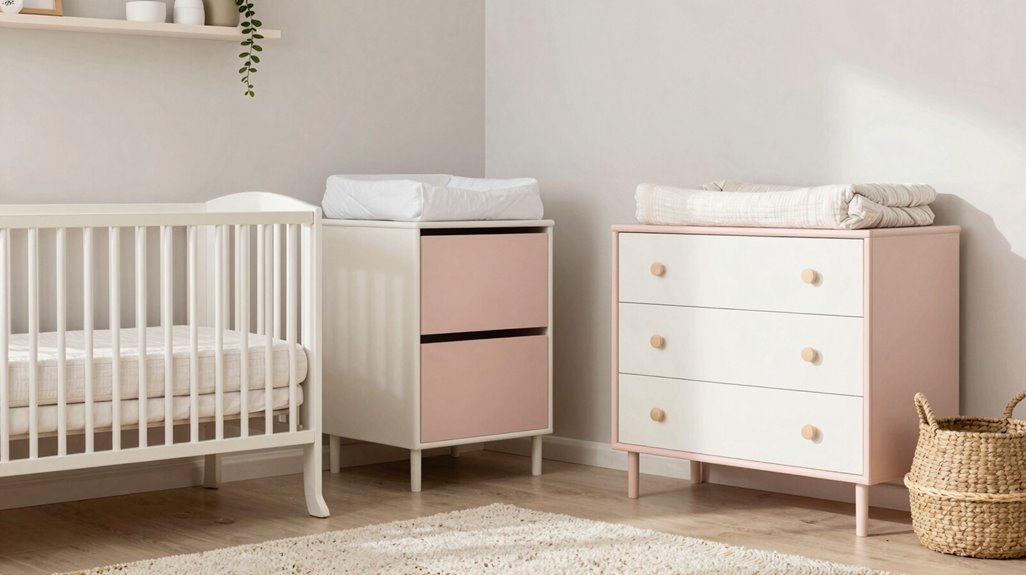
What does a functional nursery demand when square footage tops out at 120 square feet? You need wall-mounted storage that anchors securely to studs, floating shelves positioned 48 inches high, and zero floor obstruction.
Implement these four solutions:
1. Maximize vertical surfaces.
Install wall-mounted storage with 12-inch depth shelves at 36-inch intervals. Add pegboards behind doors for 8-10 pounds capacity per hook.
2. Deploy hidden storage strategically.
Select dresser-top toppers with 6-inch depth compartments. Hang curtain dividers on tension rods to mask 24-inch deep shelving zones.
3. Invest in multi-purpose furniture.
Specify changing tables with minimum three drawers (12x18x5 inches each). Source convertible cribs with 50-pound toddler rail capacity.
4. Systematize concealment.
Mount wallpapered storage panels flush to walls. Fill labeled baskets (14x10x8 inches) with diapers, wipes, toys; each category assigned distinct woven or fabric containers.
You achieve complete organization without structural modification.